






 Portuguese
  Spanish


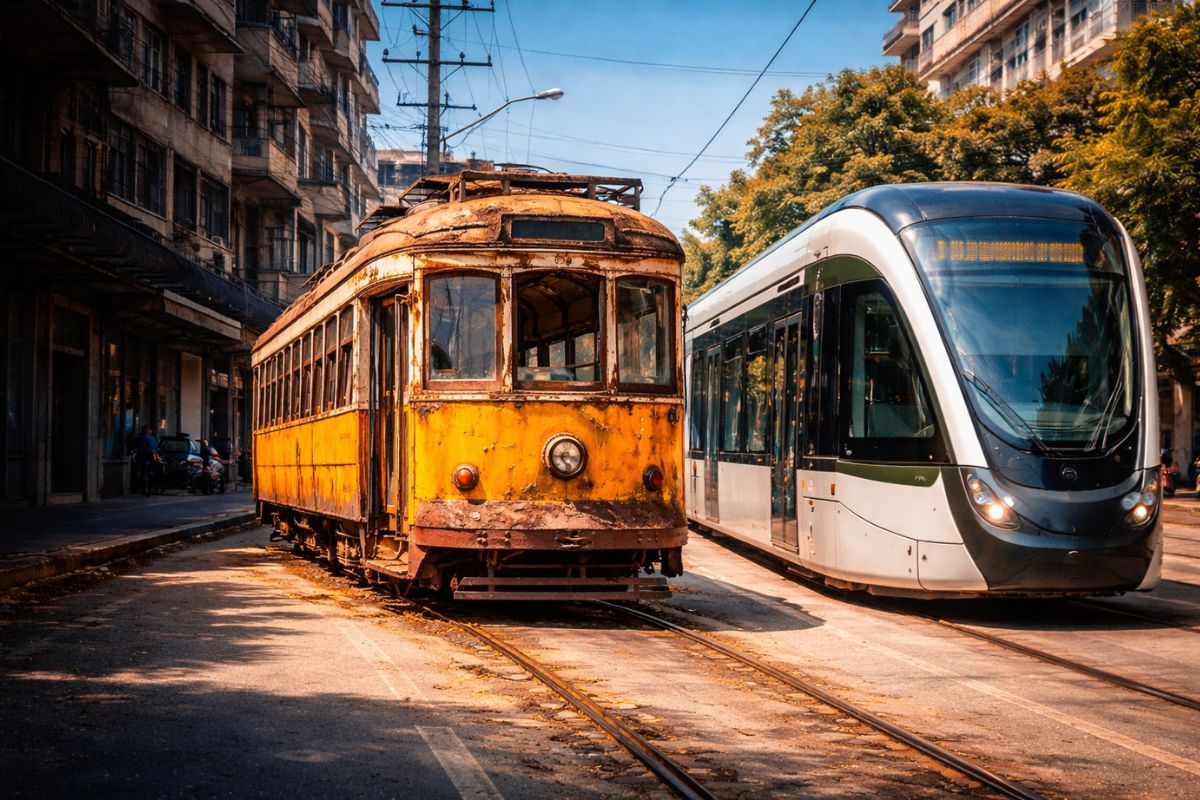


While Brazil Dismantled Its Rail Transport and Bet Everything on Cars and Buses, Lisbon Preserved and Integrated 58 Trams into the Metro, Bus, and Train System, and Today Reaps the Results in Mobility, Tourism, and Quality of Life.
Rail transport was once a symbol of modernity in Brazil. Rio de Janeiro had the largest tram network in Latin America, São Paulo organized urban growth around the tracks, and cities like Porto Alegre and Belo Horizonte operated for decades with trams as the backbone of daily commuting. In just a few years, this heritage was torn away in the name of supposed modernization, while other capitals around the world reinforced their electric systems.
Today, the scenario has flipped. What was once seen as backward has become a reference for sustainable mobility, and Brazil is scrambling to rebuild, with expensive light rail systems and limited networks, a structure of rail transport that it once had and chose to destroy. The irony is clear: we pay more to reinvent what already existed, facing urban and political obstacles that could have been avoided.
Santa Teresa Resists, While the Rest of Rio Lost Its Tracks
This is the Santa Teresa tram, the last one in operation in Rio de Janeiro. It connects the city center to the hills of the neighborhood and remains a rare piece of a past where rail transport structured the daily life of Cariocas.
-
Belo Horizonte’s Beltway Project Risks Losing $5 Billion to Metro Expansion if Court Doesn’t Act Soon; State Government Plans New Lines with IDB Support

-
Brazil to Auction 9,000 km of New Railways, Aiming to Attract $28 Billion by 2026

-
Brazil Plans $160 Billion Investment to Revitalize Railways and Reduce Reliance on Long-Distance Trucking
-
Retired Railway Workers in Brazil Preserve Locomotive for 52 Years, Now See It Donated by the Government


Where today only a single tourist and symbolic tram operates, there once existed an extensive network that reached different neighborhoods and organized the flow of people and services.
The trams arrived in Rio back in the 19th century. In 1859, the city inaugurated its first animal-drawn line, spanning about seven kilometers, presented with pomp and in the presence of Dom Pedro II.
They were simple vehicles, pulled by donkeys, but the track already represented a considerable advance: it reduced swaying, avoided getting stuck, and brought predictability to urban commuting.
Forty years later, in 1898, electric trams came onto the scene, becoming synonymous with modernity. In Rio de Janeiro, this advance was particularly striking.
In 1892, the Companhia Ferro Carril do Jardim Botânico installed the first permanent electric tram network in Latin America, positioning the city among the most advanced on the continent in terms of rail transport.
For decades, the tracks defined neighborhoods, work and leisure routes, schedules, and habits. The tram was not just a vehicle; it was part of Rio’s urban identity.
From Symbol of Modernization to Target of Roadism
The turning point happened throughout the 20th century. Starting in the 1950s, the discourse of modernization began to erode the prestige of trams.
The official narrative portrayed them as slow, noisy, and outdated, always in comparison with the cars and buses taking over the new avenues.
In 1963, then-governor Carlos Lacerda decreed the end of the trams in Rio. The justifications echoed in the newspapers of the time: electrical failures that stopped the cars when the power went out, derailments on curves, accidents with passengers on the steps, and the idea that trams interfered with traffic.
The city was plunging headlong into roadism, a model that favored roads, overpasses, private cars, and diesel-fueled bus fleets.
In just a few years, one of the largest tram networks in Latin America disappeared. What was once a reference in rail transport became a sentimental memory, an old photograph, and a street name.
Lisbon Chose to Integrate Trams, Not Tear Up Tracks

While Brazil was dismantling its networks, Lisbon was doing the opposite. The Portuguese capital also started with animal-drawn trams in 1873 and transitioned to electric trams in 1901, following the same global logic of modernization. The difference is what came afterward.
With the advent of new modalities, like metro and buses, Lisbon did not destroy the existing infrastructure. Integration became a central verb.
Instead of tearing out tracks, the city maintained the tram as a strategic part of mobility, reinforced its cultural value, and adapted the system to new demands.
Today, Lisbon operates six lines with 58 trams, including historical models and modern articulated vehicles. In many areas, they continue to ascend and descend hills, connecting old neighborhoods and new urban areas.
The tram is no longer seen merely as a tourist attraction but has become a living part of rail transport, coexisting with the metro, metropolitan trains, and a wide bus network.
While in Rio the tram was treated as an obstacle to progress, in Lisbon it was preserved as infrastructure, heritage, and a mobility solution.
The same technology generated opposite outcomes because the political and urban choices were also opposite.
When the World Prioritized the Tram and Brazil Went Off Track
Lisbon is not an exception. In Melbourne, the tram system has become the largest in the world, with about 250 kilometers of lines, more than 480 vehicles, and over 160 million passengers a year.
There, the tram is the central axis of urban mobility, not a museum piece.
In Canada, Toronto has maintained its trams as an essential part of public transport. The system has been functioning for over a century and has been modernized, reaching hundreds of millions of annual rides.
Even sharing the road with cars in some sections, the tram remains an efficient option, especially in an extreme climate of summer and winter, where traveling in an air-conditioned vehicle makes a difference.
In Europe, Amsterdam shows how the tram coexists naturally with the metro, metropolitan trains, and one of the largest cycling networks on the planet.
There, the tram does not compete with other modalities; it complements and organizes urban space, reinforcing the integrated nature of the system.
The common point among these cities is clear. The tram is electric, silent, has low emissions, and promotes urban requalification.
In various places, it has become associated with sustainable mobility policies, reductions in cars, and improvements in quality of life.
Where rail transport has been maintained, it has helped reorganize traffic, reduce congestion, and decrease dependence on automobiles.
Meanwhile, Brazil continued on the opposite path. Tracks were torn up, lines deactivated, and systems dismantled, often under the argument that trams hindered or didn’t keep up with the “new city” based on avenues, overpasses, and private cars.
How Brazil Abandoned Rail Transport
The elimination of trams in Brazil was not a single event but a process. In many capitals, the system was gradually weakened, with lack of maintenance, outdated fares, and complete absence of investment.
When the trams began to break down frequently, delay rides, and cause accidents, the perception that they were old and inefficient solidified.
In São Paulo, this cycle became evident. In the 1940s, 50s, and 60s, reports pointed to slippery tracks, operational issues, and accidents involving passengers traveling on the steps.
At the same time, the city was opening avenues, expanding for cars, and reorganizing transport around buses.
In 1968, then-mayor Faria Lima ended the last tram line. The final ride was treated as a symbol of modernization. Cars circulated bearing the phrase “Goodbye, a new São Paulo is born.” In practice, it was the farewell to surface rail transport, replaced by a road system that would bring other types of congestion and urban inequality.
Shortly after, suspicions began to arise about the influence of the diesel lobby and bus body manufacturers interested in expanding their sales.
It was not merely a technical issue of performance but a combination of deliberate neglect, economic interests, and a car-focused vision of the city.
In Porto Alegre and Belo Horizonte, the scene repeated itself. Trams operating for over 90 years were retired, often celebrated in “nostalgia tours.”
Later initiatives to reactivate them got stuck on paper, and some vehicles remained only as museum pieces.
The result was a country that swapped tracks for asphalt, without a long-term plan for what would come next.
Santa Teresa, VLTs, and the Frankensteins of Rio’s Tracks


In Rio, Santa Teresa became an extreme symbol of this trajectory. The neighborhood’s trams have been listed as heritage since 1988, but have spent years without proper maintenance.
Residents report that cars have been dismantled for reverse engineering studies in an attempt to develop new vehicles, in a transition that mixed preservation, improvisation, and lack of planning.
Instead of fully restoring the original trams, hybrid models were introduced, nicknamed “Frankensteins” by the residents, with braking and stability systems that generated insecurity. Conductors and technical bodies pointed out problems, but the warnings were not sufficient.
In August 2011, a tram lost its brakes and overturned. Six people died, including the conductor, who had already denounced the system’s conditions.
The accident officially ended the traditional Santa Teresa tram. The last icon of Rio’s rail transport survived, but deeply altered and limited.
At the same time, Rio began investing in a new VLT in the central and port regions. The VLT Carioca crossed the city center, connecting the airport, bus station, intermodal terminal, and redeveloped areas of the port, recording increased demand and establishing itself as a real mobility alternative. But it remains an exception in a country that continues to be mostly car and bus-oriented.
VLT: Late Return of Rail Transport
Today, some Brazilian cities are seeking to resume rail transport with modern VLTs, such as Rio de Janeiro and Santos.
Even so, the number is small: only about ten municipalities have this modal, meaning that a large part of the population has never even seen a VLT in operation.
A study by BNDES compiling mobility projects across Brazil shows the size of the challenge. To meet the demands of the coming decades, the country would need to quadruple its VLT and BRT networks and double its metro lines.
The current light rail network totals just over 600 kilometers, while projections suggest that around 2,500 kilometers will be necessary.
This significant difference reveals an accumulated delay. Some capitals could increase by up to 500% the number of people served if the planning projects were implemented.
At the same time, between 2014 and 2023, public transport lost about 43% of its passengers, pushed out by poor services, insecurity, overcrowding, and loss of trust.
After destroying its trams and dismantling rail transport, Brazil now needs much bigger investments, in a more complex urban scenario, to rebuild the mobility it once had.
The Cost of Reinventing What the Country Already Had in Rails
The current situation is full of ironies. Brazilian cities are pressured to reduce emissions, prioritize collective transport, and improve quality of life in central areas.
The most discussed solutions include light rail, VLTs, integration with intermodal terminals, and the reurbanization of degraded areas.
All of this requires large works, expropriations, political negotiations, and significant resources. If the country had preserved part of its rail transport structure, the costs would be lower and the results would come faster.
Instead, the tracks were removed, and now they need to be reinserted into a much denser, more expensive, and conflictual urban fabric.
More than 190 mobility projects on rails have recently been raised, indicating that there is will and technical planning.
The problem is to turn this paper into completed works and reliable service, rather than repeating the history of abandonment.
In the end, Brazil is trying to reinvent a rail transport system that it once dominated and exported. The difference is that now it costs more, requires more technology, and faces much more social and urban resistance.
What remains to be seen is whether this time we will maintain what we are creating or if the tracks will be torn up again in the next political cycle.
And you, in your city, is there still any type of rail transport, like trams, urban trains, or VLTs, or has everything been replaced by buses and cars?







Um dos culpados disso chama-se Juscelino Kubitschek.
Da maluquice criar uma capital no meio do nada custando bilhões ao desmonte de ferrovias e dos bondes
SUCATEIAM O SERVIÇO PÚBLICO, COMO ESCOLAS, HOSPITAIS E TRANSPORTE AFIM DE BENEFICIAREM MEIA DÚZIA DE EMPRESÁRIOS INESCRUPULOSOS QUE SÓ PENSAM EM LUCRO. QUAL O SERVIÇO PÚBLICO QUE DEPOIS DE PRIVATIZADO MELHOROU. PELO CONTRÁRIO SERVIÇO MAIS CARI E DE PÉSSIMA QUALIDADE.