Portuguese
  Spanish




New Hypersonic Jet Promises to Cross Brazil in Less Than an Hour and Revolutionize the Aerospace Industry. Meet the Sky Magnetar, Hydrogen-Powered Hypersonic Jet!
Revolution in the Skies: Sky Magnetar, the new hypersonic jet promises to surpass the Concorde: A new concept of hypersonic jet, called Sky Magnetar, is about to transform air travel. With an impressive speed of up to 6,174 km/h, this jet promises to be three times faster than the legendary Concorde. The innovation doesn’t stop there: the Sky Magnetar is capable of crossing Brazil in less than 1 hour, redefining the future of air transport. Get ready for a new era of speed and efficiency in the skies!
New Hypersonic Jet Has a 112-Meter Fuselage
Developed by Spanish designer Oscar Viñals, the new hypersonic jet promises to cross Brazil, completing the route from Oiapoque (AP) to Chuí (RS) in less than one hour. The project stands out for its ability to operate at subsonic to hypersonic speeds and for using hydrogen as fuel, avoiding emissions of polluting gases.
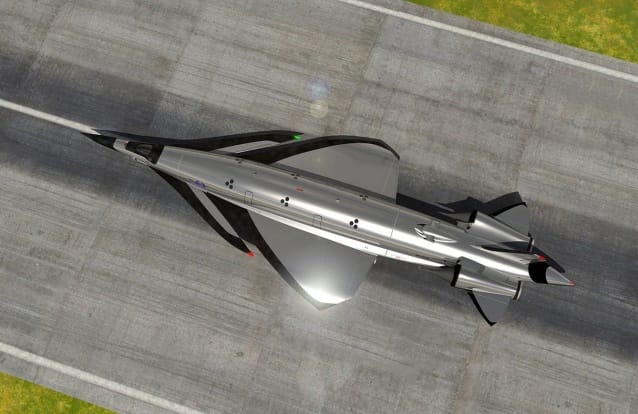
The new hypersonic jet, still in the concept phase, features a fuselage of approximately 112 meters, equipped with an advanced thermal system to withstand the extreme heat of high speeds. The structures of the Sky Magnetar include reinforced carbon fiber, which offers corrosion resistance and thermal stability.
-
Brazil Welcomes Spanish Wamos Air and Nigerian Air Peace, Potentially Transforming International Routes and Increasing Competition

-
Offshore air transport soars in Brazil, surpasses 2.5 million passengers, and reveals how oil has transformed Rio’s airports into key pieces of national logistics.

-
Latin America becomes the “global champion” of aviation taxes, tickets may become more expensive in Brazil, and IATA’s warning exposes risk for flights, tourism, and passengers.
-
Brazil has lost 85 air routes since 2019 and is still flying less than before the pandemic, leaving passengers with fewer destinations, fewer frequencies, and a more limited air network.




Despite the innovations, the viability of the new hypersonic jet is still questioned, even with the use of advanced technologies and an operational system based on Artificial Intelligence. Currently, the Sky Magnetar awaits funding and does not yet have a projected date for commercial operation.
The hypersonic jet promises to cross Brazil and is named after a type of neutron star. It was designed to accommodate up to 120 passengers and features a quadruple-wing design with two large engines, but there are no plans for windows.
In the creator’s opinion, due to the high speed and pressure level, it would be safer to opt for a unit without windows, which would be replaced by digital windows.
Experts Remain Skeptical About the New Hypersonic Aircraft
The reality is that, despite the Sky Magnetar’s proposal offering a futuristic and environmentally conscious vision for fast travel, several experts in the aerospace industry remain skeptical about its practical implementation. The challenges are not only technical but also economic, as the cost of developing and operating such technologies can be prohibitive.

The need for innovation in aviation is undeniable, especially at a time when the world is seeking greener and more efficient solutions. However, the success of such ambitious projects will depend not only on technological advancements but also on a business model that can sustain its high cost and operational complexity.
In the meantime, the Sky Magnetar remains a symbol of future possibilities, awaiting financial support and market confidence that could transform this dream into reality.
Is the New Hypersonic Jet SR-72 on the Horizon?
Reaching speeds of 6,174 km/h, this hypersonic jet promises to cross Brazil in less than one hour. However, Lockheed Martin plans to develop the SR-72, which may reach speeds of Mach 6, equivalent to 7,350 km/h.
The expectation is that this model will be one of the greatest successors to the SR-71 Blackbird, which set records in 1974 as the fastest manned aircraft and was retired by the U.S. Air Force in 1998.
The SR-72 is considered unmanned, hypersonic, and reusable. Its main functions will likely be intelligence, surveillance, and reconnaissance. The SR-72 is also expected to use Lockheed Martin’s new high-speed strike weapon (HSSW), enhancing its strike capability.
The aircraft’s combat capabilities make it ideal for striking targets in dangerous environments, where the use of manned aircraft would be too slow or risky. The new weapon system will be able to launch hypersonic weapons more agilely.