Portuguese
  Spanish


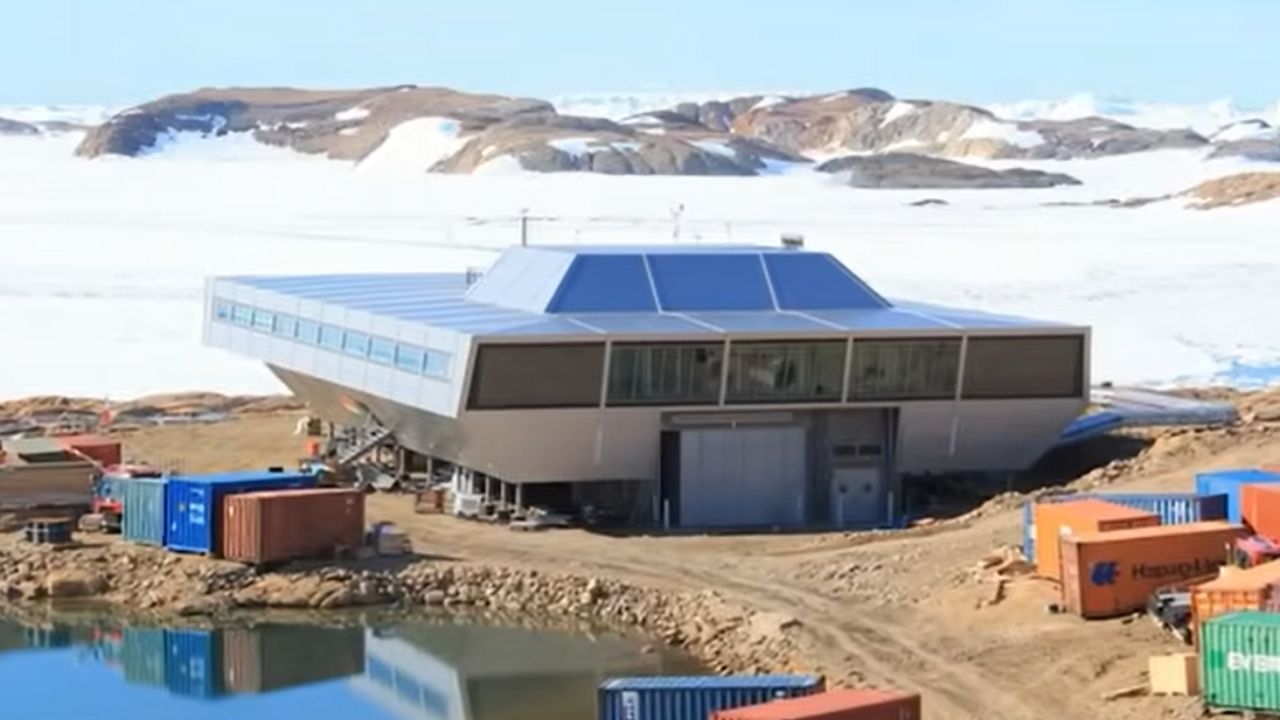

Know The Bharati Station, A Marvel Of Indian Engineering Designed To Operate Autonomously In The Most Hostile Environment On The Planet.
Amidst the relentless ice of the Antarctic, there exists a futuristic structure. It is the Bharati research station of India, built entirely with containers. Designed to withstand the most hostile extremes on the planet, it is a symbol of engineering, logistics, and smart adaptation. This modular and removable base operates efficiently and sustainably more than 12,000 km from its home country.
A Fortress Of Steel And Science In The Heart Of The Antarctic
The Bharati Station seems to have come out of a fiction project, but it is real. It was made to withstand winds exceeding 300 km/h. Temperatures can plunge below minus 40 degrees. Even in an environment where nature does not give a break, the base survives and operates efficiently.
Its location is strategic. Located in Larsman Hills, in East Antarctica, the base sits 35 meters above sea level, in a rocky area free of permanent ice. This rare condition facilitated the installation of its foundation. The site provides direct access to the Antarctic Ocean, allowing for resupply during the short polar summer. The choice also had a strong scientific component, as the region is a zone of interest for geological, paleoclimatic, and biological research.
-
Tired of Seeing Homelessness, New Westminster in Canada to Open Region’s First Tiny Home Village: 30 Container Homes with Central Kitchen, Meals, and Facilities

-
Brazil’s Santa Catarina Port Drives 770 Tons of Steel Piles into the Sea, Reaches Midpoint of $100 Million Project to Dock Two Ships Simultaneously by October
-
Expanded Polystyrene Gains Ground as a Lightweight Alternative to Traditional Masonry in Construction
-
Abandoned Brazilian Coastal Stadium, Once Hosting Major Soccer Matches, to Be Demolished for $10 Million NASCAR-Inspired Racetrack


The Journey Of 12,000 Km To The Icy Continent
The construction of Bharati is one of the most impressive feats of modular engineering. It all began in 2006 with an international architecture competition. The winning project brought together experts from Germany and India. The chosen solution was to use 134 ISO containers of 40 feet.
These modules were pre-fabricated and modified in Germany. They underwent a structural reinforcement process. Electrical, plumbing, and ventilation systems were pre-installed. Each unit was numbered, following a “Plug and Play” system to facilitate assembly. Logistics was a critical step. The modules traveled by train to Belgium and, from there, were loaded onto an icebreaker bound for the Antarctic.
A Precision Achievement In 127 Days
Before the arrival of the containers, teams prepared the site in the summer of 2010. They built a helipad and fuel tanks. The station’s foundation was made with steel piles driven directly into the rock, a crucial engineering solution for the Antarctic soil, as it avoids contact with the permafrost and allows wind circulation beneath the structure, reducing snow accumulation.
Field assembly followed a strict sequence. The containers were stacked in three levels and reinforced. Then, technicians applied the outer protective panels. The shell is composed of mineral wool, polyurethane foam, and a metal sheet. Its shape was tested in a wind tunnel to withstand gusts of up to 321 km/h. The entire process, from assembly to commissioning, was completed in just 127 days.
How Life Functions Inside The Bharati Station?

The interior of the station was designed with the surgical precision required to ensure self-sufficiency in the Antarctic. The structure is divided into three levels. On the ground floor are the vital systems: generators, scientific laboratories, workshops, and storage. The water and sewage treatment systems are also on this floor.
The second floor is the residential area. Here are the dormitories, the kitchen, the dining room, the living room, the library, and a small gym. These spaces are essential for the mental and physical health of the isolated team. A medical station equipped for emergencies is also on this floor. The third level houses the ventilation system and serves as a scientific terrace, with sensors and antennas.
The Key To Surviving In The Antarctic
Keeping the structure alive in the Antarctic requires a highly efficient energy system. The station uses three kerosene co-generation units. They provide electricity and also heating, reusing waste heat. If one generator fails, the other two maintain full operation.
The base can accommodate up to 47 people in the summer and 24 permanent residents in the winter. Its logistics are organized to operate autonomously for nine months, without the need for resupply. Communication with India is done via satellite in real time. With energy, water, heat, and waste treatment operating independently, Bharati is an example of integrated engineering for extreme environments, sustaining human presence and science in the most challenging continent on Earth.