






 Portuguese
  Spanish


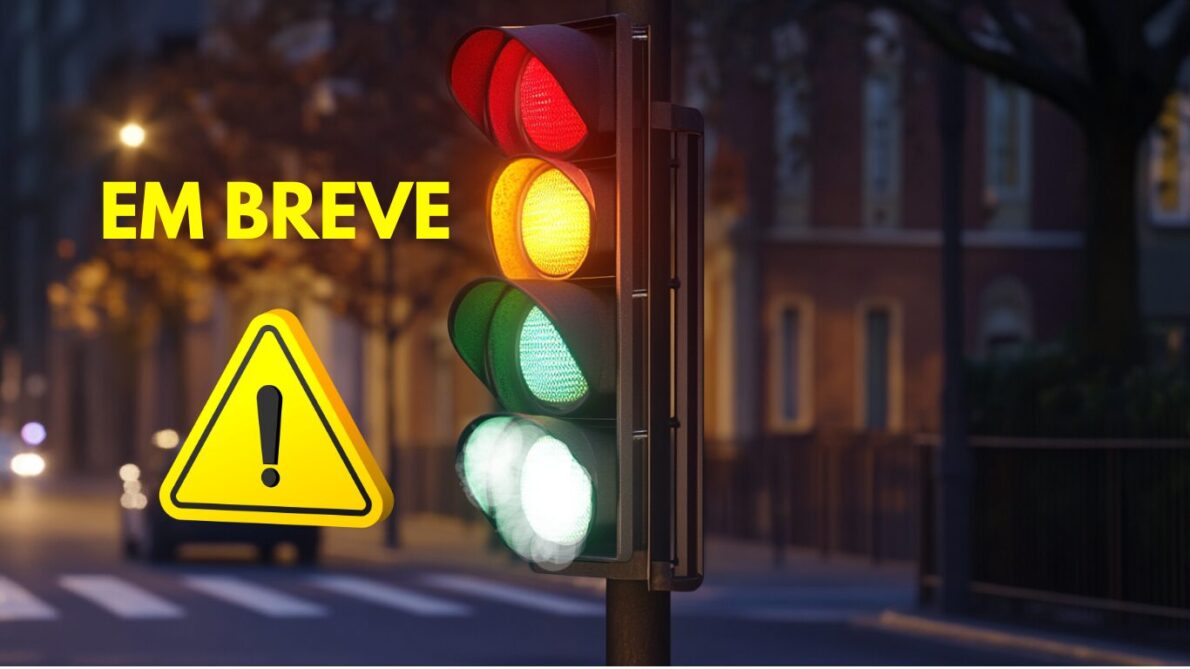
A Revolution Is Expected to Happen in Traffic: A Fourth Light May Be Added to Traffic Lights, and It Has Everything to Do with Autonomous Cars. Discover How This Innovation Aims to Transform the Streets and the Way We Drive in the Future and How the Detran and the Contran Will Act!
You are already used to the three core lights of the traffic light: red, yellow, and green. But what if I told you that a fourth light might come into play? It sounds a bit confusing, right? Well, that’s exactly it.
According to the newsmotor website, the change is being discussed globally and may even require a new law to be innovative in the cities. The Detran and the Contran have already started thinking about how this new signal can integrate with the current traffic rules, improve street flow, and reduce congestion. Want to know how it all works? We will tell you!
What Is White Light in Traffic Lights?
The white light was designed to assist in controlling traffic in autonomous cars and conventional vehicles on the same roads. When there is a specific number of exclusive vehicles in certain segments, this new light will turn on. But don’t worry, it does not replace the red, green, or yellow lights. On the contrary, the traditional core system continues to function as we know it.
-
Chinese Giant Uses Metal Structures and Cranes to Deliver Over 700 Electric Cars to Brazil

-
Uber Faces Shareholder Scrutiny as Board Accused of Ignoring Safety, Compliance, and Harassment Warnings Amid Over 3,500 U.S. Lawsuits

-
Ferrari’s First Electric Car Divides Fans, Priced at $630,000, Amid Concerns Over Limited Editions; Brand Clarifies It’s Not Just for Future Perks
-
BYD Dolphin Mini: The Electric Car That Defies Depreciation, Losing Only 3.58% in a Year and Becoming the Best-Selling Retail Model Under $22,000


The role of the white light is simple: when sensors detect many autonomous cars, this light indicates to human drivers that the autonomous vehicles are in control. Basically, it “says” to you: “Relax, let the smart cars take care of the flow here!“. This should make traffic easier, as the autonomous cars should communicate with each other and decide the best time to proceed or stop.
How the New Light Will Impact Traffic?
Have you ever imagined a situation where autonomous and conventional cars need to be understood? Well, the goal of this innovation is precisely that: to improve communication between vehicles. According to simulations conducted by researchers, the white light helps to reduce congestion and increases road safety. Thus, traffic becomes more efficient and less stressful for those behind the wheel.
Moreover, introducing this technology prepares cities for a not-so-distant future, where autonomous cars will be increasingly present. Although currently, these vehicles still represent a small portion of the global fleet, it is essential that streets and avenues are ready for this advance. And the white light is the answer to this challenge.
The Impact on Traffic Laws with the Detran and the Contran
Now, you may be wondering: “But are the Detran and the Contran already discussing these changes?”. Yes, implementing this new light in traffic lights will require adaptations in traffic laws. A new law will be necessary to integrate this innovation officially into the Brazilian Traffic Code (CTB). Thus, new signaling rules may be applied, ensuring that traffic functions properly.
It is important to emphasize that this change does not replace traditional signaling but is rather a complement. The white light will only be activated when the number of exclusive vehicles reaches a certain level. Therefore, the colors red, green, and yellow will continue governing traffic as before. But when the new light comes into play, it will be as if the independent vehicles took control more efficiently, resulting in fewer stops and waiting times.
First Tests and the Vision for the Future
Although it seems like a distant concept, the white light has already been tested in Madrid, Spain. The idea is that these first experiments provide data on the effectiveness and safety of the system, helping to shape a new traffic law. If the results are positive, the expectation is that the innovation will be adopted globally, including in Brazil.
And why is this important? Because, in addition to preparing cities for the future of autonomous cars, this change can benefit traffic as a whole. Less time stopped at intersections, greater safety on the roads, and perhaps even less stress in drivers’ daily lives.
The white light in traffic lights is a step forward toward the future. It represents an intelligent solution to the challenges of traffic and reflects the need to adapt to new technologies. Over time, this innovation may become a reality in various parts of the world, bringing more efficiency and safety to our streets.


Be the first to react!