Portuguese
  Spanish


Researchers In The U.S. Developed A New Tile That Eliminates The Need For Air Conditioning. Being Up To 3.1X More Efficient, Promising To Save Energy At Any Temperature.
Approximately half of the electricity consumed in large buildings is used for air conditioning in the summer and heating in the winter, a number that is likely to increase with the growth of urbanization and rising global temperatures. In response to this, several initiatives have been developed to save energy, including the use of cooling ceramics, thermal paints, and passive radiative cooling techniques. These approaches aim to dissipate heat directly to the cold of space. Recently, scientists took a step forward in this field with the development of a new adaptive tile that works like an air conditioner but without electricity consumption.
Prototype Of The New Tile Has 10 cm³
Charles Xiao and other scientists from the University of California, Santa Barbara, in the U.S., have now developed an adaptive tile that, when installed in homes, can save energy and reduce heating bills in winter and cooling bills in summer without the need for electronic equipment.
Since the model is modular, the material can also be used as a tile for wall coverings. According to Xiao, the new tile that functions as an air conditioner alternates between a heating state and a cooling state depending on the temperature of the tile. The target temperature is approximately 18 °C.
-
China Develops Custom 140-Ton Electric Mining Truck with 770 kWh Swappable Battery, Deploys 290 Units in Xinjiang’s Largest Zinc Mine

-
Meta to Launch Arena, a New Prediction App Targeting 3.56 Billion Users, Competing with Polymarket and Kalshi

-
Scientist Challenges Famous Human Evolution Theory, Argues Homo Sapiens Evolved Gradually Over Thousands of Years
-
15-Year-Old American Builds Ocean Generator with PVC Pipe and 3D-Printed Propeller for $12, Wins National Prize, Presents at White House, and Makes Forbes 30 Under 30 List




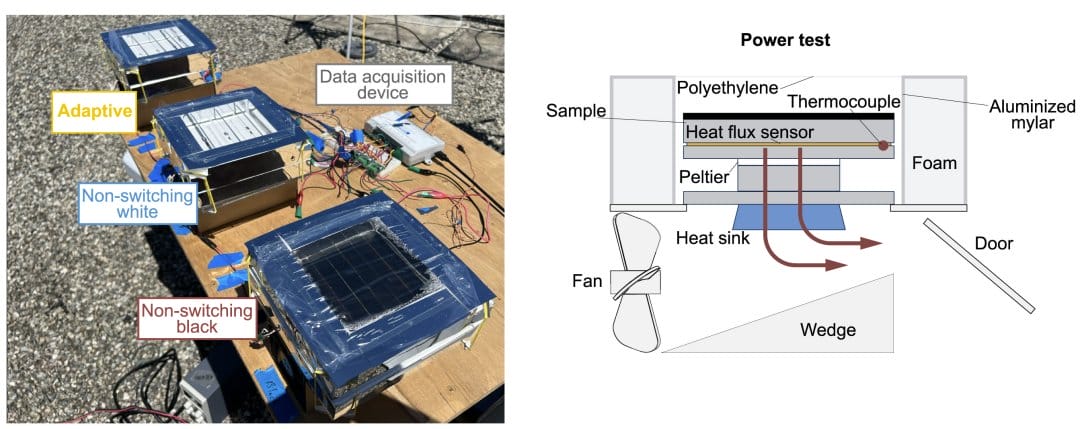
Image: Charles Xiao et al
The specific temperature was chosen based on the climatic conditions of the Northern Hemisphere; however, it can be adjusted for the average temperature of other regions. The prototypes of the new tile, which eliminates the need for air conditioning, are small, about ten square centimeters, acting as a passive thermoregulation device, a movable surface that can alter its thermal properties in response to a range of temperatures.
Tests have shown that they can save energy for cooling by 3.1 times and for heating by 2.6 times compared to non-switching devices covered with conventional reflective or absorbent coatings.
Know How The New Tile Developed To Save Energy Works
The heart of the thermoregulating tile is a wax motor, a linear actuator that converts thermal energy into mechanical energy, leveraging the phase change behavior of waxes. Based on the change in volume of wax in response to the temperatures it is exposed to, a wax motor generates pressure that moves mechanical parts, translating thermal energy into mechanical energy.
These devices are commonly found in various appliances, such as dishwashers and washing machines, as well as more specialized applications, such as in the aerospace industry.
In the case of the new tile (or slab), which promises to eliminate the use of air conditioning and save energy, depending on its state, the wax motor can push or retract pistons that close or open blinds on the surface of the tile.
Thus, at cooler temperatures, while the wax is solid, the blinds are closed and flat, exposing a surface that absorbs sunlight and minimizes heat dissipation through radiation. But as temperatures reach around 18 °C, the wax begins to melt and expand, opening the blinds and exposing a surface that reflects sunlight and emits heat.
Device Still Has No Forecast To Hit The Market
During the melting or freezing process, the wax also absorbs or releases a large amount of heat, further stabilizing the temperature of the tile and the building.
By operating with a wax motor, no electronic components, batteries, or external power sources are needed to operate the tile.
According to team member Elliot Hawkes, the device is still a proof of concept and is far from hitting the market, but the expectation is that it will lead to new technologies that could one day have a positive impact on energy spending of buildings.