Portuguese
  Spanish


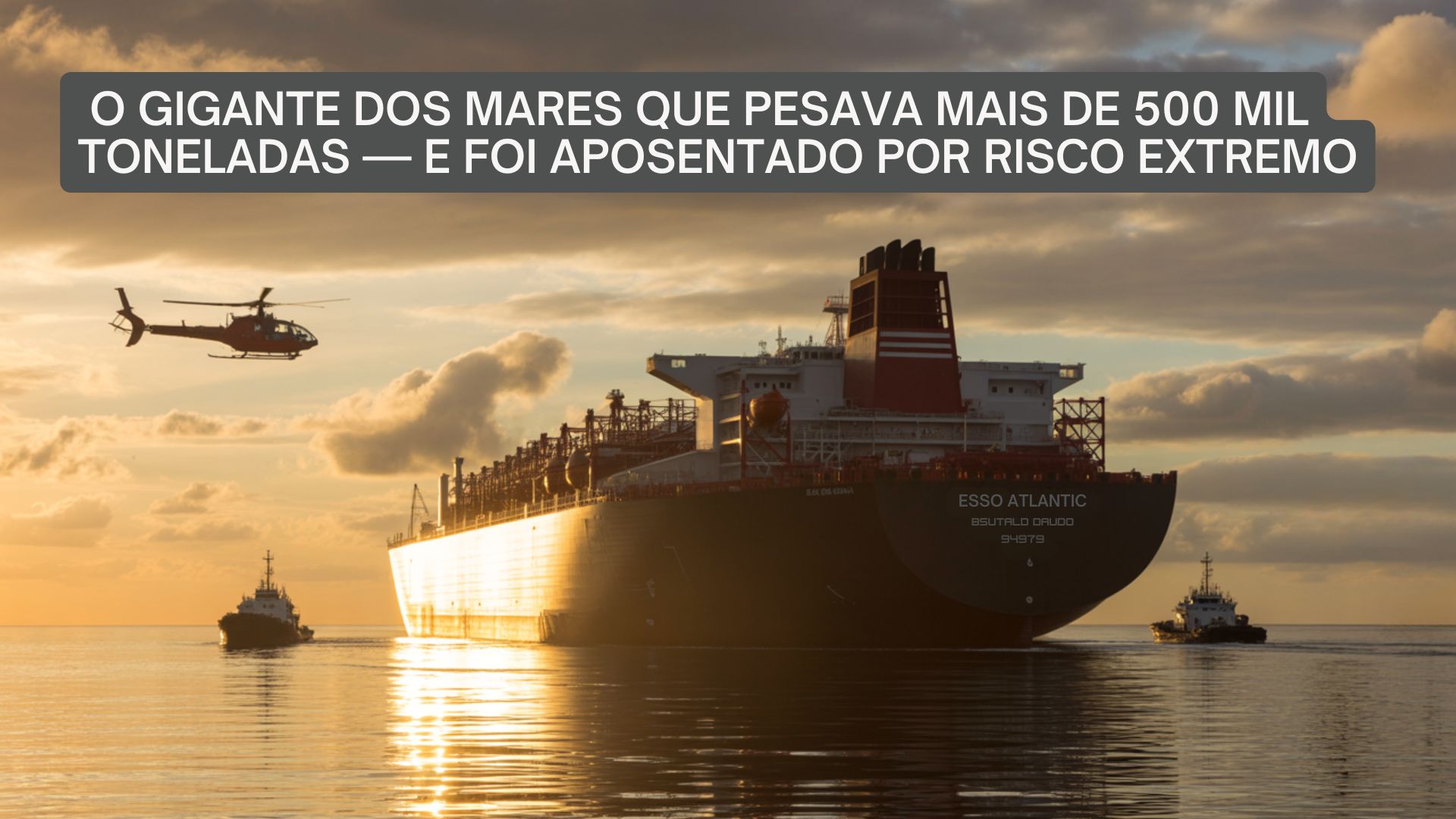

With More Than 400 Meters in Length, the Esso Atlantic Carried Oil on a Large Scale, but Was Retired for Not Meeting Modern Environmental and Structural Safety Standards.
The Esso Atlantic was one of the largest oil tankers in the history of the shipping industry. With over 406 meters in length and a deadweight tonnage (DWT) of 508,731 tons, the supertanker operated for about 25 years transporting oil on international routes between the Middle East and Europe. Its size was so colossal that, when fully loaded, it could not pass through the Suez or Panama Canals.
Built in Japan by the Hitachi Zosen shipyard, the Esso Atlantic was launched in 1977. Belonging to the ULCC (Ultra Large Crude Carrier) class, the ship was designed to meet the growing demand for oil during the 1970s, a period marked by supply shocks and large-scale production expansion. Its operation focused on ocean routes connecting major production hubs to consumer markets.
Giant Oil Tanker Operated with Steam Turbines and Advanced Navigation System
The oil tanker was powered by a Kawasaki steam turbine of 33,100 kW, allowing it to cruise at a speed of about 15.6 knots, equivalent to just over 28 km/h. For its time, the Esso Atlantic incorporated systems considered modern, such as an automated engine room, autopilot-assisted navigation, and safety systems against explosions using inert gas in the tanks.
-
Qantas and Airbus Invest in Company Aiming to Convert Unsorted Household Trash into Jet Fuel

-
Brazil’s ANP Opens 86 New Oil Blocks in the Equatorial Margin, Expanding the Amazon River Mouth Frontier

-
OPEC+ Boosts Oil Supply by 188,000 Barrels per Day in July 2026, Leading to Price Drop from $112 to $89 per Barrel in Under Two Months

-
TotalEnergies Signs 20-Year Deal to Purchase 2 Million Tons of LNG from Alaska, Boosting Project Viability



These innovations allowed for safe operations on long crossings and in open water, even with a load of hundreds of thousands of tons of crude oil. Its size and performance made it one of the only seven ships in the history of naval shipping to exceed the mark of 500,000 tons of deadweight.


Why the Esso Atlantic Was Decommissioned
Despite its robustness and operational capacity, the Esso Atlantic was retired mainly for not meeting modern safety and environmental protection requirements. Starting in the 1990s, the International Maritime Organization (IMO) began to require that oil tankers be constructed with double hulls, a measure adopted to minimize leaks in the event of a collision or grounding.
The Esso Atlantic had a single hull, a standard common at the time of its construction, but which came to be considered inadequate in light of new regulations. Adapting to the new model was technically possible but economically unfeasible given the vessel’s age and the costs involved.
Another decisive factor was the natural wear and tear of the structures. After decades of operation, the welds, piping, and internal systems showed signs of fatigue, requiring constant maintenance. The risk of operational failures increased over time, and a complete modernization of the ship was not deemed worth it compared to the possibility of replacement with more efficient and safer models.
Sale, Renaming, and Scrapping of the Oil Tanker in Pakistan
The ship was operated by Esso until 1990, when it was sold to the Greek company Ceres Hellenic Shipping and renamed Kapetan Giannis. Under a new flag, the supertanker still operated for a few more years, but with limited use and growing obsolescence.
In 2002, the Esso Atlantic was finally decommissioned and sent for scrapping in Gadani, Pakistan, one of the largest naval dismantling hubs in the world. There, like many other giants of naval engineering, it was dismantled piece by piece.
Legacy of the Era of Supertankers
The Esso Atlantic represents an important chapter in the history of maritime oil transport. Built during a time of industrial ambition and focus on volume, its size was designed to maximize cargo transportation on ocean voyages, reducing logistical costs.
However, the advancement of environmental regulations, new technical standards, and greater concern for maritime safety contributed to the end of the era of single-hulled supertankers. Today, the name Esso Atlantic remains a symbol of the transition between heavy engineering and global environmental regulation.
Throughout its lifetime, the ship fulfilled its role without records of serious accidents, reinforcing its importance as an example of efficient maritime engineering for its time. However, like many large vessels of the last century, it was surpassed by the new demands of the 21st century.