Portuguese
  Spanish


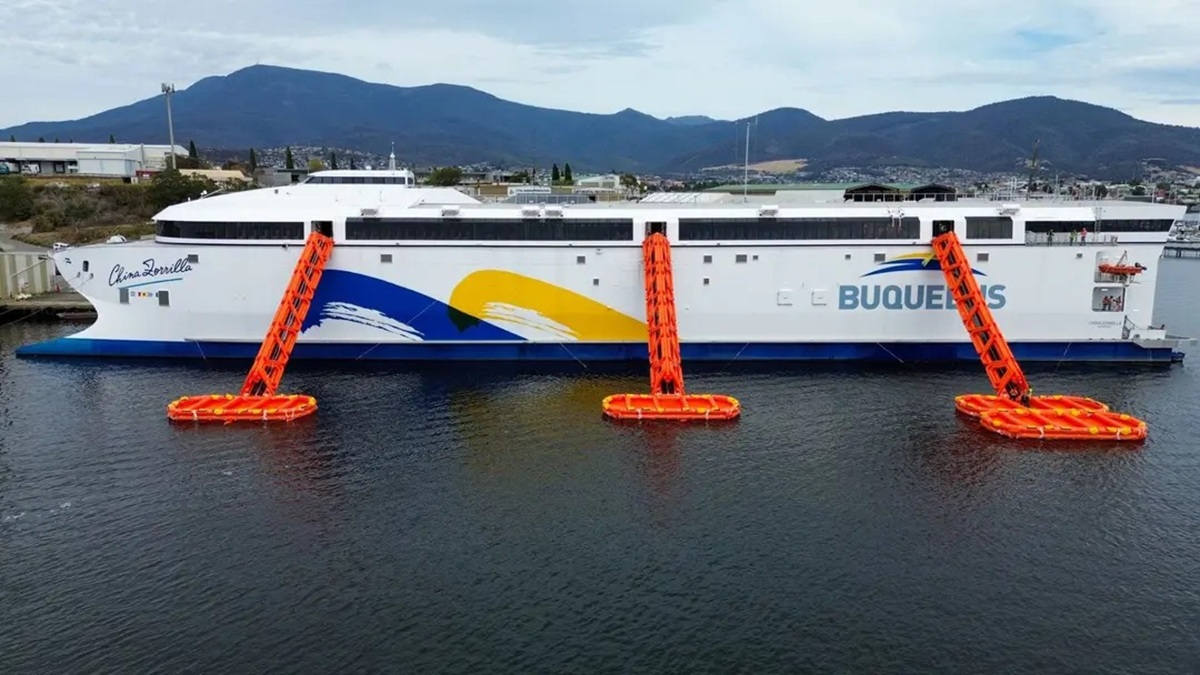


With 250 Tons of Batteries and 40 Megawatts of Energy Capacity, Hull 096 Completes the Installation of Six 22-Meter Evacuation Systems and 13 Lifeboats for 2,432 People Before Starting, in 2026, Operations of Up to 185 Km on the Río de la Plata.
The largest electric vehicle in the world reaches a crucial safety milestone before launch. Under construction by Incat in Australia, Hull 096 has completed the installation of the Maritime Evacuation System and is set to enter service in 2026, operating entirely on electricity.
Installation of the Evacuation System Reinforces the Safety of the Largest Electric Vehicle in the World
Last week, at Incat’s shipyard in Hobart, Hull 096 completed the installation of the Maritime Evacuation System, provided by Liferaft Systems Australia, marking an important safety milestone before delivery.
Six 22-meter MES units will be installed along the sides of the vessel. The system will be supported by 13 interconnected lifeboats, with a combined capacity to evacuate 2,432 people in case of need.
-
Chery Offers Lifetime Battery Warranty and Car Replacement for Major Failures Under New Chinese Regulations

-
Nissan Discontinues Qashqai SUV Amid Cost-Cutting, Chinese Competition, and Product Line Review
-
BYD Patents Revolutionary System Using Computer Vision to Detect Animals Under Cars Before Starting, Preventing Tragedies

-
BMW Completes $1.7 Billion Investment in the U.S. for Electric Vehicle Production, Positions South Carolina for New Generation as Rivals Reassess EV Race




During testing and commissioning, three MES units were evaluated on board. Each unit was connected to an open and reversible lifeboat for 128 people, along with an additional interconnected lifeboat, validating procedures and performance under operational conditions.
“Safety is paramount on all vessels we build at Incat. The successful deployment of the Maritime Evacuation System on Hull 096 demonstrates the depth of engineering, planning, and collaboration required,” stated Robert Clifford, president of Incat.
Energy Capacity of 40 Megawatts with 250 Tons of Batteries
Hull 096 is described as the largest electric vehicle in the world and the largest battery electric ship ever built. The vessel carries 250 tons of batteries that provide 40 megawatts of power.
The energy capacity is equivalent to the power of 487 Tesla electric vehicles and four times greater than any previous maritime battery installation. The system positions the project as a record development in maritime transport.
Initially planned to operate on liquefied natural gas, the ship was converted to operate entirely on batteries and electric motors. It is a roll-on/roll-off passenger catamaran, known as a Ro-Pax.
Transport of 225 Vehicles and 2,100 Passengers on a 130-Meter Vessel
The vessel measures 130 meters, equivalent to 426 feet, and can carry 225 vehicles and 2,100 passengers per crossing. Propulsion is provided by eight Wärtsilä waterjets.
With this setup, the ship reaches a maximum speed of 46 km/h, or 29 mph. Earlier this year, Hull 096 sailed under its own power for the first time, marking the transition from the construction phase to operational testing.
Last month, Incat began harbor tests on the Derwent River. The assessments include controlled maneuvers to analyze propulsion, handling, control systems, and onboard performance under real conditions.
Operation Planned on the Río de la Plata with Crossings of Up to 185 Kilometers
After final adjustments, the largest electric vehicle in the world will be sent to South America to operate for Buquebus. The vessel is expected to serve the Río de la Plata crossing.
The route will connect Buenos Aires, Argentina, to destinations in Uruguay, with distances of up to 185 kilometers, or 115 miles, per crossing. The service will transport passengers and their vehicles between the two countries.
In addition to the transport function, Hull 096 will feature the largest commercial space ever installed on a vessel of this type. Over 2,300 square meters of the deck have been allocated for commercial facilities.
The area corresponds to 25,000 square feet dedicated to shopping options during the journey. The project represents a significant advance in large-scale electric maritime transport, solidifying the largest electric vehicle in the world as a benchmark for capacity and technology.
This is the first ship of this size and capacity to operate exclusively on battery power. According to the information released, it is a milestone in the industry, with a complete transition from the construction phase to operational testing prior to entering service in 2026.