






 Portuguese
  Spanish
  4 min of reading
  0 comments


Impressive Innovation: New Transparent And Fire-Resistant Material Made From Bamboo Emerges As An Alternative To Glass And Can Transform Civil Construction
The search for more sustainable and efficient solutions in civil construction has led scientists to explore unconventional materials, and bamboo is standing out in this race. Known as the “green steel of the 21st century,” bamboo combines tensile strength similar to steel with an incredibly fast growth rate, making it a promising alternative to traditional building materials. Now, researchers have taken it a step further: they have transformed bamboo into a transparent and fire-resistant material with properties similar to glass.
Bamboo has been widely used in construction, especially in temporary structures like scaffolding and in structural elements such as walls, floors, and roofs. Recently, it has been increasingly incorporated into sustainable architectural projects. An impressive example is the Arc, a structure in Bali made entirely of bamboo, whose 19-meter arches showcase the material’s potential for modern construction.
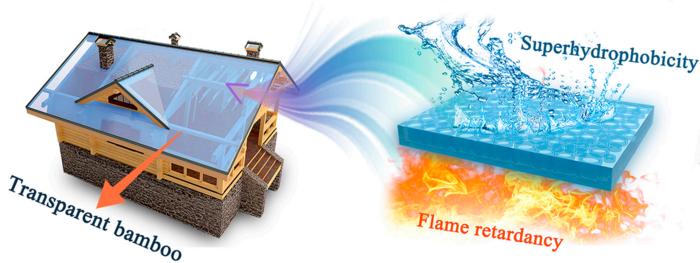
Silica Glass In Relation To Bamboo Innovation
Now, a team of researchers from the Center-South University of Forestry and Technology (CSUFT), in China, has developed a new bamboo-based material that is transparent like glass but with significant advantages in terms of sustainability and fire resistance.
-
Man builds house with concrete made from recycled paper and attracts attention in Portugal; named Porta do Caracol, the home features solar panels, a vertical garden, and a pool with natural filters.

-
Goodbye to conventional plaster? New material used on walls reduces waste and steps in construction and draws the attention of engineers by offering faster application and greater construction efficiency – discover the advantages of smooth gypsum.

-
Norway will excavate 3 million cubic meters of rock to open a 1,700-meter maritime tunnel, where ships will pass through a mountain in 10 minutes, escaping a stretch that has killed more than 30 people since 1900.

-
How much does it cost to build a sidewalk with interlocking pavement in 2026? See the average construction prices and the most common extra expenses that can increase the final budget.


This advancement opens up new possibilities for using bamboo in a wide range of applications, ranging from civil construction to optical and technological devices.
Silica glass has been widely used in construction for decades, with a global production of 130 million tons in 2020. Despite its transparency and availability, silica glass has notable disadvantages, such as high fragility, elevated density, and the significant environmental impact caused by its production. The manufacturing of silica glass emits large amounts of carbon dioxide, contributing to climate change.
In recent years, transparent wood has emerged as a sustainable alternative to glass, being considered for uses in smartphone screens, color-changing windows, and even lighting fixtures. However, the scarcity of wood and the flammability of these materials limit their large-scale application. It is in this scenario that bamboo, with its rapid growth and high availability, emerges as a more efficient and eco-friendly solution.
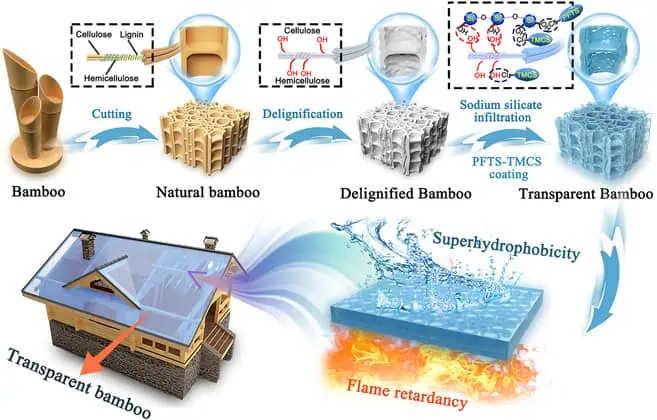
Properties Of Transparent And Fire-Resistant Bamboo
Bamboo has several advantages over wood. It reaches maturity in four to seven years, compared to the 20 to 50 years required for many tree species, and produces up to four times more wood per acre than oak. In addition, despite being a grass, bamboo has a chemical structure similar to wood, making it suitable for the production of composite materials.
The team of researchers at CSUFT developed a vacuum impregnation process that infuses sodium silicate into the porous structure of pre-delignified bamboo (i.e., with the removal of its lignin, a compound that gives rigidity to the plant). This process is followed by a hydrophobic treatment that creates a three-layer fire-resistant barrier. The result is a material with impressive mechanical properties and fire resistance much higher than that of other materials.
The material developed by the scientists has a prolonged ignition time (116 seconds), low heat emission, minimal smoke production, and low concentrations of carbon monoxide. In addition, it has high mechanical resistance, with good flexural and tensile moduli, making it suitable for a variety of applications in civil construction.
Transparent Bamboo
One of the most promising aspects of this new material is its performance when used as a substrate for perovskite solar cells. Transparent bamboo has a light transmittance of 71.6%, along with a haze value of 96.7%, which increases the energy conversion efficiency to 15.29%. This makes it an attractive option not only for construction but also for use in renewable energy technologies.
Researchers at CSUFT believe that transparent bamboo has the potential to be produced on a large scale and used in various applications, including the manufacture of windows, optical devices, and construction materials that combine high strength and sustainability. This advancement represents a significant innovation in the construction of green buildings, offering an alternative to traditional glass with lower environmental impact and greater durability.
The creation of transparent materials from bamboo can also contribute to reducing the carbon footprint of the construction industry, one of the largest greenhouse gas emitters in the world. With this new technology, bamboo not only reaffirms its place as a viable and sustainable option but also establishes itself as one of the most versatile and promising materials for the future of eco-friendly construction.
The innovation in the production of construction materials based on bamboo demonstrates how the combination of science and sustainability can create solutions that meet the demands of the future without sacrificing the planet’s natural resources. The transparent and fire-resistant bamboo is a perfect example of how it is possible to unite efficiency, sustainability, and modern design in a single material.






Be the first to react!