Portuguese
  Spanish



China’s New Project Could Be Considered By Many A Revolution In The Naval Construction Sector
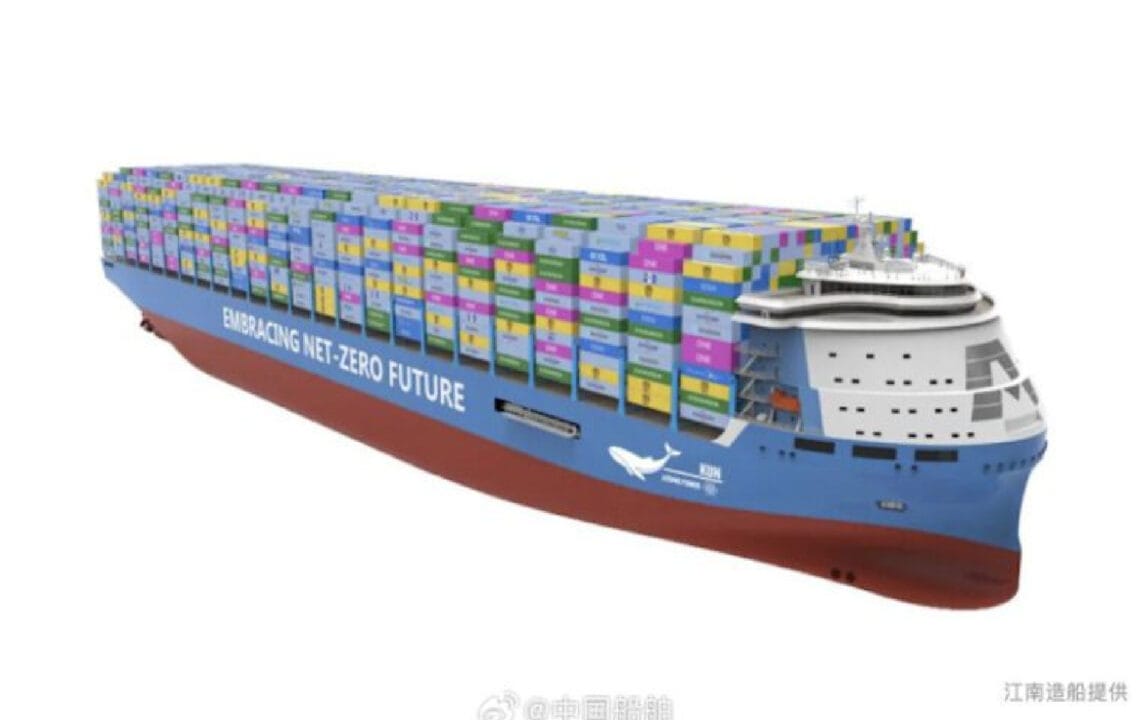
The China State Shipbuilding Corporation (CSSC) shook the naval landscape by unveiling ambitious plans for the construction of what could become the world’s largest nuclear-powered container ship. This announcement took place on Tuesday, the 5th, during the prestigious Marintec China exhibition in Shanghai, revealing a 24,000 TEU class vessel powered by a fourth-generation molten salt reactor, according to the gCaptain website.
The CSSC, in a post on Weibo, stated that the colossal nuclear container ship was meticulously designed to achieve “zero emissions” throughout its operational cycle. This initiative reflects the growing commitment of the naval industry to more sustainable practices aligned with international emission reduction goals.
The classification society DNV was present at the launch ceremony to issue a “principle approval” to the CSSC Jiangnan Shipbuilding yard, signaling a significant advancement in the acceptance and viability of this visionary naval project from China.
-
Helsinki Residents Receive Water That Travels 120 Kilometers Through a Hidden Rock Tunnel from a Lake Before Treatment

-
SENAI Launches $36 Million Innovation Round to Boost Brazilian Manufacturing Productivity and Reduce Business Risks with R&D Projects by 2026
-
Indonesia Plans to Build 5,000 Suspension Bridges by 2026 to Connect Rural Communities to Schools, Health Centers, and Markets
-
U.S. Invests $75 Million in Projects to Extract Rare Earths, Gallium, Germanium, and Aluminum from Coal Waste




Molten Salt Reactors: Innovation In Nuclear Propulsion In Naval Construction
The heart of this Chinese naval giant will be a molten salt reactor (MSR), an innovative technology that offers greater safety and efficiency in electricity production. According to the CSSC, the reactor operates at high temperature and low pressure, minimizing the risks of core meltdown and integrating non-proliferation features.
The molten salt reactors being developed in China (MSRs) are an advanced form of modular nuclear reactors, using a liquid mixture of salts as fuel and coolant. This approach allows for more precise control of the nuclear reaction, resulting in greater safety and potential for fuel optimization.
Challenges And Perspectives For Maritime Nuclear Propulsion
Despite decades of success in applying nuclear energy to naval and governmental vessels, commercial utilization still faces significant challenges. A recent study by ABS suggested that nuclear propulsion in commercial vessels could offer substantial benefits, from increased cargo capacity to the elimination of CO2 emissions and the need for refueling over 25 years.
Christopher Wiernicki, President and CEO of ABS, emphasized that nuclear propulsion is a key piece in achieving a world with net zero emissions. However, he points out that there are critical issues to be addressed, and the naval industry must evaluate these technologies with a focus on safety.
This advancement from China opens new horizons and challenges the naval industry to rethink the future, exploring nuclear energy as a pathway to more sustainable and efficient navigation. The expectation is that this pioneering project will be the catalyst for significant changes in how commercial ships are powered, positively impacting the environment and meeting global environmental requirements. The future of nuclear navigation may be closer than we ever imagined.