






 Portuguese
  Spanish


StuG III vehicle was found in Nordholz, on the North Sea coast, with preserved interior, marks on the barrel, and signs that it may have been buried shortly after the end of the war
A German armored vehicle from World War II was found almost intact during construction work at the Nordholz naval air base in northern Germany.
The vehicle, identified as a StuG III, weighs about 29 tons and was buried for more than eight decades in an area of dry sand.
The find caught the attention of archaeologists because such discoveries usually reveal only fragments, loose parts, or corroded sections.
-
Ohio Restaurant Owners Close for a Week to Take All 60 Employees on a Bahamas Cruise with Full Pay

-
Brazilian Mother Turns Pasta Business into $12,000 Monthly Success Using YouTube and TikTok for Marketing and Web Design Skills

-
Construction Worker Finds $30,000 Left in Florida Gas Station Bathroom, Tracks Down Owner to Return It, Declines Dinner Offer as Thanks
-
$100 Thrift Store Painting Bought in 1966 Becomes $254,000 Treasure After Google Gemini Identifies It


This time, workers found an almost complete tracked vehicle, with the interior accessible and parts of the structure still preserved.
The armored vehicle appeared during construction and surprised with its state of preservation
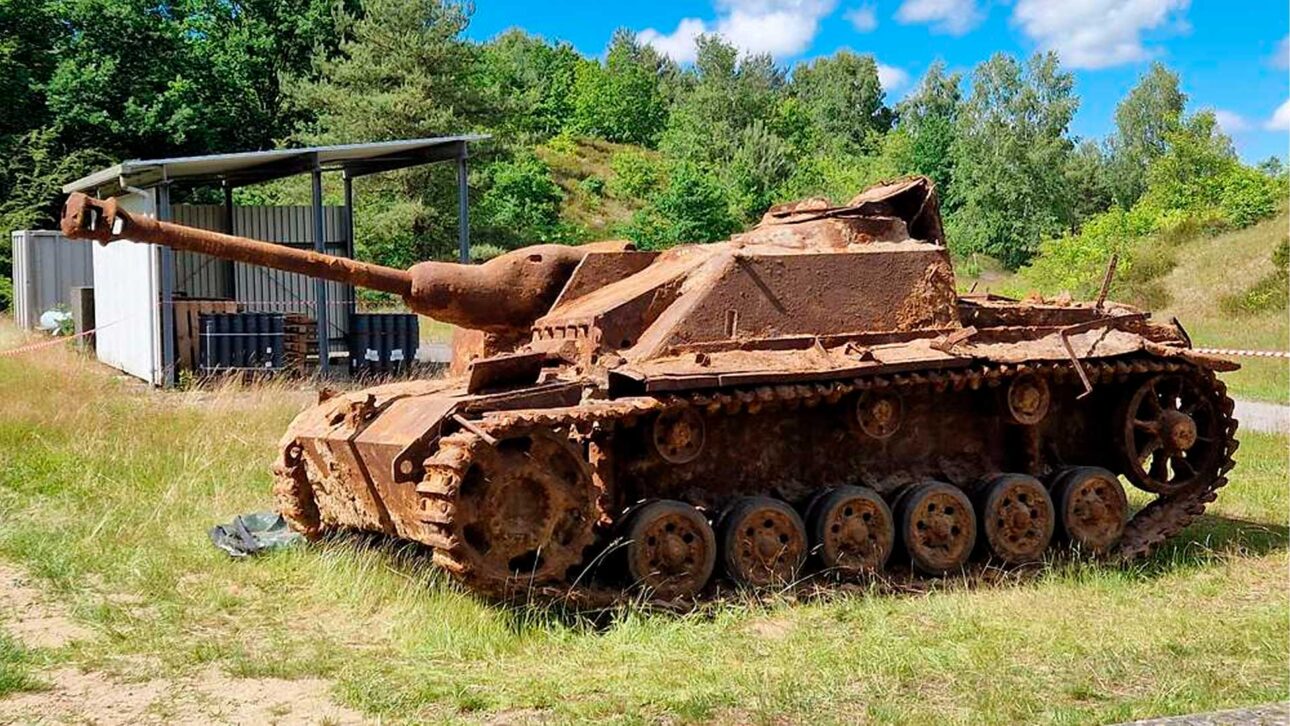
The discovery occurred on the grounds of the Marinefliegerstützpunkt Nordholz, a naval base linked to the German military aviation in the Cuxhaven district, near the North Sea. The vehicle was buried in a former military section, in an area associated with the last months of World War II in northwest Germany.
According to the German Federal Agency for Real Estate Management, the BImA, the StuG III was removed from the site after excavation and had its destination defined on June 11, 2026. The armored vehicle will be incorporated into the Military History Museum of the Bundeswehr, in Dresden, but will first go to Munster for conservation.
What most caught the attention of specialists was the combination of size, integrity, and context. A vehicle of almost 29 tons, buried for 80 years, still preserved parts of the running system, remnants of camouflage paint, and internal components.
The StuG III was not a common tank and this helps explain its importance
The StuG III, short for Sturmgeschütz III, was an assault gun used by the Wehrmacht. Although often called a “tank” by the public, it had a decisive difference from traditional combat vehicles. It did not have a rotating turret.
Its gun was fixed at the front. To aim, the crew had to move the entire vehicle, which required coordination between the driver, commander, and gun operator. This configuration made the armored vehicle lower and simpler to manufacture, but limited its flexibility in combat.
According to information released by the Bundeswehr on June 25, 2026, the model found in Nordholz is a casemate construction vehicle on the Panzer III chassis, equipped with 7.5-centimeter armament. The initial analysis also indicated that it is a late version, identified by visible details on the gun’s armor.
More than 9,300 units of the StuG III were produced during the war. Manufacturing continued until April 1945, when the conflict was already nearing its end in Europe. The model was mainly used against enemy tanks and became one of the most numerous tracked armored vehicles in the German arsenal.
The white marks on the barrel provided a clue about the vehicle’s past
One of the most curious details of the find is on the gun barrel. Researchers identified at least 17 white marks painted on the structure, a type of record that may be linked to the number of enemy tanks destroyed during the armored vehicle’s use.
The information does not yet allow us to affirm that this specific vehicle participated in all these battles. The experts’ hypothesis is that it belonged to a brigade stationed in Nordholz and primarily employed in military operations in France.
As reported by Euronews, there is still no proof that the armored vehicle found fought in that country. Even so, the set of marks, wear, and overall condition indicates that the vehicle likely remained in service for a considerable period before being abandoned or discarded.
During the excavation, fragments of ammunition and small parts of projectiles were also found. These remnants reinforce that the site does not hold just an isolated object, but part of a scene linked to the closure of the conflict in that region.
The preserved interior showed how four soldiers operated in a tight space
Upon opening the StuG III, archaeologists found the interior in rare condition for a vehicle buried for so long. The driver’s seat remained preserved, as well as supports used in the operation of the gun.
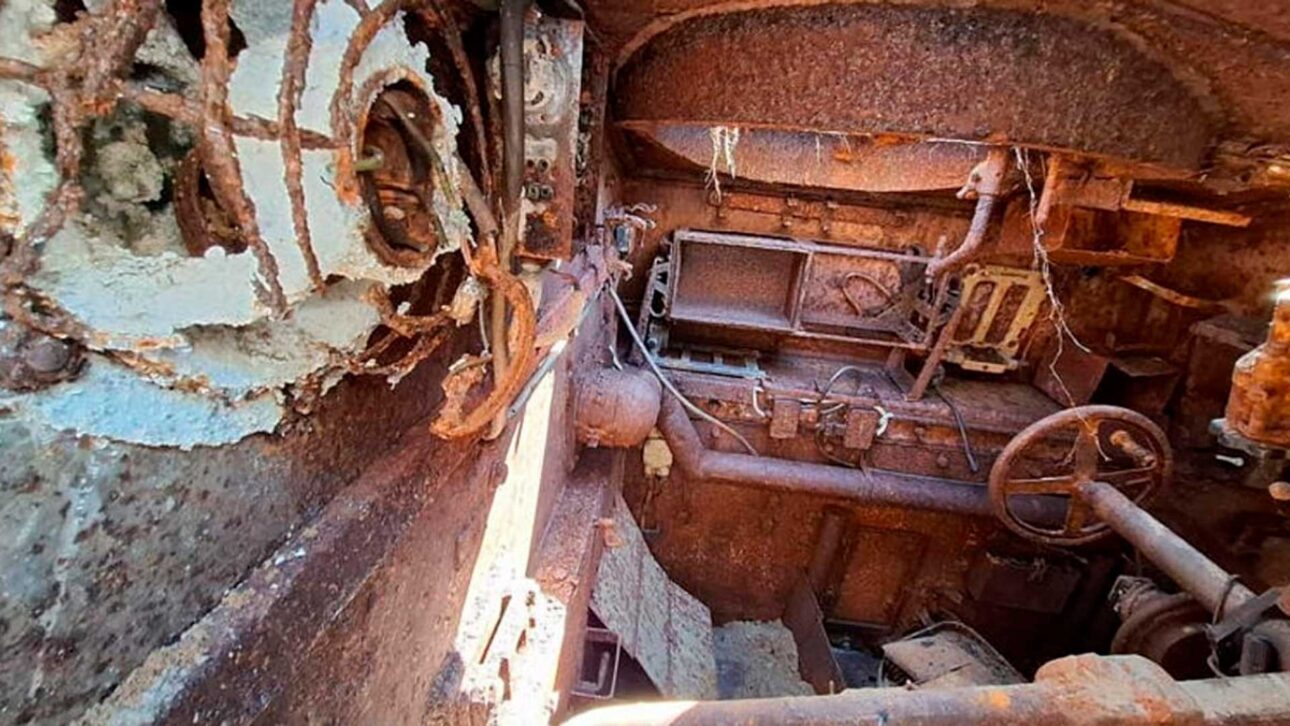
The crew consisted of four soldiers. The driver was at the front, while another soldier operated the weapon. The commander coordinated the action and a fourth crew member was responsible for loading the armament.
The reduced internal space gave researchers a concrete notion of the working conditions inside the armored vehicle. It was not just a heavy war machine. It was a closed, narrow, noisy compartment subjected to heat, smoke, impact, and constant risk during use.
This part of the find helps shift the discovery from the purely technical field to the human field. The preserved vehicle shows the military engineering of the period, but also reveals the physical routine of those placed inside these machines.
The dry sand may have protected the armored vehicle for eight decades
The excellent state of preservation is mainly attributed to the soil where the StuG III was buried. The dry sand, near the edge of a slope, reduced the degradation of the metal and helped preserve components that could have disappeared in wetter areas.
In several places, there are still signs of the original camouflage paint. Parts of the lower structure and the track system were also found in better condition than specialists usually see in materials buried since the 1940s.
NDR reported that the vehicle was discovered in April 2026 during excavator work at the Nordholz naval airfield. The German broadcaster also pointed out that ground radar images indicate the possible existence of other remains in the former military terrain, including a possible buried plane.
This possibility still depends on further verification. For now, the StuG III is the main confirmed find, and its preservation is already enough to make the discovery one of the most relevant in recent military archaeology in Germany.
The destination now will be conservation and a future public exhibition
After removal from the site, the armored vehicle was safely stored at the base itself, away from unauthorized access. The operation was accompanied by specialists, partly due to the risk of ammunition, hazardous residues, or still sensitive parts of the armament.
The plan is for the StuG III to be taken to Munster in August, where it will undergo conservation. The intention is not to rebuild the vehicle as if it were new, nor to complete missing parts. The goal is to preserve the armored vehicle as an archaeological find, keeping even part of the sand layer that helps tell its story.
After this stage, the vehicle will be linked to the Bundeswehr Military History Museum in Dresden. The public presentation should allow visitors to see not only a military equipment from World War II but also a material remnant of how weapons, vehicles, and remnants of the conflict were discarded after 1945.
The find in Nordholz shows that the war still appears in the European underground in unexpected ways. What began as a construction project revealed a 29-ton object, silently preserved for 80 years, capable of opening new questions about the last days of the conflict in northern Germany.
Leave your comment about this discovery. Do you think military relics like this StuG III should be kept exactly as they were found, with marks of time and excavation, or restored to show how they were during World War II?


