Portuguese
  Spanish


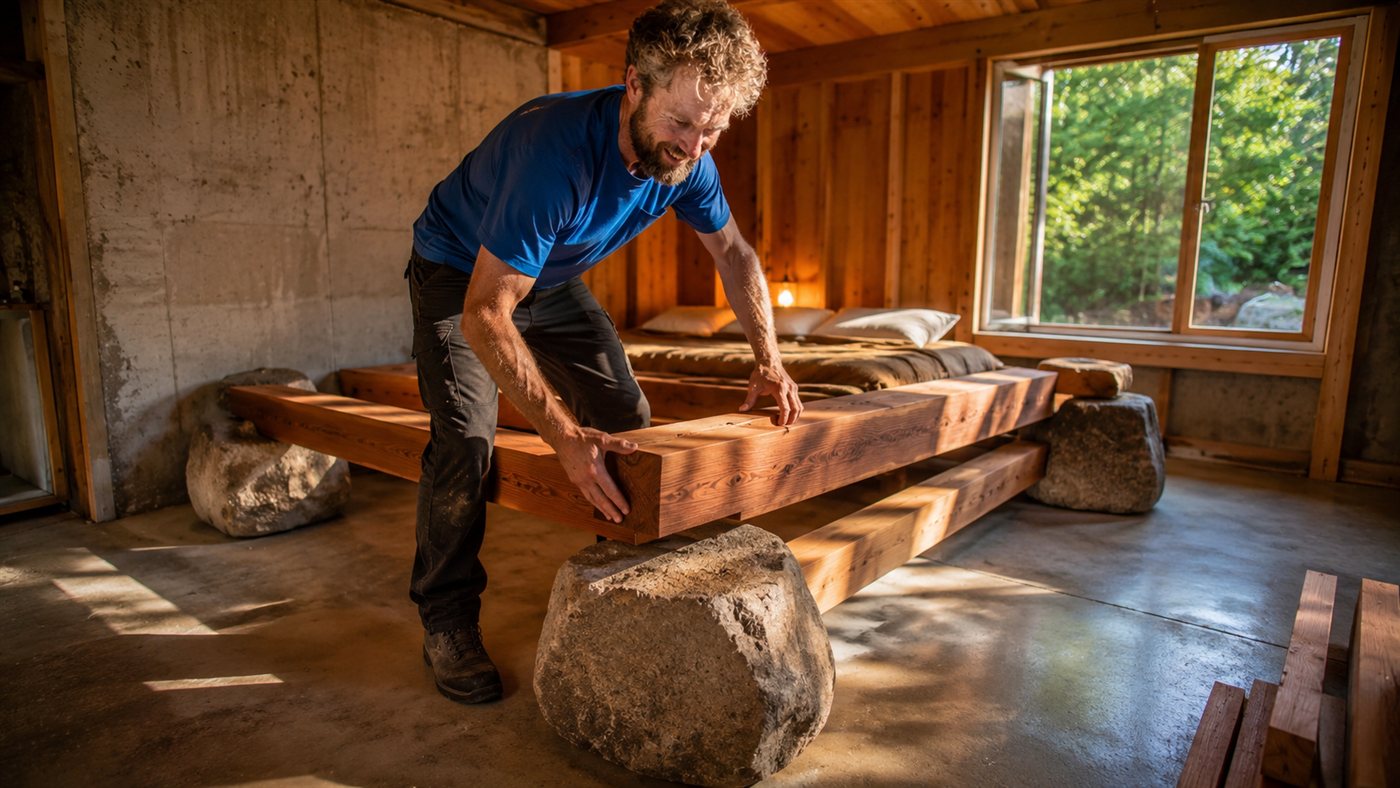

The channel creator used stones as bed legs, fitted cedar beams cut at the manual sawmill he has operated for over 20 years, and even stained the terracotta concrete floor in the basement room
A real stone bed, with granite rocks instead of legs and cedar beams sawn at home, is the star of the new chapter of one of the most followed constructions on YouTube. According to the channel Bonus Bolts, in a video published on June 18, 2026, the piece was assembled in the basement room of the annex that the owner himself has been building, and the episode already has over 437 thousand views.
The project did not use a single screw from a purchased piece of furniture. The rocks were positioned centimeter by centimeter in the room, the beams received handcrafted notches, and the set was anchored in the concrete with anchors, as Bonus Bolts shows over 48 minutes of work. It is carpentry, stonemasonry, and stubbornness in the same piece of furniture.
The granite rocks became the bed legs
The logic of the stone bed reverses the order of traditional furniture. Instead of hiding the structure, the channel creator made the granite rocks the apparent skeleton: the blocks were dragged and adjusted gradually, millimeters at a time, until each occupied the exact position at the corners of the bed, according to Bonus Bolts.
-
Brazilian Researcher Develops Color-Changing Roof Tile to Reduce Air Conditioning Use by Up to 15%

-
21-Year-Old Moves Back to Parents’ Home in Arizona, Finds New Private Apartment in Converted Garage as Families Tackle U.S. Housing Pressures

-
Innovative Container Studio in Brazilian Beach Town Thrives with High Demand and Plans for Expansion
-
30-Square-Meter Container Home with 2 Bedrooms, Living Room, Kitchen, and Bathroom Sold for $12,000 in Brazil, Tour Reveals Project Details


The fit between stone and wood is the secret of the set. Two of the notches opened in the rock received the beams with an almost perfect fit, and the third required planing the wood until it slid into the recess, as the Bonus Bolts channel on YouTube details, because it’s always easier to adjust the cedar than the stone. After fitting, expansion anchors locked everything in place.
The choice of granite as a structure has a logic that any engineer would endorse. The stone does not creak, does not warp with the humidity of the basement, and is termite-proof, the three classic enemies of any wooden bed. The weight, which would be a defect in common furniture, here becomes a quality: a bed anchored in rock and bolted to the concrete simply does not move, no matter how many decades pass.
Cedar beams with old-fashioned joints
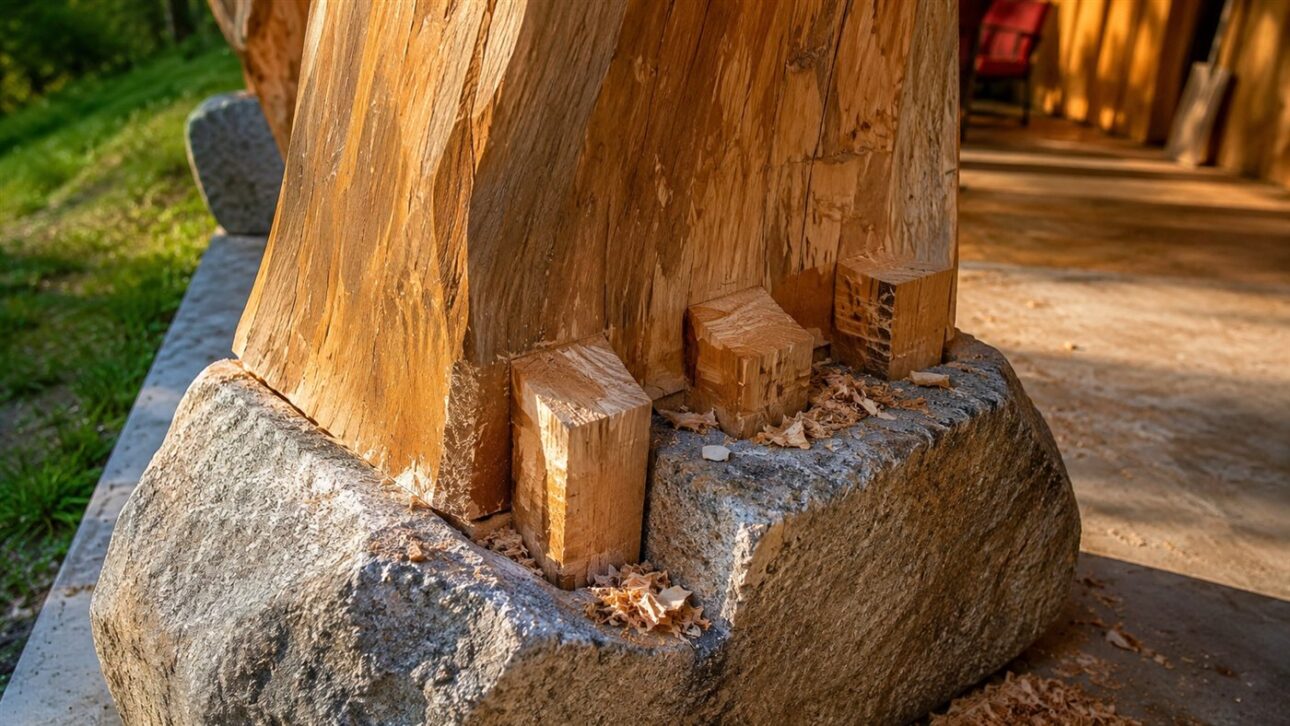
The woodwork was as labor-intensive as the stonework. According to Bonus Bolts, the four pieces of the bed frame came from robust cedar beams measuring 6 by 6 inches, about 15 by 15 centimeters, carved one by one with a saw, chisel, and patience.
The chosen material has a difficult personality. Cedar is soft yet resistant to cutting, with long fibers that tangle in the tools, as Bonus Bolts explains, and each complex carving at the ends of the beams consumed hours of work. The creator even shows a cutting error that turned into a homemade solution: two glued and sanded shims filled the gap, in a patch that no one will see once the bed is assembled.
600 attempts: the shelves embedded in the rock
The bedside tables of the project are not furniture, they are live-edge shelves emerging from the stone. According to Bonus Bolts, on the higher side of the bed, the creator sawed a slot in the rock itself to slide the board; on the lower side, he did the opposite and contoured the wood to embrace the stone, because cutting the granite there would break the remaining flake.
The fine-tuning bordered on obsession. There were hundreds of test fittings, with the creator marking the high points, trimming, and starting over about 600 times until the board touched the rock all around, according to the Bonus Bolts channel on YouTube. The result is two supports leveled at the same height, anchored to the concrete, that seem to have sprouted from the stone.
The terracotta-stained concrete floor
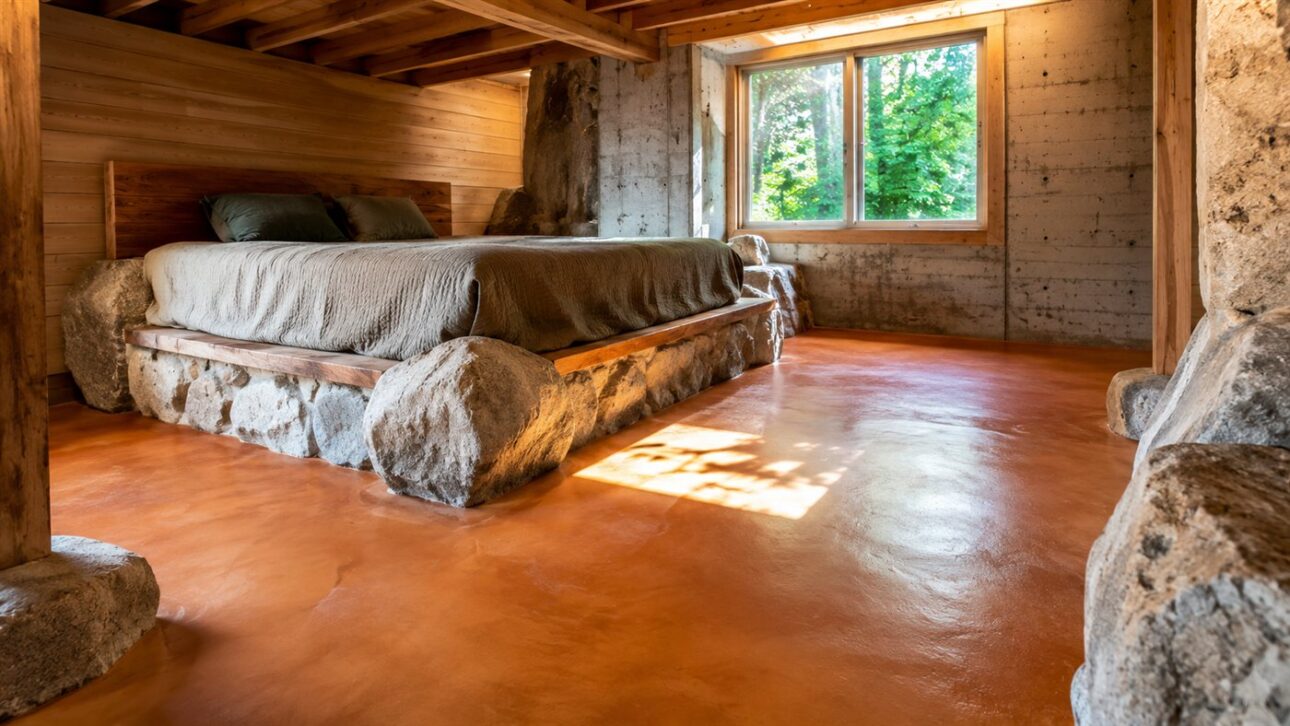
The stone bed’s room received a floor to match. According to Bonus Bolts, it was the first time the creator stained a concrete floor, in a multi-step process: complete cleaning, acid wash to etch the surface, primer coat, and finally, the layer of reddish terracotta paint.
The order of operations was thought out like a puzzle. The walls were painted before the rocks were brought in, and the floor was stained with the stones already positioned, to avoid dragging heavy blocks over the fresh finish, according to Bonus Bolts. The only self-criticism recorded in the video: ideally, the bed wood should have been stained before joining it to the rocks, a lesson noted for the next project.
Custom-made for the king size mattress, without slack
The mattress slot was made with millimeter precision, perhaps too much. According to Bonus Bolts, the internal space of the bed was designed for a king size mattress of 80 by 80 inches, about 2 meters by 2 meters, and the actual mattress arrived with only 5 centimeters of slack on each side.
The mattress support came from repurposing. Leftover structural plywood nearly 3 centimeters thick, previously used as temporary flooring, became the bed base, capable of spanning the entire gap without central support, according to the Bonus Bolts channel on YouTube. The creator considered using planed and varnished cedar slats but gave up with the most honest justification in carpentry: no one will see the bottom of a bed for the rest of its life.
The manual sawmill that has been cutting the house’s wood for 20 years
Nothing in the construction came from a lumberyard. According to Bonus Bolts, the creator’s manual sawmill has been operating for over 20 years and has cut practically all the boards for the house, as well as treehouses and standalone projects, all done manually: carrying the logs, turning, lifting, and pushing the cutting cart, only the blade is motorized.
The raw material also has a story. The cedar logs came from trees felled by windstorms in the region, used before they turned into firewood, according to Bonus Bolts, who also teaches in the video how to sharpen the saw blade without dismantling it. The channel explains the choice of species: the local cedar resists decay like no other wood available there, and the older the tree, the redder and more beautiful the wood.
The pantry with live edge shelves


The same spirit took over the annex’s pantry. According to Bonus Bolts, the shelves were made from live edge planks 5 centimeters thick, sawn from various species, including hemlock, pine, and fir, with a workbench about 50 centimeters wide and shelves about 30 centimeters.
Even the hardware was repurposed. The iron brackets holding the back of the shelves came from the wooden crate of an imported machine, according to the Bonus Bolts channel on YouTube, and the strength test was done using the classic confident builder’s method: climbing on the shelf. The piece held up, and the pantry earned the informal seal of scalable furniture.
Watch the construction of the stone bed
The complete episode shows each stage of the process, from the notching of cedar beams to the precise fitting of shelves into the rock, including the staining of the floor and the sawing of logs at the manual sawmill. It’s worth the 48 minutes: it’s the kind of work that no furniture store can sell.
The stone bed embodies the spirit of the channel: transforming what the property offers, rock, fallen logs, and leftover plywood, into pieces that last generations. Tell us in the comments: would you sleep in a bed with granite legs or do you prefer the good old store-bought headboard?