Portuguese
  Spanish


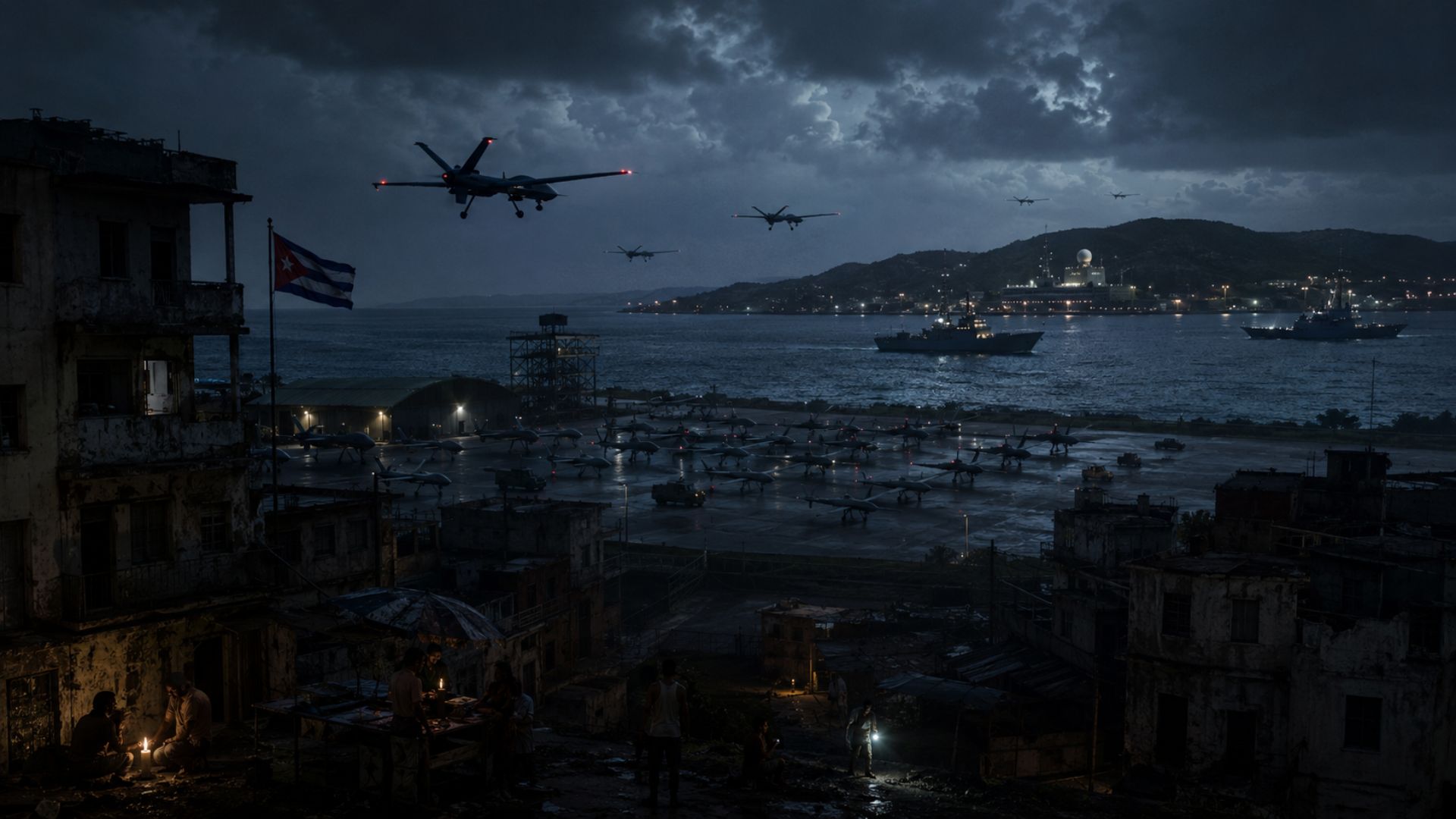

Cuba bought more than 300 military drones from Russia and Iran since 2023 and is already discussing scenarios to use them against American targets, according to a report from the Axios site based on classified United States intelligence. According to information from DW Español, the considered targets include the Guantánamo naval base, warships, and possibly Key West, Florida, 150 kilometers from Havana. A retired American Army colonel classified the number of drones as militarily irrelevant.
Cuba has entered the radar of United States military intelligence for a reason that would have been unlikely a few years ago: drones. According to a report from the American site Axios, published on Sunday (17), classified reports reveal that the Cuban government acquired more than 300 military drones from Russia and Iran since 2023, stored the equipment in strategic locations throughout the island, and has already initiated internal discussions on how to use them against United States targets, including the Guantánamo naval base, American military vessels in the Caribbean, and possibly Key West, in southern Florida, just 150 kilometers from Havana.
The revelation comes at a time of accelerated deterioration in the relationship between Washington and Havana. Trump administration officials told Axios that the concern goes beyond the number of drones: what alarms is the presence of Iranian military advisors in Cuba, the learning of drone warfare tactics brought by Cuban soldiers who fought for Russia in Ukraine, and the fact that the island continues to serve as a platform for Russian and Chinese electronic espionage installations. Cuban President Miguel Díaz-Canel responded by affirming Cuba’s right to self-defense and warning that a potential American attack would provoke “a bloodbath.”
What American intelligence revealed about Cuba
The report obtained by Axios indicates that Cuba has been acquiring attack drones of “varied capabilities” since 2023, supplied by Russia and Iran. Last month, Cuban authorities sought even more drones and military equipment from Russia, according to intelligence interceptions cited by the publication. The drones are spread out in strategic locations across the island’s territory, although the exact type has not been officially detailed.
-
Pennsylvania Mine Creates Ice in Summer Heat and Melts in Winter, Turning a Mountain Crevice into a Reverse Natural Refrigerator

-
China Accelerates Global Expansion of Robotics: From Smart Vacuums to Industrial and Humanoid Machines, Millions Exported to Over 150 Markets
-
Polar Air Mass to Hit Brazil: Temperatures to Plummet in Nine States, Near Freezing in the South with Frost Risk Until Monday
-
Chinese “dark factories” produce electric cars 24/7 with minimal human intervention, as Zeekr assembles 800 units daily, raising concerns in Brazil.





Military analysts point out that the models likely resemble the Iranian Shahed-136 or the Russian variant known as Geranium, the same used by Russia against Ukraine and by Iran in the Middle East. The export cost of each Shahed is estimated between 20,000 and 50,000 dollars, meaning the entire batch could have cost between 6 and 15 million dollars, an affordable amount even for Cuba’s devastated economy.
Guantánamo, ships, and Key West as possible targets
According to Axios, American intelligence intercepted internal discussions where Cuban officials evaluated scenarios for using the drones against three categories of targets: the Guantánamo naval base, American military vessels in the Caribbean, and potentially, facilities in Key West, Florida. Cuba is only 150 kilometers from the southernmost point of the continental United States, a distance that places medium-range drones within operational range.
The American publication also highlighted that Cuban intelligence officials are “trying to learn how Iran resisted the United States,” according to the interceptions. The presence of Iranian military advisors in Havana reinforces this line of cooperation. However, analysts interviewed for the report emphasize that Cuba does not have the capability to close the Florida Strait or to reproduce anything comparable to the missile crisis of 1962.
Cuba’s reaction and the rhetoric of self-defense
President Díaz-Canel publicly reacted to the revelations. In a statement, he affirmed Cuba’s right to self-defense and warned that an American aggression would result in extreme violence. Cuban Foreign Minister Bruno Rodríguez was more direct on social media: he classified the report as a “fraudulent dossier” fabricated to justify “the ruthless economic war against the Cuban people and the eventual military aggression.”
The rhetoric of resistance is not new in Cuba. The government has maintained for decades the narrative that an American invasion is imminent and uses this threat to justify internal control measures. According to Cuban writer and journalist Amir Valle, the current strategy serves two objectives: to position Cuba as a victim before international public opinion and to generate enough fear among the population to maintain cohesion around the regime, even under conditions of economic and energy collapse.
Are the 300 drones really a threat?
The retired American Army colonel Manuel Superviel, former advisor to the United States Southern Command, was emphatic: the 300 drones are militarily irrelevant. In modern warfare, like the one unfolding in Ukraine, attacks involve thousands of drones in a single operation and the Ukrainian capability, today considered the most advanced in the world in this type of weaponry, operates on an incomparably larger scale.
Superviel classified the acquisition as a propaganda tool, not a combat tool. According to him, Cuba’s goal is to create the perception of a threat to scare American public opinion and attract media attention, not to confront the Southern Command. The assessment is shared by other analysts: Cuba lacks the logistical, aeronautical, and command and control capacity to sustain any military operation against the United States. The real threat, according to experts, lies in the electronic espionage that Russia and China conduct from facilities on the island — and the possibility that drones supplied by Russia and Iran serve as a pretext for an American military escalation against Cuba, with Guantanamo at the center of the tension.
The island that buys drones while the people live without power


The contrast between the acquisition of military drones and the daily reality in Cuba is stark. The island’s power grid suffered another partial collapse last week, leaving most of the population without electricity for 20 hours or more per day. Cuba faces shortages of food, medicine, drinking water, and fuel at levels analysts describe as the worst since the Special Period of the 1990s.
While millions of Cubans struggle to survive, the government invested between 6 and 15 million dollars in drones that an American colonel considers useless. The priority given to military cooperation with Russia and Iran, to the detriment of the population’s basic needs, is pointed out by critics as evidence that the regime prioritizes its own political survival over the people’s well-being. Valle summarized the situation: Cuba is using the narrative of an external threat to buy time and avoid the internal collapse that seems increasingly inevitable.
Do you think Cuba represents a real threat to the United States with these drones, or is the story being used as a pretext by both sides? What catches your attention the most: the purchase of the drones, the situation of the Cuban people, or the presence of Russia and Iran on the island? Tell us in the comments.