Portuguese
  Spanish


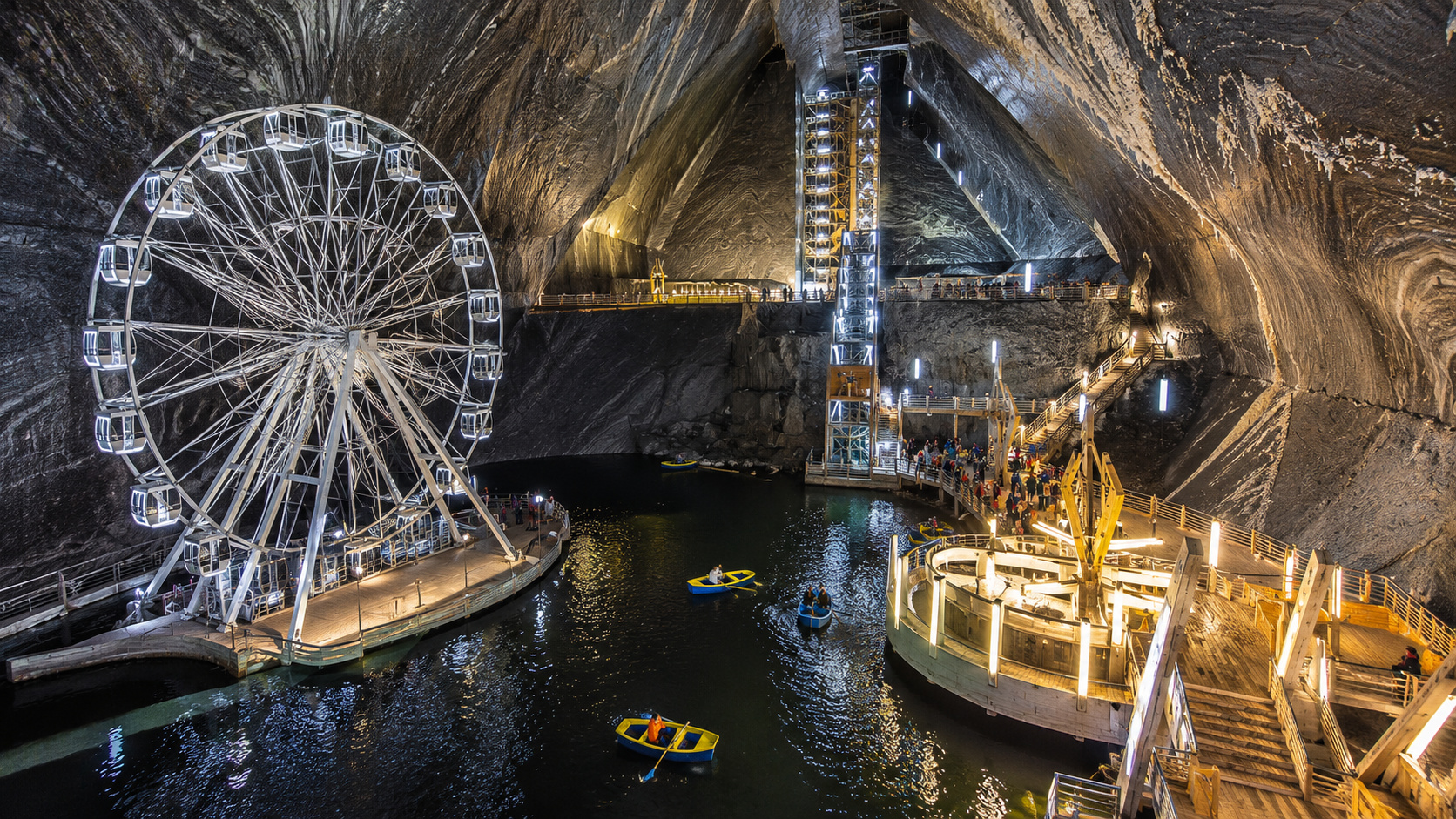

Salina Turda shows how an old salt mine in Romania became an underground park, with a Ferris wheel, internal lake, and walkways in chambers opened by mining, creating a rare example of architectural reuse, underground tourism, and utilization of a mineral infrastructure that previously had another function.
An old salt mine in Romania ceased to be just a space related to mineral extraction and started functioning as an underground attraction with a Ferris wheel, internal lake, and walkways.
The information was released by Salina Turda, the official site of the Romanian underground tourist complex. The case draws attention because it combines mining, architecture, and leisure in one place, without turning the mine into an artificial setting.
The impact lies in the use of the very void left by mining. The giant chambers, once linked to extraction work, now receive visitors in a subterranean environment designed for public circulation.
-
Seen from space, an astronaut captures in Canada a geometric carpet of crops drawn over the backdrop of a ghost lake that disappeared 12,000 years ago, was once larger than all the Great Lakes combined, and left a scar of fertile mud that still sustains agriculture.

-
Billionaire says the most valuable skill will help overcome job elimination caused by AI, following Bill Gates’ fears

-
A Dutchman created a ‘box’ that makes trees grow in the desert almost without water and without irrigation: the invention has already brought seedlings to dozens of countries and achieves up to 90% survival where common planting did not exceed 10%.

-
Abandoned warehouse hid a giant collection of rare computers, with over 2,000 artifacts from the 1930s to the 1980s.




An old salt mine became an underground park without erasing its mineral origin
Salina Turda is not a hidden underground mall, nor a metro station, nor an ancient buried city. The strength of the place lies in another point: a structure created by mining began to host leisure.


The former salt extraction opened large cavities within the earth. These areas formed wide, deep, and striking spaces, which could later be adapted for visitation.
This type of transformation shows a different way of looking at old industrial structures. Instead of abandoning the mine or hiding its origin, the project uses the very mineral history as part of the experience.
The Ferris wheel inside the mine creates the strongest visual hook of Salina Turda
The presence of a Ferris wheel inside a salt mine is the element that most draws attention. The contrast is immediate, as this type of attraction is usually found in open parks, tourist areas, and outdoor spaces.
Inside Salina Turda, the Ferris wheel changes the visitor’s perception. It helps reveal the scale of the chambers and reinforces the sensation of being in a park installed in an unusual environment.
The attraction functions as a point of reading the space. The visitor does not just observe a ride. They perceive the height, depth, and size of the cavity created by mining.
Internal lake and walkways transform the mining void into public circulation
The internal lake enhances the experience within the old mine. It creates an area for staying and contemplation, without erasing the mineral appearance of the environment.
The walkways fulfill an essential function. They organize the visitor’s path, guide circulation, and help make the former cavity more comprehensible for those entering the space.
In a repurposed mine, walking safely is a central part of the project. The visitor needs to circulate through prepared areas, with clear paths and well-defined observation points.
Lighting, humidity, and ventilation are central challenges in an underground attraction
Transforming a salt mine into an underground park requires more than installing attractions. An environment below the surface has different conditions from a common construction.
The lighting needs to allow good vision but also preserve the visual strength of the chambers. Too much light can detract from the environment. Too little light can hinder circulation.

Humidity and ventilation also require constant attention. In underground spaces, the air, surfaces, and equipment need to function safely to accommodate visitors.
Salina Turda reinforces the value of architectural reuse in industrial structures
The Salina Turda, official site of the Romanian underground tourist complex, presents the space as a leisure area installed within the old salt mine. The information reinforces the site’s role as an example of adapting a mineral infrastructure.
This type of architectural reuse shows that an industrial structure can gain a new function without losing its identity. The mine remains visible but starts to receive another type of human presence.
The result does not depend solely on visual curiosity. It also shows how spaces once linked to heavy labor can be converted into public areas for visitation, leisure, and memory.
Why the old salt mine in Romania draws attention in underground tourism
The old salt mine in Romania stands out because it combines a real mining environment with easily understandable attractions. Ferris wheel, indoor lake, and walkways are simple elements to understand, but they take on another dimension inside the underground chambers.

This contrast helps explain the fascination around Salina Turda. The visitor enters a structure created to extract salt and finds a space adapted for leisure, observation, and circulation.
The transformation also shows a possible path for old infrastructures. The void left by mining doesn’t need to be just abandonment. It can become a public underground space, as long as it is treated with safety, conservation, and respect for the origin of the place.
Salina Turda shows that an old mine can gain new life without losing its history. What was once a mineral extraction area has become an underground park with strong visual appeal.
This transformation raises a simple and powerful question: if a salt mine can become a public attraction underground, what other abandoned industrial spaces could also gain a new function?