Portuguese
  Spanish


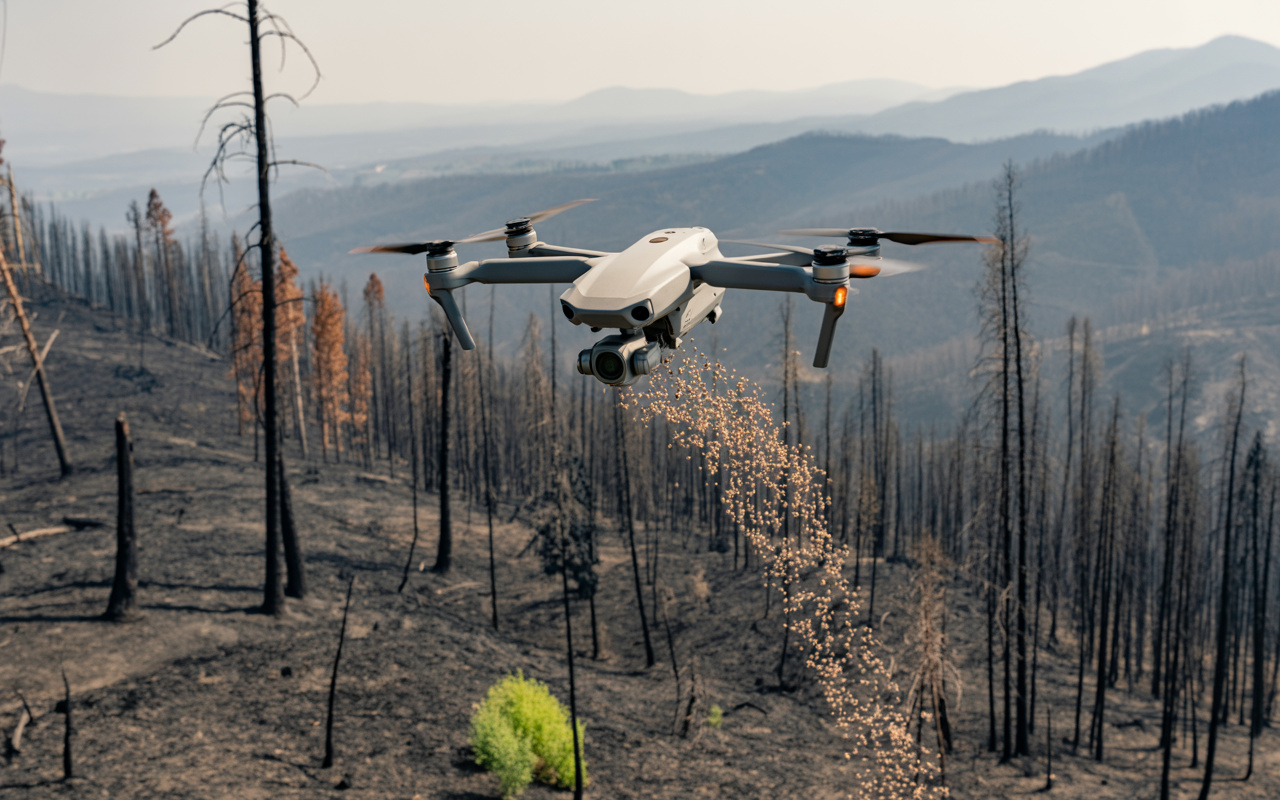


Drones Launch 400 Thousand Seeds/Day to Restore Burned Forests in the U.S. and Accelerate the Return of Pines, Insects, and Birds After Mega-Fires.
The image may seem futuristic: small drones slowly crossing the sky over blackened landscapes, releasing biodegradable capsules filled with seeds and nutrients. But it is real and documented. Since 2019, especially after exceptional fire seasons in the U.S., aerial reforestation systems have been tested and applied in severely degraded areas — and some can launch up to 400 thousand seeds per day. The goal is ambitious: to accelerate the regeneration of ecosystems that would take decades to recover on their own.
Fires That Changed the Landscape and Local Climate
The U.S. is undergoing a phase where mega-fires have become more frequent, long-lasting, and intense. States like California, Oregon, and Washington have already recorded seasons where millions of hectares were affected.
In some incidents, such as the 2020 season, smoke covered entire cities and crossed the country. When the fire goes out, what remains is rarely an easy recovery scenario: hydrophobic soils, charred trunks, absence of pollinators, silted rivers, and a heightened risk of erosion.
-
7-Year-Old Girl Rejects Lollipop, Questions Sugar’s Impact on Teeth, and Launches Sugar-Free Brand Now in 25,000 U.S. Stores

-
Scientists Find Regular Activity Can Mitigate Alzheimer’s Impact, Even in Genetically High-Risk Individuals, Offering Strong Evidence for Cognitive Protection and Healthy Aging

-
Exploring Nazareth: Uncovering the Historical Setting of the Annunciation, Not Proving a Biblical Miracle
-
Former Student Returns to Teach Over 100 Children in São Paulo How PET Bottles Can Help Protect the Oceans



It is in this “day after” that the use of drones gained momentum. The goal is not to replace the work of nurseries, firefighting teams, and traditional reforestation, but to add speed — something crucial when erosion, rainfall, and biological invasions can compromise the return of native vegetation.
How Aerial Reforestation with Drones Works
The technology is not limited to randomly scattering seeds from the sky. Companies and universities studying the topic utilize three technical pillars:
- Mapping and Terrain Analysis — drones equipped with LiDAR sensors and multispectral cameras collect data on slope, moisture, and thermal damage.
- Seed “Bullet” Formulation — biodegradable capsules mix seeds, organic compounds, biofertilizers, and germination stimulants.
- Targeted Dispersion — software selects points with a higher chance of success, such as gaps in the charred canopy, areas of exposed soil, and edges of ravines.
With this, in a single day of work, a group of drones can launch hundreds of thousands of capsules, something unfeasible at the same pace using only manual techniques. There are cases where the devices land to recharge and return to the exact coordinate where they stopped, ensuring uniform coverage.
What Life Returns First After the Fire
Although the public associates forests with trees, the ecological basis of recovery involves many other organisms. Without insects, pollinators, soil microorganisms, and small vertebrates, vegetation struggles to establish itself. Aerial replanting attempts to rebuild this chain from the beginning, which is why the capsules rarely carry just one species of seed.
Mixtures may include native pines, nitrogen-fixing species, plants that increase soil moisture, and flowers that attract insects. The return of insects creates the food that attracts small birds, which in turn spread more seeds. Bit by bit, the charred landscape ceases to be an ecological desert and begins to present mosaics of recovery.
Why 400 Thousand Seeds Per Day Can Make a Difference
In intensely burned areas, the soil seed bank is often destroyed. This means that, unless something is added, vegetation may return slowly, fragmented, and more vulnerable to pests and erosion. The scale — 400 thousand seeds per day — is precisely what allows vast areas to be covered quickly, taking advantage of the short window between the end of the fire season and the beginning of the rains.
It is important to clarify that not all seeds germinate, and among those that do germinate, not all become mature plants. The success rate depends on the species, climate, soil microbiota, and the presence of herbivores. Still, the density of dispersion increases the likelihood of significant ecological return.
What Researchers Are Saying and Challenges Ahead
American and Australian researchers studying post-fire reforestation point out that the technique is still evolving and that long-term data is essential. Total recovery of a forest does not occur in months — it can take decades. Even so, initial studies show that drones can facilitate the initial establishment of pioneer plants, reducing erosion and creating micro-habitats for fauna.
There are still technical debates about which species should be reintroduced first, how to avoid invasive plants, and how to ensure genetic diversity. There are also logistical issues: many national parks in the U.S. require specific permits for flight, use of autonomous aircraft, and introduction of seeds.
Restoration of Ecosystems — And Not Just Trees
The public narrative about reforestation often focuses on tree planting, but the issue is broader. The real goal is to restore hydrological cycles, soils, insects, birds, carbon flow, and ecological stability. In a burned forest, planting only trees can result in a depleted and fragile environment. Therefore, advocates of aerial replanting refer to functional restoration, not just aesthetic.
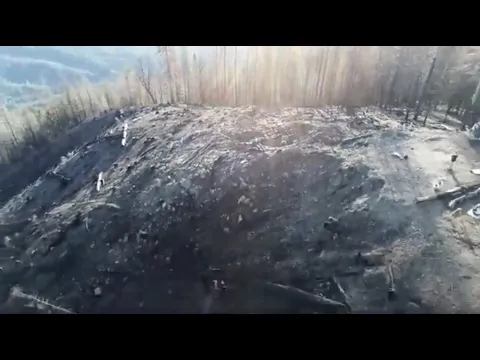
When, after a few years, an area ceases to be exposed soil and returns to having flowers, insects, and small birds, the ecological return is already in progress, even if the pines do not yet form a closed canopy. This helps to contain runoff, feed pollinators, reduce atmospheric dust, and stabilize local temperature.
And the Future?
In the U.S., the technique continues to advance because there is a real urgency. Each recent fire season reignites the alarm about climate risk. It is not a miracle solution, but an attempt to buy time against ecological collapse in vast burned areas.
If the experiment proves successful on a large scale, the sight of drones flying over charred forests may become common worldwide — especially in regions where fire has already become annual. The real question is: how long will it take for ecosystems to recover not only their trees but also their sounds?
Silence, ashes, and then seeds. This is how science tries to write the next chapter of burned forests.