






 Portuguese
  Spanish




Tobacco Companies Spread Cigarettes in Hospitals and the Media in the 1940s and 1950s, Used Doctors and Cultural Icons, and Opened an Influence Battle That Changed Strategic Reading
Cigarettes occupied spaces that today seem unlikely. In the 1940s and 1950s, smoking was treated as a sign of elegance, relaxation, and even self-care.
The presence was constant and institutional. The product appeared in military rations, offices, commercial airplanes, and inside hospitals, creating a normalization that pushed the habit to the center of social life.
When Smoking Seemed Harmless
Tobacco advertising relied on clean images, gentle rhetoric, and authority figures. The strategy was to transform risk into routine and sell tranquility as if it were protection.
-
Bruno Guimarães, 28, Misses Crucial Penalty Against Norway in World Cup After Replacing Vinicius Jr.

-
Inspired by a school lesson on Africa’s water crisis, a young boy raised money through chores to fund a well that transformed a Ugandan community.

-
Brazilian Construction Worker Moves to France, Earns Up to €2,500 Monthly with Home Renovations, Gains Social Media Attention

-
US Navy Sinks USS Oriskany with 230 kg of C-4, Creating World’s Largest Artificial Reef in 37 Minutes





This movement consolidated influence on a large scale. In a wartime and post-war context, the message functioned like a chess piece on the social board, reducing resistance and increasing acceptance.

A Mascot Circulated in Hospitals in 1948
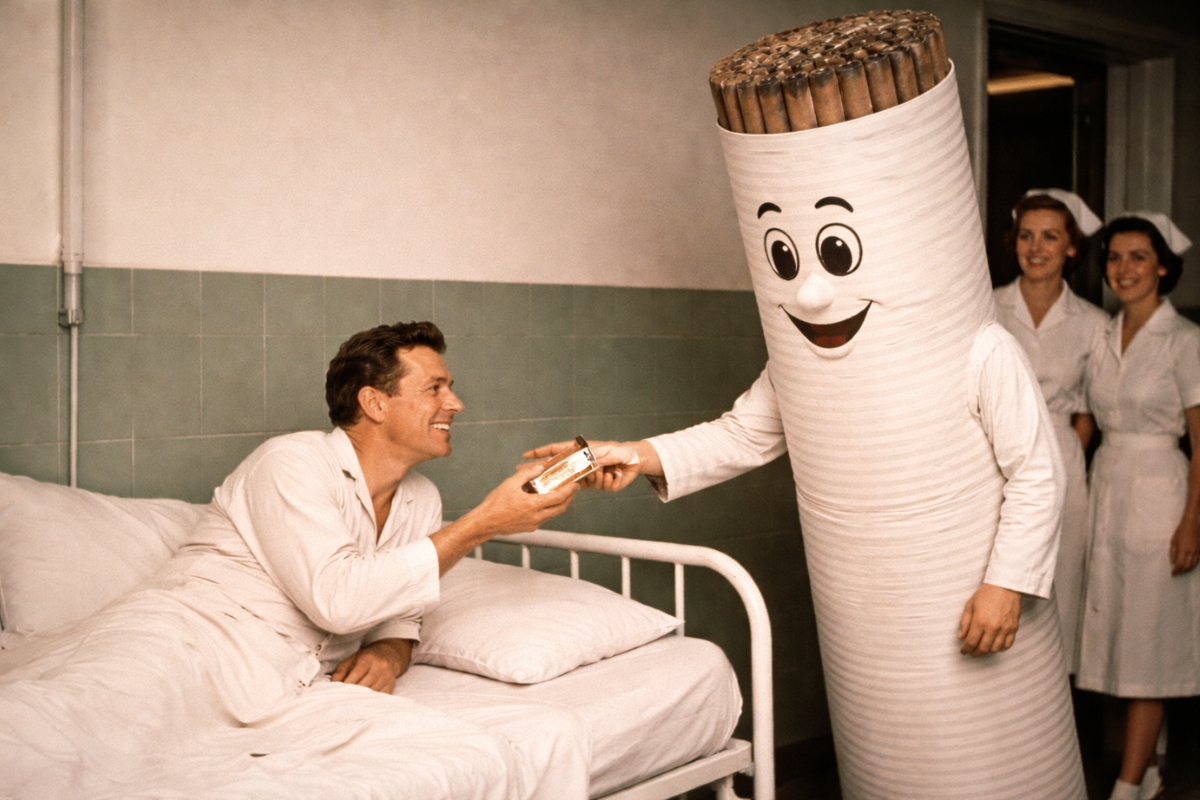
In 1948, a character dressed as a cigarette, known as Mr. Cig, toured hospitals distributing free cigarettes to patients. The action aimed to associate the act of smoking with recovery, comfort, and well-being.
Today, the scene sounds absurd, but at that time it was seen as a common practice. Some current images may be digital recreations, without altering the central fact that there were real campaigns for distribution in healthcare settings.
Lab Coats Became a Sales Tool in 1946
In 1946, R.J. Reynolds launched the campaign with the phrase More Doctors Smoke Camels Than Any Other Cigarette. The action exploited research conducted at medical events to create an appearance of scientific endorsement.
Other brands followed the same path, citing studies and promising less irritation in the throat and nose. The logic was straightforward: the image of the doctor functioned as a seal of trust and expanded influence.
Science Began to Press the System
Scientific advancements began altering the landscape. In 1947, an article linked smoking to lung cancer. In 1950, studies in the United States and the United Kingdom consistently reinforced this relationship.
In 1953, JAMA stopped accepting cigarette advertising and banned tobacco company presence at AMA events, signaling that the scientific radar was already active.

Rules Advanced and Advertising Retreated
In 1955, the FTC classified as false and misleading ads suggesting health benefits. In 1957, a report from Surgeon General Leroy E. Burney acknowledged increasing evidence linking excessive consumption to lung cancer.
Pressure increased in the following years. In 1964, the report Smoking and Health officially linked tobacco to death and disease. In 1965, the Federal Cigarette Labeling and Advertising Act began requiring warnings on packages, while the United Kingdom banned cigarette ads on television.
The Battle Migrated to the Point of Sale
With bans on radio and TV, companies shifted resources to magazines, newspapers, and billboards. Later, the focus concentrated at the point of sale, the final line of influence before purchase.
According to the WHO, the United Nations health agency, complete advertising bans reduce consumption, explaining why the strategy began to seek loopholes and new formats.
Frauds Exposed and Forced Corrections
In 2006, a federal court in the United States declared major tobacco companies guilty of organized fraud, concluding that they deceived the public about risks, secondhand smoke, and the addictive nature of their products. In 2017, they were required to publish corrective statements.
The story of Mr. Cig shows how presence and influence advanced into hospitals when the narrative dominated the environment. It was a game of image, authority, and repetition, with a profound impact on collective behavior.
What was seen as normal became unthinkable. This turnaround reshaped rules, altered strategies, and keeps the region under constant pressure, a movement that changes strategic reading.





