Portuguese
  Spanish


FAO and World Meteorological Organization report reveals that extreme heat is already threatening food production and the livelihoods of more than 1 billion people worldwide. Each degree of global warming reduces the harvest of the four main crops on the planet by about 6%, and the intensity of extreme events could quadruple if the temperature rises 3 degrees.
The global food production is being pushed to the limit by extreme heat, and the numbers from the latest report by the UN’s food and meteorology agencies leave little room for optimism. According to the document published by the FAO and the World Meteorological Organization, each increase of one degree in the average global temperature reduces the production of the four main crops in the world—corn, rice, soybeans, and wheat—by approximately 6%. This data is alarming because global warming is accelerating: 2025 is among the three hottest years on record.
The report goes beyond harvest statistics and touches on an issue that directly affects the lives of those who work in the field. Kaveh Zahedi, head of the FAO’s climate change office, stated that extreme heat is rewriting the script on what farmers, fishermen, and foresters can grow, when they can grow it, and in some cases, whether they can still work. More than 1 billion people depend on agri-food systems that are already operating under increasing thermal pressure, and the safety margin on which plants, animals, and humans depend to function is shrinking.
How extreme heat reduces the production of the main crops on the planet
According to information released by the portal g1, the relationship between temperature and agricultural yield follows a curve that has a clear breaking point. The productivity of most major crops drops significantly when temperatures exceed about 30°C, the threshold beyond which essential biological processes such as photosynthesis and pollination are impaired. Above this level, each additional degree disproportionately intensifies losses.
-
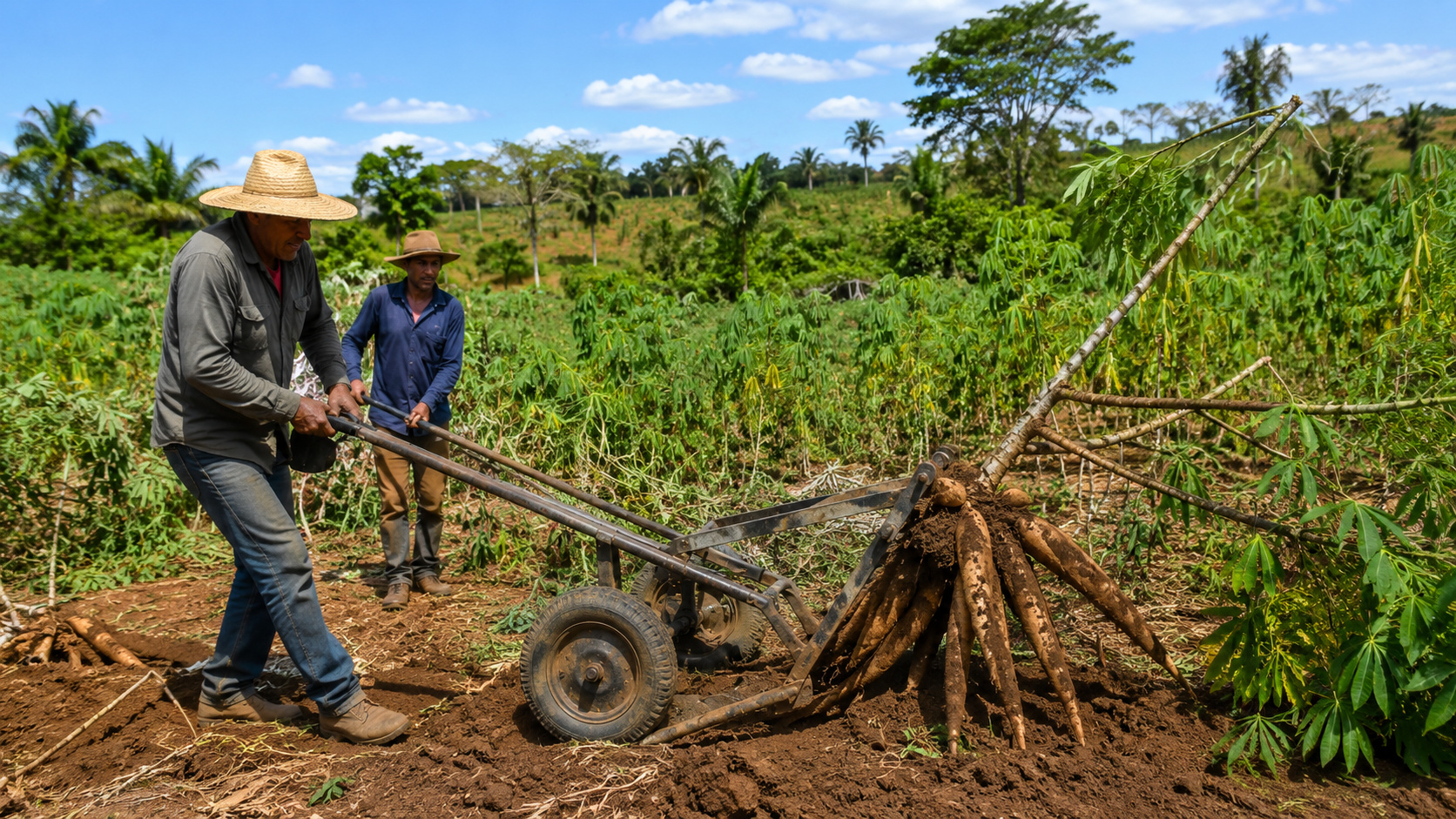
Brazilian Farmers Develop Wheeled Metal Lever to Ease Cassava Harvesting Without Heavy Machinery

-
Study of Brazil’s Tietê River Finds 25 Pesticides in Water, Including Cancer-Linked Substance Near Source
-
Young Entrepreneur Expands from 50 to 1,400 Chickens, Proving “Happy Hens” Can Be a Viable Business
-
Small Farm in Brazil’s Minas Gerais Produces 403 Liters of Milk Daily, Sets Benchmark for Rural Producers


The case of Morocco illustrates what happens when extreme heat combines with prolonged drought. Six consecutive years of drought followed by record heat waves led to a decline of more than 40% in the country’s cereal production, as well as devastating olive and citrus harvests. For Zahedi, the Moroccan example is not an exception but a sign of what could become routine in vulnerable agricultural regions around the world if warming continues at the current pace.
What happens to food production if the temperature rises 2 or 3 degrees
Risks increase non-linearly as global warming progresses. According to the report, the intensity of extreme heat events approximately doubles at 2°C of warming and quadruples at 3°C, compared to the 1.5°C scenario that the Paris Agreement set as a goal. This means that the difference between 1.5°C and 3°C is not just numerical: it separates scenarios of possible adaptation from scenarios of agricultural collapse in entire regions.
For the production of corn, rice, soybeans, and wheat, the math is straightforward. If each degree reduces yield by 6%, a warming of 2°C would represent a loss of 12% in the global harvest of these crops, and a 3°C scenario would reach 18%. These numbers do not consider the combined effects of drought, pests, and soil degradation, which tend to intensify simultaneously with heat, creating a multiplier effect that agricultural models still struggle to quantify accurately.
The oceans are also suffering and fishing is affected
The impact of extreme heat is not limited to land. Marine heat waves are becoming more frequent, reducing oxygen levels in the water and threatening fish stocks that feed hundreds of millions of people around the world. In 2024, 91% of the oceans experienced at least one marine heat wave, according to the report from the FAO and the UN.
The rise in water **temperature** compromises the marine food chain from its base, affecting phytoplankton and reducing nutrient availability for commercial species. **For coastal communities that depend on fishing as a source of income and protein, the combination of warmer oceans and declining stocks represents an existential threat** that adds to the problems faced by terrestrial agriculture. The report treats both phenomena as parts of the same problem: thermal pressure on the systems that feed humanity.
What the UN proposes to protect food production in the face of heat
The **FAO** and the World Meteorological Organization state that the fragmented responses adopted so far are inadequate. **The report calls for better governance of climate risks and early warning weather systems that allow farmers to adjust their planting and harvesting decisions** before heat causes irreversible damage. Zahedi emphasized that if climate data reaches **farmers** in time, they can choose what to plant, when to plant, and when to harvest with greater certainty.
However, the document is clear in stating that adaptation alone does not solve the problem. **The only lasting solution to the growing threat of extreme heat to global food production is ambitious and coordinated action to curb climate change at its source**, by reducing greenhouse gas emissions that fuel global **warming**. Without this structural action, early warning systems and adaptation techniques will be insufficient to offset losses that increase with each additional degree of **temperature**.
Have you noticed the effects of extreme heat on food production or the price of what you buy at the supermarket? Tell us in the comments if the reality described by the UN report makes sense in your region and what you think should be done to protect agriculture.