Portuguese
  Spanish


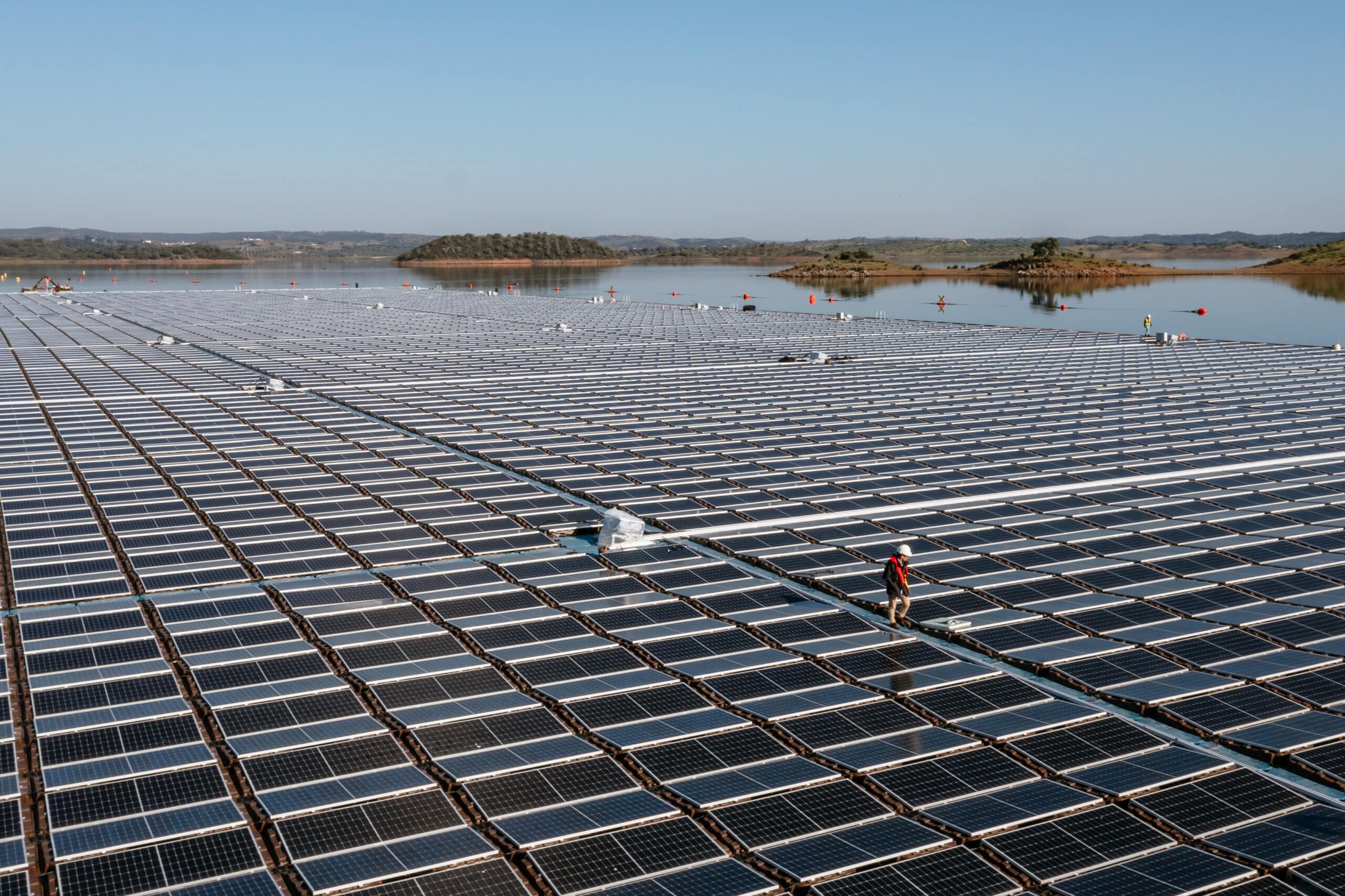

EDP Completed Its Floating Solar Plant in Portugal, Capable of Generating 7.5 GWh Per Year. The Project Has 12,000 Solar Panels, Serving 30% of the Region’s Population.
EDP inaugurated, in southern Portugal, more precisely in Alqueva, what could be the largest floating solar plant project installed in a European hydroelectric reservoir. With about 12,000 panels covering 4 hectares, equivalent to 0.016% of the lake’s total area, EDP’s new solar panel platform has a capacity of 5 MW and can produce approximately 7.5 GWh annually, potentially supplying more than 30% of households in the Portel Moura and Moura region.
EDP’s Floating Solar Plant Features 12,000 Solar Panels
The platform that supports the solar panels is made from recycled plastic combined with cork composites, reducing the platform’s weight by 15%, in addition to enhancing the mitigation of CO₂ emissions from the project by about 30%.
In total, EDP installed 12,000 solar panels in its floating solar plant, with a power output of 5 MW and the capacity to produce around 7.5 GWh annually, which is equivalent to the consumption of about one-third of households in the region. The platform, which covers an area of four hectares, was inaugurated last Friday (15).
-
Engie Secures 10-Year Use of 625 MWh in Batteries to Store Excess Solar and Wind Energy in Spain by 2028

-
Giant Batteries Take Center Stage in Chile Auction as Company Offers 960 GWh of Solar Energy for Nighttime Use, Aiming to Stabilize Solar Power Supply
-
After a Year of Success in Switzerland, Solar Railway Attracts Italy’s Interest for Clean Energy Transformation
-
Robots Clean Solar Panels in Desert Power Plants Without Water, Preventing Energy Losses


This is the second floating solar plant built in Portugal, following EDP’s pilot project at the Alto Rabagão dam. The solution, which is being tested for the first time, is the result of a partnership with Corticeira Amorim and Isi Genere, a Spanish company responsible for manufacturing the float. A battery system, with a nominal power of 1 MW and a storage capacity of approximately 2 MWh, is also planned for installation.
EDP Plans to Invest in Innovation and Fully Clean Technologies
The company’s technologies will use a single connection point to the existing grid, promoting the optimization and efficiency of assets while reducing environmental impacts.
The projects are part of EDP’s plan to invest in innovation and fully clean renewable technologies by 2030. According to EDP Renewables CEO Miguel Stilwell d’Andrade, floating solar technology, in which EDP is a global pioneer, is a remarkable advancement in the expansion of renewable energies and in promoting the decarbonization process.
According to the executive, the hybridization strategy, combining water, wind, and solar energy, is the direction of the group’s energy investments. EDP’s CEO stated that Alqueva is currently an example of innovation and sustainability that the company will soon reinforce with the new project gained in the first floating solar plant auction in Portugal.
Company Plans to Build More Than 60 Solar Plants
Recently, EDP announced a global partnership to build up to 100 MWp of solar energy at Faurecia units, a company of the Forvia group, in Asia, the United States, and Europe.
The company’s projection is to build more than 60 self-consumption solar power parks in the multinational’s factories in Portugal, Italy, Spain, the United States, South Korea, China, Japan, and Thailand by the end of next year.
The parks are expected to total up to 200,000 solar panels, in the Energy as a Service (EaaS) model, where the consumer pays for an energy service without needing to invest in infrastructure.
The project is the company’s largest undertaking in terms of distributed solar energy and the first to be installed with the same partner on different continents simultaneously.