






 Portuguese
  Spanish


Egypt Is Developing a New Mega Project That Promises to Significantly Reduce Hunger in the Country. This Initiative Has the Potential to Transform Egypt Into the Largest Fish Producer in the World, Strengthening Its Position in the Global Food Market and Contributing to Regional Food Security.
A report released by the UN in 2021 revealed an alarming scenario: after five years of relative stability, hunger in the world jumped significantly in 2020. According to the document “The State of Food Insecurity and Nutrition in the World in 2020,” prepared by five UN agencies, up to 811 million people faced hunger in 2020 alone. In response to this global crisis, Egypt initiated an ambitious Mega Project that could transform the country into the largest fish producer in the world, offering an innovative solution to combat hunger and promote food security.
How the Mega Project in Egypt Began?
In the last century, Egyptian authorities decided to diversify food sources and realized that, due to climate change and human activities, the flow of water from the Nile River was becoming increasingly diminished and pollution levels were rising.
Worrying data, since Egypt depends on the River for over 80% of its water needs, including a large part for agriculture and livestock.
-
France Revamps 530 Social Housing Units with Large Balconies and Glass Facades Without Demolishing Existing Buildings

-
10-Year-Old Max Makes History with Paris Fashion Show, Launches Own Brand, Hires Staff, and Sets World Record as Youngest Runway Designer

-
Bolivian Female Construction Workers Form Association to Combat Discrimination and 38% Pay Gap in the Industry
-
Near Amsterdam, residents buy land and discover they must also build streets, manage drainage, handle waste, and grow food on half their plot.





This population increase is not recent and has been a problem for decades, causing Egyptians over the years to use more chemical fertilizers, further depleting the soil and reducing grazing areas for livestock.
For these reasons, they launched a major campaign to develop the fishing industry, promoting sustainable sources and proteins for the population.
In 1970 the Egyptian government proposed a mega project to accelerate the development of the sector. By the end of this campaign, in the mid-1980s, annual fish production jumped from 17 thousand tons to 48 thousand tons, making the country the largest fish producer in the world.
During this period, four large fish hatcheries, six tanks, and five juvenile fish collection tanks were built. In a relatively short time, Egypt succeeded in diversifying its food resources while also generating thousands of jobs in the sector.
Project That Transformed the Country Into the Largest Fish Producer in the World Began in 2017

But despite the efforts, the challenge was immense, and the country’s population has more than doubled in the last 40 years. Egypt was unable to meet its domestic fish demand until recently. So, to achieve self-sufficiency in fish production and perhaps even initiate export production, the government realized that it needed more drastic measures.
Thus, in 2017 it launched a mega project with the bold goal of constructing the largest large-scale fish production complex on the continent. However, due to its complexity, it was divided into two phases.
In the first phase, the government needed a strategic location to facilitate logistics, so they built a complex 10 km east of Port Said, a crucial port city that provides access to the Suez Canal, which in turn allows Egypt to import its goods between Europe and Asia. With the location chosen for the mega project, the preparatory process began, which included area studies, soil and rock sample analysis, and water level measurements.
What Is the Structure of the Mega Project in Egypt?
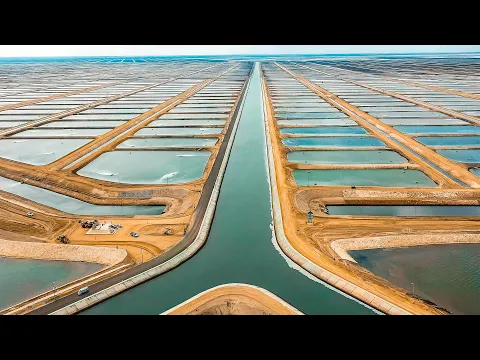
Based on this data, a gigantic project was developed, and 700 lakes occupy over 8,000 hectares, along with several docks measuring 9,600 square meters to accommodate six fishing boats over 30 meters long each.
For the construction of the artificial reservoirs, it was necessary to excavate 500 thousand cubic meters of earth, bury about 1.5 million cubic meters to create artificial banks with a total length of over 100 kilometers, and pour concrete over large surfaces totaling more than seven thousand square meters.
But for the entire ecosystem to function, it was also necessary to build a complex of auxiliary structures to ensure self-sufficiency and operational autonomy. Thus, in addition to the reservoirs, plants for fish processing, ice production, feed production and packaging, as well as several veterinary and incubation laboratories were built within the territory of the mega project.








