Portuguese
  Spanish


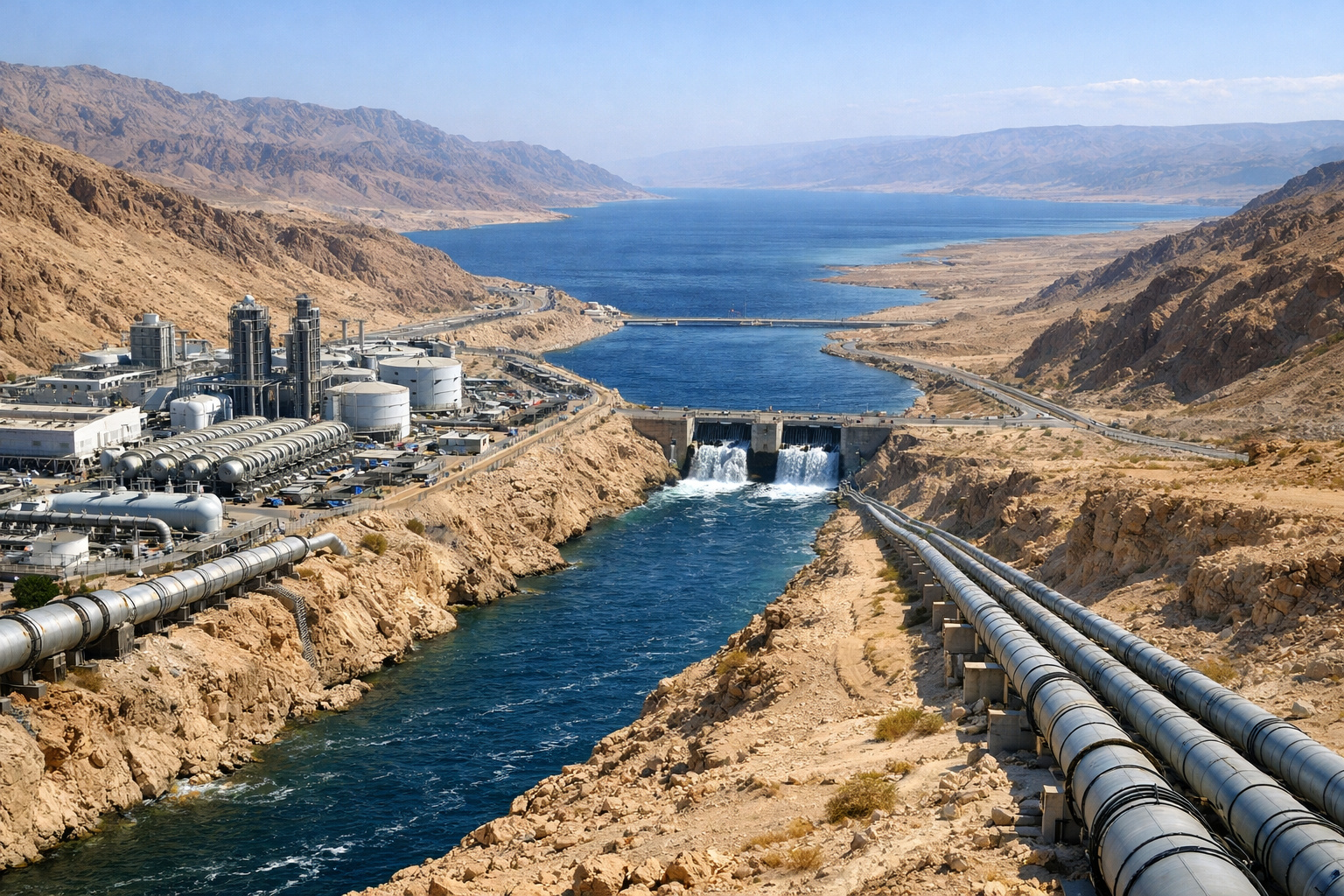

Between Extreme Evaporation, Salinity of 34%, and the Risk of Disappearance in Four Decades, Engineers Bet on Desalination, Hydroelectric Energy, and International Cooperation to Reverse the Water Crisis at the Lowest Point on Earth
The Dead Sea, located between Israel, Jordan, and Palestine, is facing an alarming decline in its water levels. Considered the lowest point on Earth, at an impressive 428 meters below sea level, this hypersaline lake is at real risk of disappearing in the next four decades. The situation worries scientists, governments, and investors, as the combination of intense evaporation and human water use has been accelerating an unprecedented environmental crisis in the Middle East.
The information was disclosed by the channel “Construction Time,” which details the complex engineering project to try to save the ancient lake by connecting it to the Red Sea, as highlighted in recent technical analyses on the subject.
Why Is the Water Level of the Dead Sea Decreasing So Rapidly?
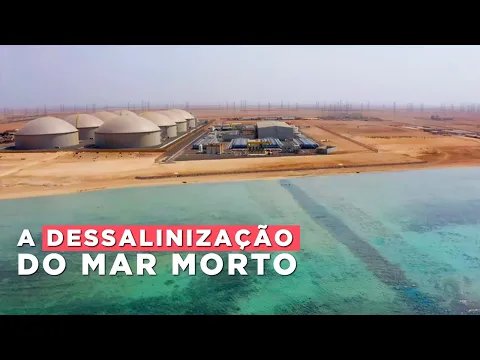

First of all, the main cause of the shrinking of the Dead Sea is the drastic reduction in the flow of the Jordan River, its largest tributary. Over the past few decades, neighboring countries have diverted much of the water for agriculture and human consumption. Consequently, the lake has ceased to be naturally replenished in sufficient volume to compensate for the extreme evaporation of the desert region.
-
European Parliament Approves Digital Euro, Aiming to Challenge Visa and Mastercard’s Dominance and Transform Payments Across Europe by 2029

-
Israel finds Hezbollah militarized tunnel over 200 meters long under village, with 4 missile launch shafts, 12 chambers, anti-tank missiles, drones, and weapons depots at a depth of 25 meters.

-
Ukraine launches largest drone attack on Moscow since 2022, Russia claims to have intercepted nearly 200 aircraft near the capital, Kapotnya refinery targeted again, and offensive reignites alert about war reaching the Russian energy heart just a few kilometers from the Kremlin.

-
Truck drivers, freight, and fines from 2022 take center stage in politics: Chamber approves MP with amnesty, mandatory tracking by CIOT, million-dollar penalties, and new minimum wage for those who spend more than 24 hours on the road.



Additionally, intensive mineral extraction contributes to the problem. Companies extracting potassium and magnesium use industrial evaporation ponds, which further accelerates water loss. As a direct result, the shoreline of the lake is receding year after year.
This retreat, in turn, causes the emergence of thousands of sinkholes. These holes have already destroyed roads, hotels, and tourist areas, compromising infrastructure and affecting the local economy based on wellness tourism.
To understand the scale of this unique and fragile ecosystem, it is essential to observe its technical indicators:
- Salinity: about 34%, roughly ten times higher than that of the oceans.
- Altitude: 428 meters below sea level, the lowest point on Earth.
- Biodiversity: limited to extremophilic microorganisms, capable of surviving in highly saline environments.
How Does the Two Seas Canal Project Work?

Given this critical scenario, the so-called Two Seas Canal has emerged, an ambitious project that aims to pump water from the Red Sea to a desalination plant in the city of Aqaba, in Jordan.
Initially, the captured water would be desalinated to supply local populations. Afterwards, the brine, a highly salty byproduct of the process, would be directed to the Dead Sea with the goal of raising its level.
Moreover, the project takes advantage of the natural drop of 428 meters to generate hydroelectric energy during the water’s descent. Thus, part of the system could operate with the support of the altitude difference itself, making the solution more energy-efficient.
However, mixing waters from different seas is not a simple decision. Environmentalists warn that introducing water from the Red Sea could alter the unique chemical composition of the Dead Sea. Consequently, there is a risk of proliferation of red algae and formation of gypsum crystals, which would change the color and transparency of the waters.
To illustrate the complexity of the operation, observe the technical comparison between the two water sources:
| Water Source | Average Salinity | Density |
|---|---|---|
| Red Sea | 4% | 1.025 kg/m³ |
| Dead Sea | 34% | 1.240 kg/m³ (body floats easily) |
Therefore, the difference in density and salinity is significant, which requires rigorous environmental impact studies before any definitive implementation.
How Much Does It Cost to Save the Lowest Point on Earth?
The estimated cost to make the canal and desalination plants viable exceeds US$ 2 billion. In addition to the high financial investment, the project depends on delicate diplomatic agreements between Israel, Jordan, and Palestine.
On the other hand, proponents of the initiative argue that the cost of inaction could be even greater. Without coordinated technical and political intervention, the Dead Sea will continue to shrink, permanently altering the geography of the Middle East and affecting tourism, biodiversity, and the regional economy.
Meanwhile, experts emphasize that the sustainable management of the Jordan River is equally essential. Without restoring the natural flow of the tributary, any solution may become merely palliative.
In Brazil, for instance, the management of water resources is monitored by the National Water Agency (ANA), which reinforces the importance of preserving watersheds. Likewise, in the international arena, the portal of the Ministry of Foreign Affairs keeps track of discussions on environmental cooperation among nations.
What Does the Future Hold for the Dead Sea?
The fate of the Dead Sea directly depends on the combination of engineering, diplomacy, and sustainability. If the Two Seas Canal project advances with environmental responsibility, it could represent a historic milestone in preserving a millennia-old geological heritage.
However, if political and ecological challenges are not overcome, the lake may continue to shrink until it reaches an irreversible point.
After all, we are facing one of the greatest water engineering experiments of the century and also a crucial test for international cooperation in times of climate crisis.
Do you think engineering can really reverse the disappearance of a millennia-old lake, or does the solution need to start with reducing water consumption in the region?