






 Portuguese
  Spanish


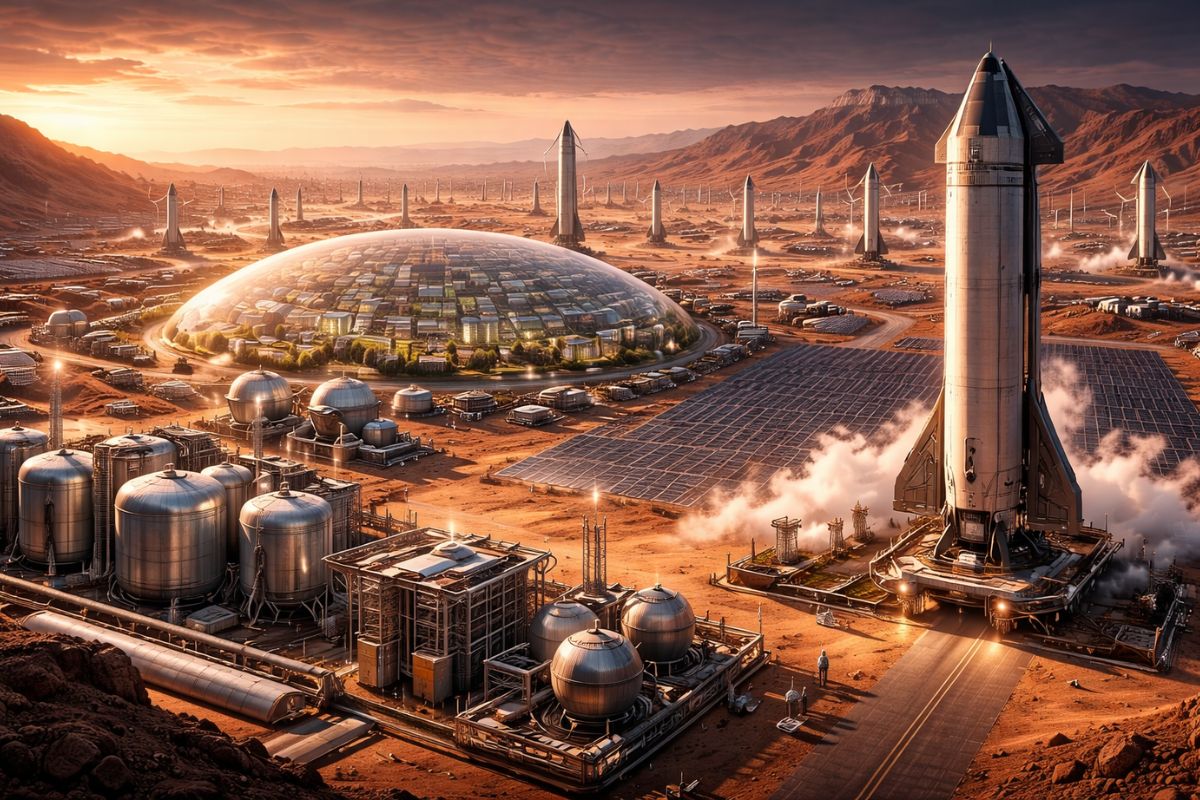

At Starbase, In South Texas, Elon Musk Turns Ambition Into Schedule: Wants 1,000 Starships, 20 Years of Launches, and Up to 100,000 People Per 26-Month Window Towards Mars. The Plan Relies on Total Recycling, ISRU, and Industrial Scale, and Reignites the Environmental Cost on Earth Right Now
Elon Musk has put numbers to what seemed like just a dream: a self-sustaining city on Mars, with one million inhabitants by 2050, supported by a fleet of about 1,000 Starships and two decades of launch campaigns. The symbolic stage for this script is Starbase, in South Texas, where a neon sign already calls the place “Portal to Mars.”
The ambition, however, has less to do with a red landscape and more with survival engineering: every liter of water, every breath, and every meal would need to function in a closed loop. And, on this side, the unavoidable question is what this project reveals about technology, priorities, and environmental cost.
The Plan in Numbers, and Why It Seems Like an Industrial Project

What distinguishes this announcement from generic promises is the way the goal is “sliced” into deliverables: Elon Musk talks about 20 years of launches, using favorable alignments between Earth and Mars to send up to 100,000 people per window, as well as millions of tons of cargo.
-
World’s Most Powerful MRI Machine in France, Weighing 132 Tons and Generating 11.7 Tesla Magnetic Field, Offers Unprecedented Clarity of the Human Brain

-
Hong Kong Converts Former Coastal Landfill into Desalination Plant Producing 135 Million Liters of Drinking Water Daily
-
Texas Teens Win $50,000 at World’s Largest Science Fair for Developing Non-Surgical Brain-Controlled Bionic Prosthesis with 98% Accuracy
-
Samsung Galaxy A27 Launches with 6.7-inch Super AMOLED Display, Full HD+ Resolution, Android 16, Six Years of Updates, Snapdragon 6 Gen 3, and Dust and Splash Resistance; Available for Pre-order in the US for $350


The idea is not a single big flight, but rather a production line with repetition, rhythm, and standardization.
The Starship emerges as the central tool because it was designed as a fully reusable super-heavy rocket, with a planned capacity to carry between 100 and 150 metric tons to low Earth orbit before refueling and heading to deep space.
Without reuse, the plan turns into a scrap and cost problem; with reuse, it becomes a scale, reliability, and cadence problem.
The 26-Month Window as a Bottleneck: When Calendar Turns to Engineering

Mars does not “wait” for human will.
The launch window mentioned by Elon Musk opens approximately every 26 months, and that turns time into a technical requirement.
If a mission delays, it’s not like missing a commercial flight; it pushes the entire logistics to the next cycle, impacting fuel, planning, and ship availability.
That’s why the talk of “flying multiple times a year” is not a rhetorical detail: it attempts to solve what the calendar imposes.
To send large fleets in each window, the operation would need to master accelerated production, rapid maintenance, and a robust supply chain, as if the space sector were trying to behave like the aviation industry, only with smaller margins for error and greater consequences.
Sustainability on Mars Is Not a Slogan, It Is a Closed System
On Mars, “sustainable city” does not mean a set of good practices, but rather the difference between existing and failing.
The planet is hostile: extremely thin atmosphere, surface pressure below 1% of Earth’s pressure, and composition around 95% carbon dioxide, with minimal traces of oxygen and water vapor.
Average temperatures are well below zero. Without a spacesuit, loss of consciousness would come in seconds.
This pushes the city into a logic of technological bubble: water circulating through filters and treatment stations, air constantly purified and monitored, organic waste feeding bioreactors and greenhouses, and continuous maintenance as routine, not as exception.
This is where the use of in situ resources (ISRU) comes in, the concept of producing on-site what would be unfeasible to transport continuously from Earth.
Oxygen, Fuel, and the Current Limit of Scale
The most revealing part of the plan is that the basic “ingredients” have already been demonstrated, but are still far from urban scale.
NASA tested a piece of the puzzle with MOXIE, a device aboard the Perseverance rover that converted Martian carbon dioxide into oxygen.
In two years, it produced about 122 grams in total, peaking at approximately 12 grams per hour. This helps to prove the chemical route, not to fuel a metropolis.
There is also research aiming at systems that would generate oxygen and methane from Martian air and water ice, with greater efficiency and dual usefulness: supporting life and as propellant. The critical point is the transition from bench to city.
The jump from “works” to “works consistently, at scale, and with redundancy” is where projects of this type are usually defined.
The Environmental Cost on Earth, and the Debate That Won’t Go Away
A plan with 1,000 ships requires metal, energy, factories, and launch bases operating for decades.
A recent life cycle assessment cited in the material indicates that construction and launches concentrate most of the emissions in the space sector, and that reusable vehicles can reduce manufacturing-related emissions by over 90% compared to disposable rockets.
At the same time, launches still represent well less than one-tenth of one percent of global carbon dioxide emissions.
The risk, according to cited warnings, is not just CO2: soot and particles in the high atmosphere during launch and re-entry can have a disproportionate warming effect and potential damage to the ozone layer if launch volume increases significantly.
Hence the clash of narratives: critics ask whether it makes sense to invest so many resources in a Martian “lifeboat” while decarbonization at the source is still stalling; defenders respond that the circularity and efficiency technologies required for Mars can accelerate useful solutions on Earth.
In the end, Elon Musk forces a practical redefinition of the term “sustainability”: on Mars, it is living within a small, fragile bubble; on Earth, it is keeping the existing bubble stable.
And the detail that “drives the result” may be less glamorous than rockets and more basic than it seems: constant energy, water circulating without losses, and oxygen produced at a reliable scale.
If you had to choose an investment focus for the next few decades, what would be your objective criterion? Would you prioritize technology for a city on Mars, or would you require the same level of engineering to be applied first to make cities on Earth more self-sufficient, especially regarding water, energy, and waste?


