






 Portuguese
  Spanish


Three teenagers from Texas created Neuroflex, a brain-controlled bionic leg prosthesis without surgery, using an EEG band. The prototype, aimed at amputees, achieved the desired movement in 98% of tests and won US$ 50,000 at the world’s largest science fair.
A prosthesis that obeys thought seems like science fiction, but it came from the hands of three high school students. In Texas, USA, the trio created Neuroflex, a bionic leg that reads brain signals through a band placed on the head and moves according to the user’s intention, without needing any surgery. The project was recognized by the Society for Science, organizer of the largest science fair on the planet.
The recognition came with weight and figures. Neuroflex received the Gordon E. Moore Award, worth US$ 50,000, one of the main prizes at the Regeneron ISEF 2025, the international science and engineering fair that brings together the best young scientists in the world. In tests, the prosthesis achieved the movement the user wanted to make about 98% of the time.
Before proceeding, it’s worth an honest caveat. Neuroflex is an award-winning prototype, tested on one person, and not a medical product already approved and for sale. Even so, what these teenagers have shown, combining brain, sensors, and artificial intelligence at low cost, is enough to make news worldwide and ignite real hope for amputees.
-
Samsung Galaxy A27 Launches with 6.7-inch Super AMOLED Display, Full HD+ Resolution, Android 16, Six Years of Updates, Snapdragon 6 Gen 3, and Dust and Splash Resistance; Available for Pre-order in the US for $350

-
Five Brazilian Students Invent Drug Test Pen That Detects Date Rape Drugs in Seconds

-
Viedma Glacier Retreat in Patagonia Uncovers 900-Meter-Deep Basin, Making Viedma the Deepest Lake in the Americas
-
Xiaomi Unveils Smart Pressure Cooker That Cooks Meat Up to 40% Faster


The bionic prosthesis controlled by the mind
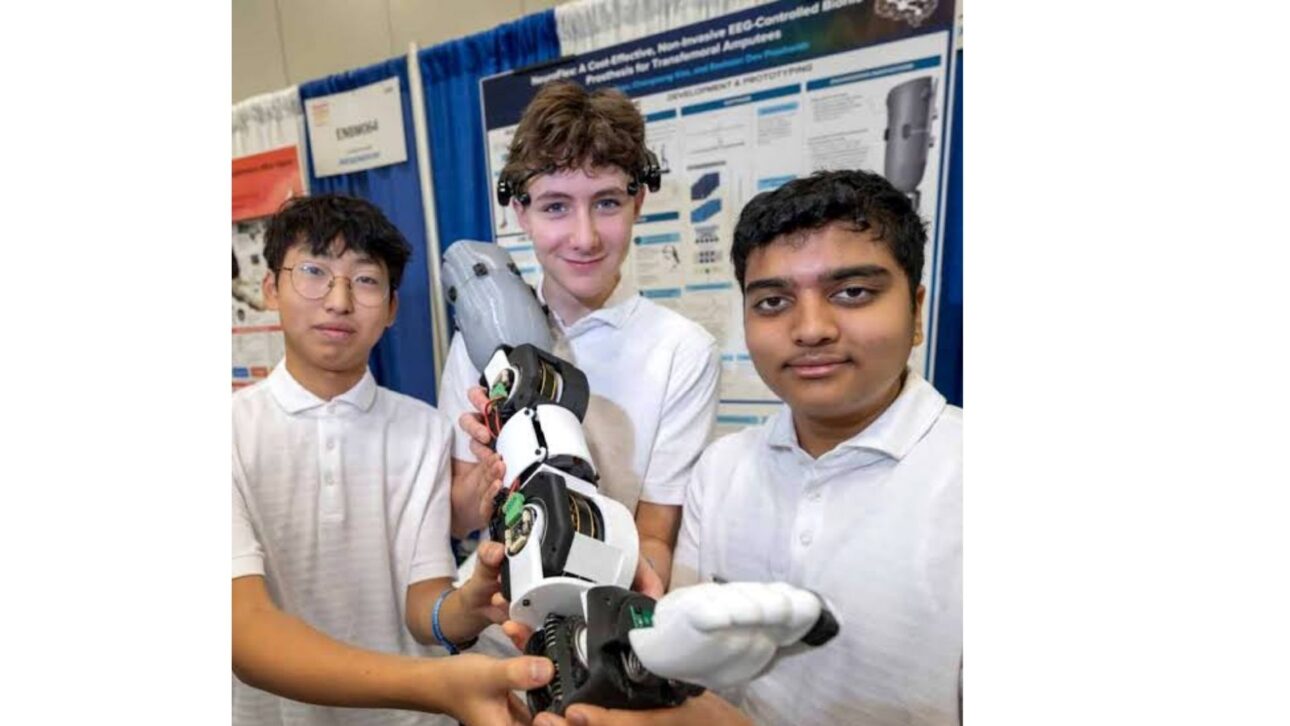
image: morefound/instagram
The central idea of Neuroflex is simple to understand, even though it’s complex to execute. Instead of relying solely on muscles or buttons, the prosthesis captures the intention of movement directly from the user’s brain and transforms it into mechanical action. It’s thought turning into step, without wires connected inside the body.
The piece is a transfemoral prosthesis, meaning it’s for those who have lost a leg above the knee, one of the most challenging situations to resolve in rehabilitation. The higher the amputation, the more joints need to be recreated, and the harder it becomes to restore a natural walk. Neuroflex tackles precisely this complicated case.
For this, the device combines hardware and software. Motors move the structure and an ankle with realistic joints tries to mimic the natural movement of the foot, while an artificial intelligence system interprets what the brain wants to do. The sum of these elements creates a prosthesis that responds to the person, not the other way around.
The result, according to the team, is a lighter and more economical movement. The Neuroflex is said to have reduced energy expenditure by about 35% compared to conventional prostheses, which means less fatigue for the user. In a leg prosthesis, using less energy to walk is a difference felt with every step.
The 3 Teenagers from Texas Behind Neuroflex
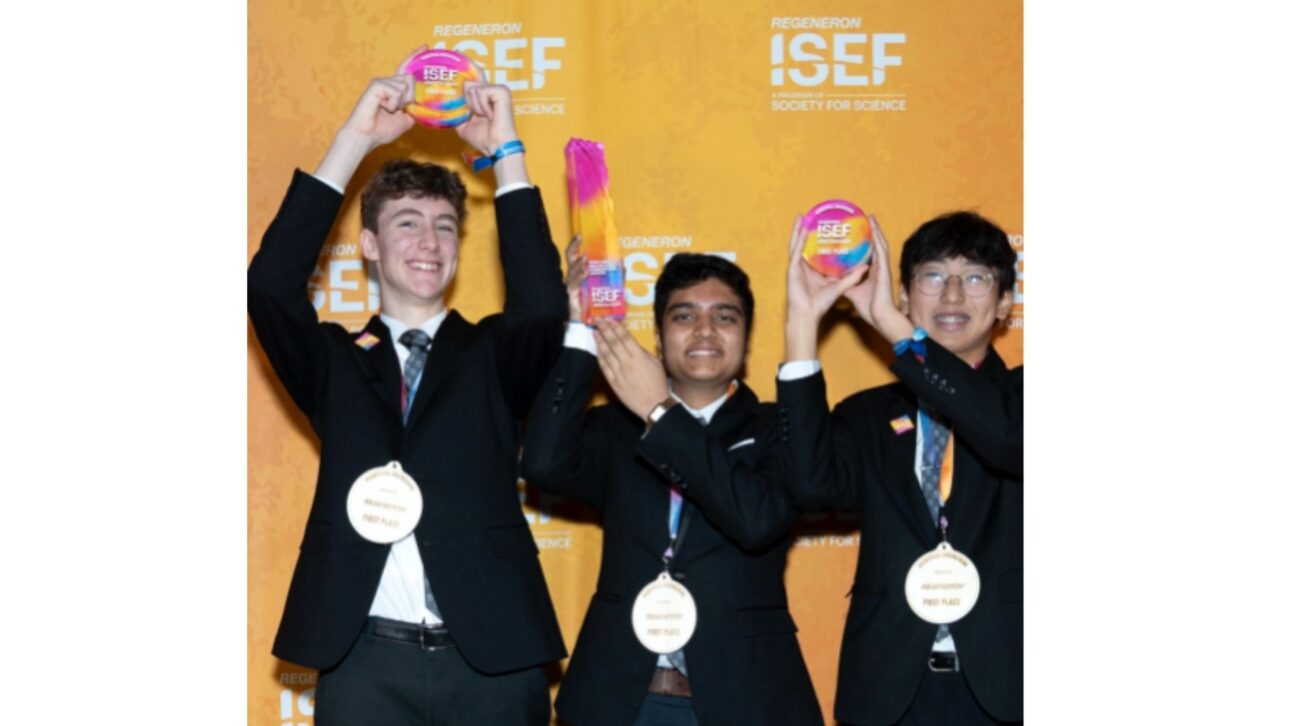
image: morefound/instagram
Behind the invention is a very young trio. According to the Society for Science, Neuroflex was created by Samuel Skotnikov, 17, from Highland Village, and Chanyoung Kim and Eeshaan Prashanth, both 16, from Flower Mound, all in the state of Texas. The three study at the same high school.
They are not isolated geniuses in a closed laboratory. They are ordinary teenagers who decided to tackle a giant problem in medicine, diving into neuroscience, engineering, and programming on their own. What they had in abundance was curiosity and the desire to solve something they saw up close.
Their maturity is evident in the way they talk about the project. “I’m speechless right now. We want to take our project and help a lot more people than just our friend Aiden,” said Skotnikov upon receiving the award. For a group of teenagers, turning a school idea into a healthcare technology is quite a leap.
It is also noteworthy that they did this outside of a major research center. Without a million-dollar laboratory, the three divided tasks among programming, electronics, and assembly, learning what was missing through the internet and trial and error. It was garage ingenuity applied to a cutting-edge medical problem, which makes the result even more impressive.
It All Started with a Friend: Aiden’s Story

image: morefound/instagram
Neuroflex was not born from a quest for a medal, but from a friendship. The starting point was Aiden, a friend of the three and an amputee, who shared with them the frustration of living with a prosthesis that didn’t help him as it should. It was this conversation that pushed the trio into research.
The motivation is in Skotnikov’s words. “It all started around helping our friend. He shared his difficulty and how the current prosthesis wasn’t helping much. This made us dive into research on prosthetics, with the goal of creating something better for him,” said the student. The project, therefore, had a face and name from the beginning.
Aiden was not only an inspiration, but also the tester. The team evaluated the prototype on him, including on a treadmill, monitoring the movements to adjust the system, and it was in these tests that the prosthesis hit the movement intention about 98% of the time. Building for a real person gave the project a standard of demand that a simple model would never have.
This origin explains the advice Skotnikov left for other young people. “Do what you’re passionate about. Don’t do it just for the science fair, do it for someone you genuinely want to help,” he stated. It’s proof that the best technology often arises from a concrete human problem.
How it works: from brain to movement
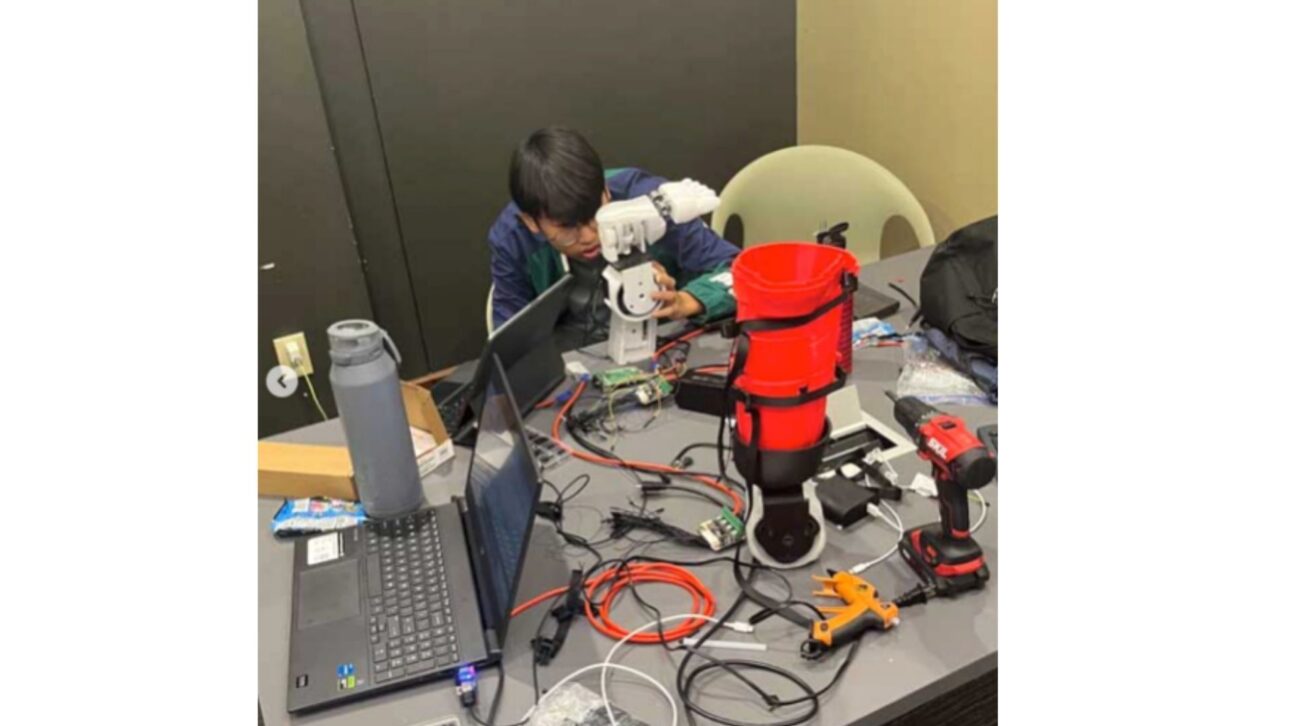
image: morefound/instagram
The heart of Neuroflex is in reading the brain without invading it. The prosthesis uses an EEG band, short for electroencephalography, placed on the head, which captures the electrical signals of brain activity from outside the skull. Nothing is implanted, and no needle or electrode enters the body.
Capturing the signal, however, is only half the challenge. These brain data are confusing and full of noise, so the team created a hybrid artificial intelligence system to interpret them and figure out which movement the person wants to make. According to the Society for Science, this model classifies the user’s intention with 98.67% accuracy, an impressive number for a high school project.
After understanding the order, the prosthesis acts. The Neuroflex motors activate to support and anticipate the movement, in a constant feedback cycle where the device learns and adjusts to the user. It is the real-time translation of a thought into a step taken by the bionic leg.
It’s worth separating the two numbers to avoid confusion. The 98.67% refers to the precision of the artificial intelligence system in classifying the intention, while “98% of the time” describes the accuracy observed in tests with Aiden. They are close measures, but it is fair to present them as prototype results, not as a guarantee of large-scale performance.
No surgery: why this matters so much
The detail of “no surgery” is not a whim, it’s what changes the game. Many brain-controlled prostheses depend on surgical implants, which require expensive, risky procedures that are not always available. By using an external EEG band, Neuroflex eliminates this barrier at once.
For the amputee, this means simpler and safer access. There is no hospitalization, no surgical risk, and no long recovery just to start using the equipment, simply by wearing the prosthesis and the band. In practical terms, the technology moves out of the hospital and closer to the person’s home.
This non-invasive approach also expands the potential audience. People who could not or would not want to undergo brain surgery remain excluded from implantable solutions, but could, in theory, use a prosthesis like Neuroflex. Making the technology less invasive is, ultimately, making it more democratic.
Brain-machine interfaces: the frontier that Neuroflex explores
Neuroflex is part of a rapidly advancing field: brain-machine interfaces. These are technologies that create a direct bridge between the nervous system and a device, allowing the control of prostheses, wheelchairs, or even computers just with brain activity. It is one of the hottest frontiers in current science, with tech giants investing billions.
In this field, there is a major division. On one side are the invasive interfaces, with chips implanted in the brain, promising high precision but requiring surgery and carrying risks. On the other, the non-invasive ones, which read the brain from the outside, are safe and cheap, but usually capture a weaker, noisier signal that is harder to decipher.
It is precisely in this second path that the teenagers’ merit lies. Making a non-invasive prosthesis respond with about 98% accuracy is difficult exactly because the external signal is tricky. By combining the EEG band with a well-trained artificial intelligence model, they pushed forward what is usually the weak point of solutions that dispense with surgery.
US$ 1,000 versus US$ 100,000: the prosthesis that wants to be accessible
Perhaps the most revolutionary aspect is not the brain, but the price. According to the team, the Neuroflex can be produced for about $1,000, while advanced bionic prostheses can cost up to $100,000. It’s a difference of up to a hundred times, which can separate those who walk from those who remain without.
The high cost is currently one of the biggest obstacles to rehabilitation. Many amputees simply cannot afford a quality prosthesis and end up with rigid and limited models, or without any prosthesis at all. A cheap and functional alternative directly addresses this exclusion.
That is why the fair’s organization itself highlighted the social impact of the project. As summarized by the Society for Science, the students’ model could alleviate part of the financial burden of prostheses. When cutting-edge technology becomes affordable, it stops being a privilege and becomes a possibility for many more people, including low-income amputees.
The $50,000 prize at the world’s largest science fair
The stage for the achievement was the largest possible for a young scientist. The Neuroflex was awarded at the Regeneron ISEF 2025, the International Science and Engineering Fair, held in Columbus, United States, and considered the largest science fair in the world. The event reached its 75th edition in 2025.
The competition gives the dimension of the achievement. The science fair gathered about 1,700 finalists from 48 American states and over 60 countries, all with high-level projects, and distributed more than $9 million in prizes and scholarships. Winning there places the teenagers among the best science students on the planet.
For the Neuroflex, the trio received the Gordon E. Moore Award for Positive Outcomes for Future Generations, valued at $50,000, in addition to a category award in biomedical engineering. It is a recognition that rewards precisely projects with the potential to improve the lives of future generations, a profile that the prosthesis fits easily.
From prototype to product: what is still missing
As exciting as it is, the Neuroflex is still at the beginning of the road. What exists is a science fair-winning prototype, validated in tests with one person, and not a medical device approved by health authorities. Between the lab bench and the hospital pharmacy, there is a long road.
This road involves more tests and strict regulations. To become a product, the prosthesis would need to be evaluated in many users, undergo clinical trials, ensure safety and reliability over time, and obtain the necessary certifications. None of this is quick or cheap, even with a brilliant idea at its core.
The creators themselves are aware of this and are already looking to the future. “We want to spread the technology and help other people too,” said Prashanth, indicating that the ambition goes beyond Aiden. Treating the Neuroflex as a very well-founded promise, and not as a ready-made solution, is the fairest way to tell this story.
What Brazil has to do with it: expensive prostheses and young science
The problem that Neuroflex addresses is also significant in Brazil. The country has a large number of amputees, many of whom depend on the public health system, and access to quality prosthetics is hindered precisely by cost and waiting lists. An affordable and functional solution directly addresses this reality.
The logic of making technology cheaper is especially welcome here. Imported bionic prosthetics are extremely expensive, and initiatives that reduce the price without losing quality can expand access for those who need it most, both within and outside the SUS. The path opened by the teenagers from Texas shows that this is not utopia.
There is also inspiration for young Brazilian science. Brazil often sends students to international fairs and has plenty of talent in public and private schools, often lacking only structure and encouragement. Stories like Neuroflex show that teenagers, with support, can tackle health problems that challenge even large companies.
In the end, the message coming from the United States is universal. Science done with purpose, aiming at a real person, can generate technology capable of helping millions. It is the kind of investment that Brazil can make by investing in scientific education and accessible health solutions.
And you, would you trust a prosthetic like this?
The journey of the three teenagers from Texas shows that age does not limit the size of the idea: they created Neuroflex, a brain-controlled bionic prosthetic without surgery, which gets the movement right about 98% of the time, can cost a fraction of its competitors, and won $50,000 at the world’s largest science fair. For now, it is a prototype, but it is a prototype that points to the future.
And you, do you believe that brain-controlled prosthetics like Neuroflex can democratize access for amputees to a life with more autonomy? Share in the comments if you would trust such technology and what you think Brazil needs to do to train more young scientists like these.


