






 Portuguese
  Spanish


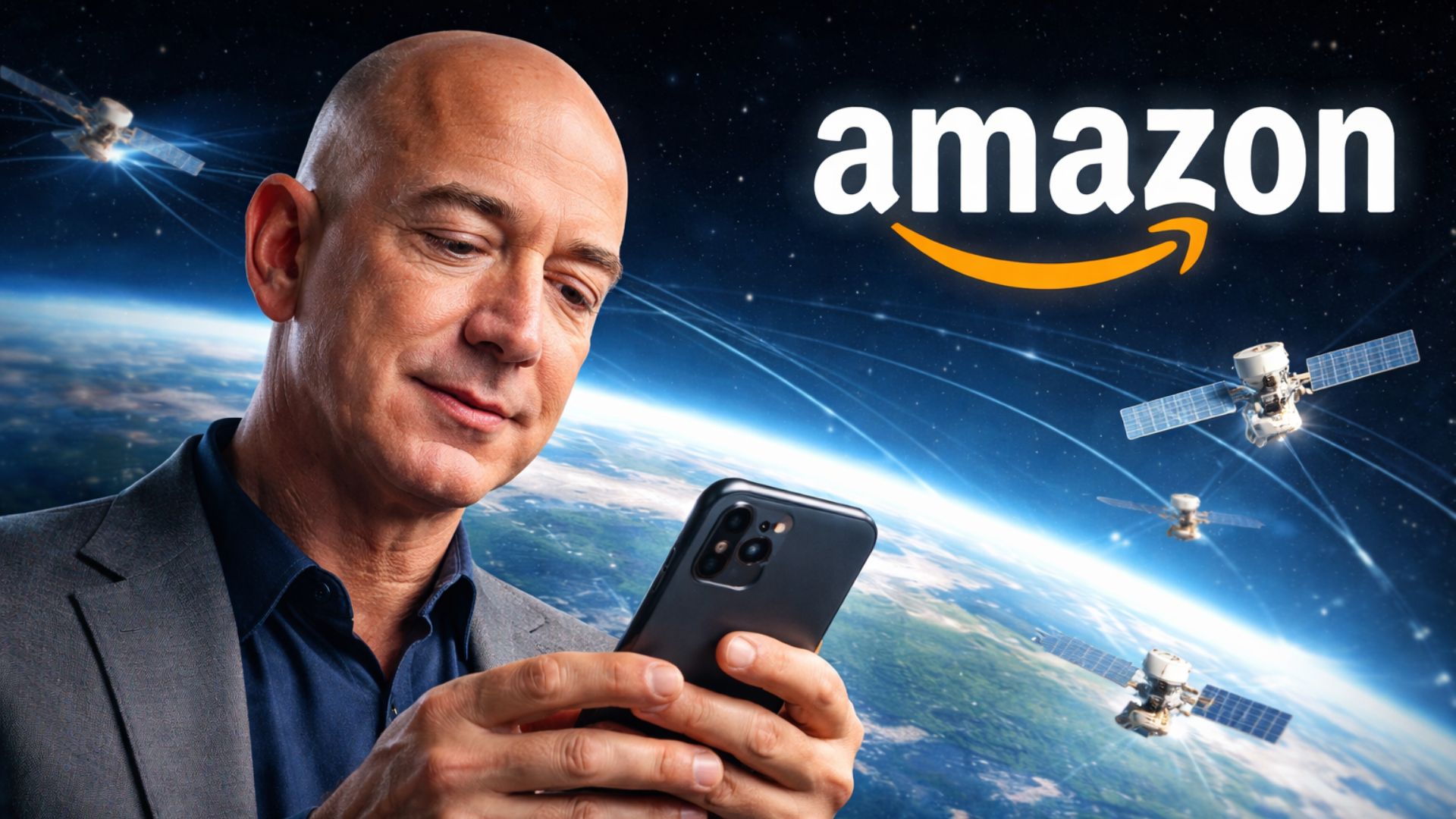

Amazon’s expansion into space reignites global dispute for satellite connectivity and expands integration with Apple mobile devices, promising technological evolution, coverage in remote areas, and strategic advancement against Starlink in the orbital internet market.
Amazon announced the purchase of satellite operator Globalstar for $11.57 billion and, at the same time, formalized an agreement with Apple to maintain and expand satellite communication capabilities in compatible iPhone and Apple Watch models.
The operation strengthens the competition with Starlink, from SpaceX, by giving Jeff Bezos’s company access to infrastructure, spectrum, and direct connection technology with mobile devices, known as Direct-to-Device (D2D).
Globalstar purchase strengthens Amazon’s strategy
According to Amazon itself, the new D2D system of the Amazon Leo network is expected to start being deployed in 2028.
-
Engineers Develop Jacket That Converts Air Humidity Into Drinkable Water, Producing Up to 900 ml Daily for Hikers, Campers, Rescuers, Rural Workers, and Military in Remote Areas

-
NASA Plans to Repurpose Mars Rover for Lunar Mission, Sending a 1-Ton Nuclear-Powered Vehicle to Explore the Moon’s South Pole Without Solar Dependence
-
Early Humans Made Beds Nearly 200,000 Years Ago in African Caves, Study Reveals

-
Japanese Smart Bike Detects Cyclist’s Intent to Turn and Potential Falls


The proposal is to enable voice, data, and messaging services on mobile phones and other connected devices, without relying on coverage from ground towers in remote areas, on maritime routes, or in emergency situations caused by natural disasters.
The acquisition also preserves the existing relationship between Apple and Globalstar.
Today, the Cupertino company uses this infrastructure to enable satellite functions on iPhones starting from the 14 line and on the Apple Watch Ultra 3, including contact with emergency services, messaging to friends and family, roadside assistance requests, and location sharing when there is no cell signal or Wi-Fi.
With the new agreement, Amazon will sustain this current base and collaborate with Apple on future services supported by the expansion of the Amazon Leo network.
Amazon Leo project and global internet expansion
By incorporating Globalstar, Amazon gains not only operational satellites but also spectrum licenses and technical capacity already used in mobile satellite services.
This set is seen as strategic because it accelerates the company’s entry into a segment where Starlink is trying to advance with agreements with telecommunications operators, while Globalstar is already working with direct communication between satellite and device in low data rate and high criticality applications.
In practice, this expands the reach of the Amazon Leo project, the current name of the former Project Kuiper initiative.
The company had already indicated that it intends to place thousands of satellites in low orbit to offer global connectivity.
According to Reuters, Amazon is working on a constellation of about 3,200 satellites by 2029 and is preparing to launch its satellite internet services as early as 2026, while the more advanced D2D module will be postponed to a later stage, with a planned start in 2028.
Direct connection on iPhone is still limited to specific features
The most sensitive part of the announcement is understanding what actually reaches the iPhone.
What has been confirmed is an agreement between Amazon and Apple to continue existing satellite features and develop new functions in the future.
Apple states in its official documentation that the iPhone 14 or later can use satellite connection for emergency messages, roadside assistance, conversations with contacts, and location sharing, provided the device is outside cellular and Wi-Fi coverage and in areas where the service is available.
On the Apple Watch Ultra 3, the company describes a similar set of features, also aimed at situations outside the traditional network.
The watch can trigger emergencies, send messages, and share location via satellite, as long as there is a line of sight to the sky and suitable conditions for use.
These features, therefore, already exist on specific devices and do not currently mean full broadband internet navigation directly on the iPhone.
Still, Amazon stated that the next-generation D2D system will enable more advanced voice, data, and messaging services on mobile phones and other devices starting in 2028.
The company also mentioned that the new architecture will utilize spectrum more efficiently than legacy direct-to-cell systems, promising better performance for the user.
The exact scope of these future functions, however, has not yet been publicly detailed by either Apple or Amazon beyond what is stated in the announcement.
Disclosed speeds refer to dedicated terminals
Another point that requires precision is the disclosed speed.
Amazon has already presented different terminals for the Amazon Leo network, and part of the figures associated with the project is linked to these devices, not to the D2D service for mobile phones.
In official materials, the company states that the Leo Pro terminal can achieve up to 400 Mbps download, while the Leo Ultra, aimed at more demanding applications for businesses and government, can reach 1 Gbps download.
There is also an antenna aimed at commercial aviation with similar specifications of up to 1 Gbps download and 400 Mbps upload.
This means that the highest speeds disclosed so far are associated with satellite internet delivered by antennas and terminals of the Amazon Leo network.
The D2D front, announced for mobile phones starting in 2028, was described by the company in terms of capacity for voice, messaging, and data, but without a specific public speed rate for use in smartphones in the announcement about Globalstar.
Brazil enters Amazon’s commercial strategy
In the Brazilian market, SKY previously reported that it will be responsible for marketing Amazon’s satellite internet in the country, as part of the Werthein Group’s regional strategy for South America.
In a statement published within the company’s commercial structure, the offer was presented as part of the expansion of the Amazon Leo brand in the region, focusing on increasing access in urban and rural areas still underserved by conventional networks.
The arrival of Amazon in the sector comes at a time when Starlink is already operating on a large scale and maintains an advantage in coverage and installed base.
According to Reuters, SpaceX’s network has already surpassed 9 million users worldwide and has more than 10,000 satellites, which helps explain why Amazon views the acquisition of Globalstar as a decisive step to accelerate its competitive position.
In a statement released by Amazon, Greg Joswiak, Senior Vice President of Worldwide Product Marketing at Apple, stated that the company has a long-standing relationship with Amazon’s infrastructure and that the new partnership aims to ensure the continuity of satellite resources that users already depend on.
This statement reinforces that the agreement has an immediate focus on continuity and another on gradual expansion as Amazon’s network scales up.


