






 Portuguese
  Spanish
  4 min of reading
  1 comment


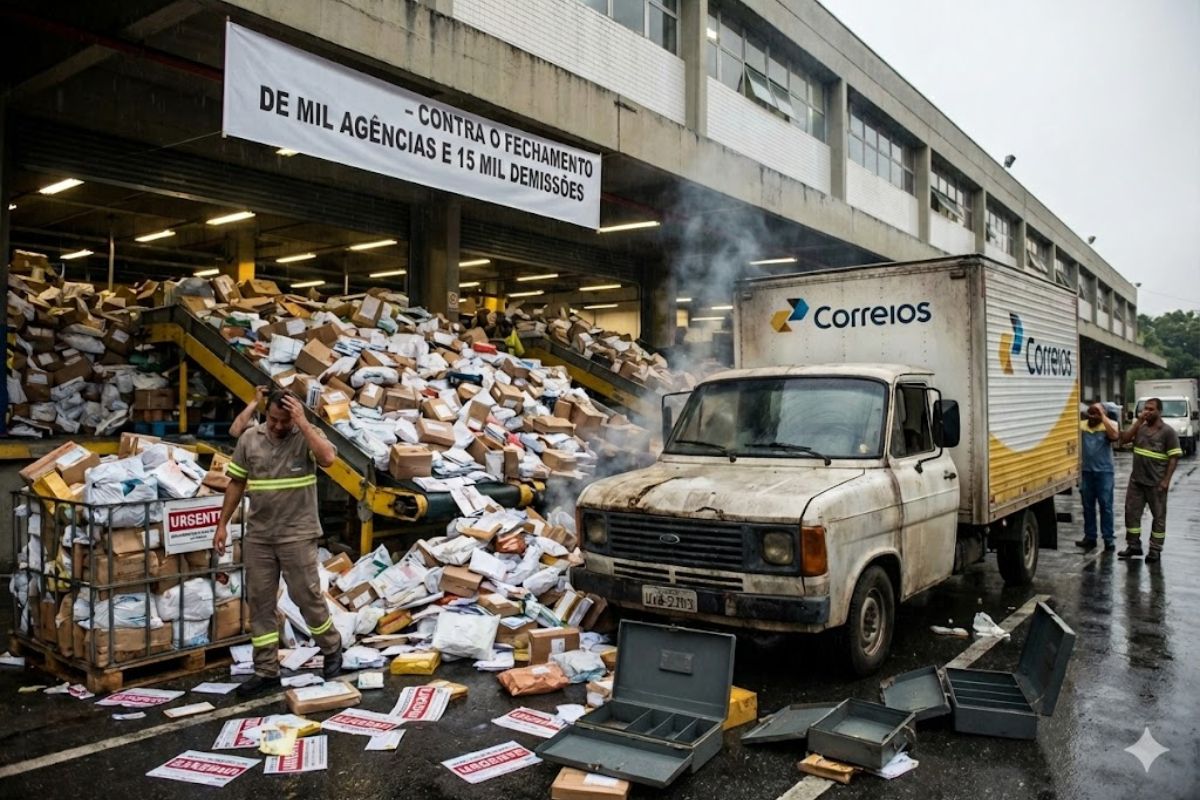


With the Decline in Orders, Deterioration in Service Quality and Rising Costs, Correios Sees 32 Percent of Deliveries Late, Plans to Lay Off 15,000 Employees, Close 1,000 Units, and Awaits Treasury Support to Pay Salaries and 13th, Suppliers, Service Providers and Maintain Basic Operations.
In a serious financial crisis, Correios is facing in 2025 a combination of declining transported orders, deterioration of delivery quality, and rising expenses that pressure the state-owned company’s cash flow. Internal documents show a rapid decline in key operational indicators between January 28 and December 6, 2025, with fewer packages circulating and more delays recorded across the country.
On December 10, 2025, when the situation was detailed, Correios’ management was already working on cutting benefits provided in a collective agreement, a plan to lay off 15,000 employees, and close 1,000 agencies, while simultaneously seeking emergency assistance from the National Treasury to pay the December payroll, the second installment of the 13th salary, suppliers and essential service providers.
Decline in Orders and Explosion of Late Deliveries
Internal data indicates that the daily volume of packages delivered by Correios dropped from 1,745,897 on January 28 to 1,293,675 on December 6, a 26 percent reduction in that period.
-
Brazil has 8.4 million illiterates and more than half live in the Northeast, where 10.6% of people cannot read or write a simple note, compared to 2.3% in the Southeast, according to the Pnad Contínua Educação 2025 from IBGE.

-
A great economist predicted that by 2030 we would work only 15 hours a week, and John Maynard Keynes’s forecast is about to fail miserably almost 100 years later.
-
Brazilian fintech unexpectedly closes office, lays off dozens via video call, and leaves employees insecure while the company denies mass layoffs.
-
Largest investment per capita in Brazil: city receives R$ 1 billion in sanitation, invests 322% above the national average, and gains a new ETA capable of supplying an additional 1,270 liters of water per second.



Instead of taking advantage of the natural uptick in year-end shopping, the state company is arriving in December transporting less than at the beginning of 2025.
In the monthly daily average, the outlook is also negative. In January, Correios moved about 1.75 million packages per day.
In December, this average fell to 1.46 million, a 16 percent decline in nearly a year.
The contrast with 2022 is significant: in that December, the company was operating with a daily average of 2.28 million packages.
The quality of service has followed the decline in volume.
The indicator measuring on-time deliveries fell from 98.95 percent on February 3, a record performance for Correios, to 68.15 percent on December 6.
In practice, 32 percent of the packages began to be delivered late at this critical moment.
The December average of 76.63 percent is well below the 97.7 percent recorded in January.
Rising Expenses and Pressure on Payroll
While operational indicators decline, expenses are rising.
Correios’ projection is to end 2025 with BRL 22.9 billion in current expenses, an increase of 2.9 percent compared to the previous year.
The majority of this amount is concentrated in personnel costs, estimated at BRL 15.1 billion, including salaries, charges, and benefits.
This combination of declining revenue from orders and rising fixed costs deepens the company’s financial imbalance.
Management admits internally that the margin to maintain labor benefits and the current structure of agencies has significantly reduced, which explains the escalation of austerity measures announced throughout the second half of 2025.
End of Collective Agreement and Plan to Lay Off 15,000 and Close 1,000 Agencies
On Tuesday, Correios’ management informed worker representatives that it will not renew the Collective Work Agreement, which expires on December 15.
The ACT signed by the previous administration provided, among other points, a 70 percent bonus on vacation, Christmas bonus, and salary and meal voucher adjustments for inflation, items now called into question by the crisis.
The official justification is that Correios’ financial situation prevents the granting of benefits outside the restructuring plan being developed.
This plan proposes to lay off 15,000 employees through a voluntary dismissal program and close 1,000 agencies in different regions of the country, in an attempt to reduce payroll and cut fixed operating costs.
Bet on Emergency Funding from the Treasury and a BRL 20 Billion Loan
While cutting benefits and redesigning the workforce, Correios’ management is rushing to secure emergency funding from the National Treasury.
The intention is to use the money to pay December salaries, the second installment of the 13th salary, suppliers, and essential service providers, avoiding an operational shutdown amid high year-end demand.
A decree published on Tuesday paved the legal way for this funding. Internally, the concern is to find a solution that provides minimal financial sustainability to Correios and has legal backing, avoiding new challenges from regulatory bodies.
The funding is treated as a temporary alternative until the state company can close a BRL 20 billion bank loan backed by the Union.
Management admits that, without cash flow replenishment and deep restructuring, the risk of financial collapse for Correios is no longer just a theoretical scenario and is now part of short-term discussions about the company’s future.
For you, in light of the Correios crisis, what should come first: preserving jobs, keeping agencies open in vulnerable regions, or concentrating everything on saving the company’s finances?










Primeiro lugar salvar os empregos de mais de 80 mil funcionários que longe disso, não são os culpados pela roubalheira dos Correios. A culpa é do governo atual.