





 Portuguese
  English
  Spanish
 4 min of reading
  0 comments


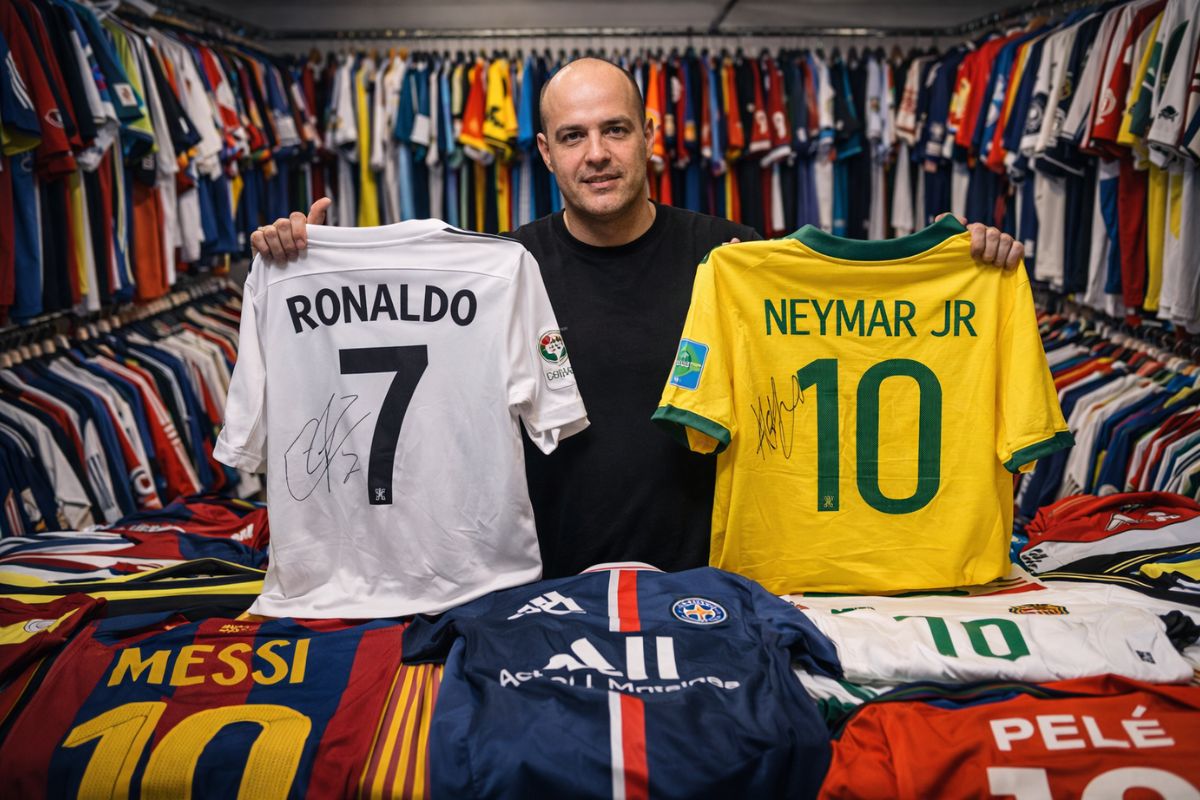
Ten Years Ago, The Businessman From Santa Catarina, Eduardo Daleffe, Received The First Football Shirt From A Player And Started A Collection That Transformed From A Hobby To An Asset Estimated At Around R$ 1 Million, With Over 3,000 Pieces, Autographs, And Daily Conservation Rules In A Room Just For Them
The businessman from Santa Catarina, Eduardo Daleffe, lives in Criciúma, in the south of Santa Catarina, and turned a childhood dream into a collection that now exceeds 3,000 football shirts. The impact is not just in the number but in the effect these pieces have when someone enters the dedicated room.
The central point is not the fetish of the “rare item.” It’s the structure: how these shirts arrive, how they are stored, how much they are worth, who opens doors to get a signature, and why a collection estimated at around R$ 1 million requires a daily routine to continue existing.
The Decade When The Hobby Became Domestic Heritage
The beginning is simple and quite common: a first shirt delivered by a player, kept as a memento, then another, then another.
-
The commander of the Brazilian Army publicly admitted that the country now perceives real threats in South America, something that, according to him, did not exist in the past, and advocates for the increasing use of drones and technology to secure the borders.

-
While thieves looted almost all the neighboring tombs over 2,600 years, an Etruscan chamber in Italy remained sealed and untouched all this time, and archaeologists have just opened it to find more than a hundred objects in the exact place where they were left.

-
A window-sized device, without electricity or filters, managed to extract potable water from the dry air of Death Valley using only sunlight, in an MIT study published in Nature Water that gives new impetus to a technology crowned with the Nobel Prize in Chemistry in 2025.
-
Giant Boeing 777 model receives official Boeing paint, cut-out windows, and functional lights, but first flight with final look reveals landing gear problem, lost tire, and battery adjustments until achieving perfect landing.




Over time, the businessman from Santa Catarina realized that the collection stopped fitting into the idea of a keepsake and became a system of its own, with physical space and method.
The leap becomes clear when he describes what he had gathered by 2025: at least one model from all clubs in the Brazilian Championship’s A, B, C, and D series, and shirts from approximately 400 different clubs.
It’s no longer impulse buying; it’s building a collection.
The Shirt That Silences The Visitor Before Any Conversation
Among the thousands of football shirts, he points to one as the piece that most disarms visitors: the shirt of Cristiano Ronaldo.
He says that the player wore and signed the item, and that this is his favorite piece.
It’s the type of item that changes the visitor’s reaction from curiosity to silence.
The journey to this shirt shows how collecting, at this level, relies more on networking than luck.
He recounts that he obtained the item from a football executive, Marcelinho Salazar, with whom he had a friendship, and that the delivery involved a contact in the Arab World, a physiotherapist friend who was coming to Rio.
Two days later, the call came, along with a photo confirmation of what was arriving.
Neymar, Tafarel, And The Real Value Of Contacts
The businessman from Santa Catarina does not treat the collection as a lineup of famous names but as proof of access.
In addition to Cristiano Ronaldo, he mentions shirts from Tafarel and Neymar as part of the collection, obtained through friendships and contacts of people involved in football.
This detail matters because it answers, without an explicit announcement, the question many people silently ask: who can achieve this.
The “who” is not just a collector; it’s someone who has built bridges with players and intermediaries over time.
The collection becomes a biography in fabric.
The Mandatory Room And The Routine That Protects What Cannot Be Damaged
When the family moved to a house in August 2025, the criterion was straightforward: it had to have an extra room for the shirts.
It’s not decoration; it’s logistics, as he states that the pieces require daily care, with the use of scent, a “fabric protector,” mold repellent, and the rule of keeping the environment ventilated.
This care explains why the collection is not just “storing.” It’s preserving.
A shirt kept without control can lead to mold, odor, stains, and loss of value, including sentimental value.
The most expensive part of the collection may be precisely the discipline to keep everything intact.
The Limit That Became A Joke And The Goal Of 10 Thousand
He mentions that he realized the size of the problem when there was no more space for his son to put his own clothes in the room.
The collection had transitioned from a manageable phase to a real physical occupation within the house, something that requires family negotiation, planning, and often, the renunciation of space.
Even so, he speaks without hesitation that if he could, he would have up to 10,000 football shirts. He says he doesn’t intend to stop and will continue as long as he has health and energy.
The statement is not about quantity; it’s about identity.
What the businessman from Santa Catarina built in Criciúma is not just a room full of items.
It’s a collection of over 3,000 football shirts, estimated at around R$ 1 million, sustained by contacts, conservation criteria, and a room that turned into a home archive.
And the most revealing detail is this: the childhood dream did not turn into nostalgia; it became a routine.
To spark genuine comments, without automatic responses: if you entered this room and had to choose just one piece to hang on the wall of your home, would you choose based on the weight of the idol, the value of the autograph, or the personal story behind how the shirt got to you?








-

-

-

4 people reacted to this.