Portuguese
  Spanish


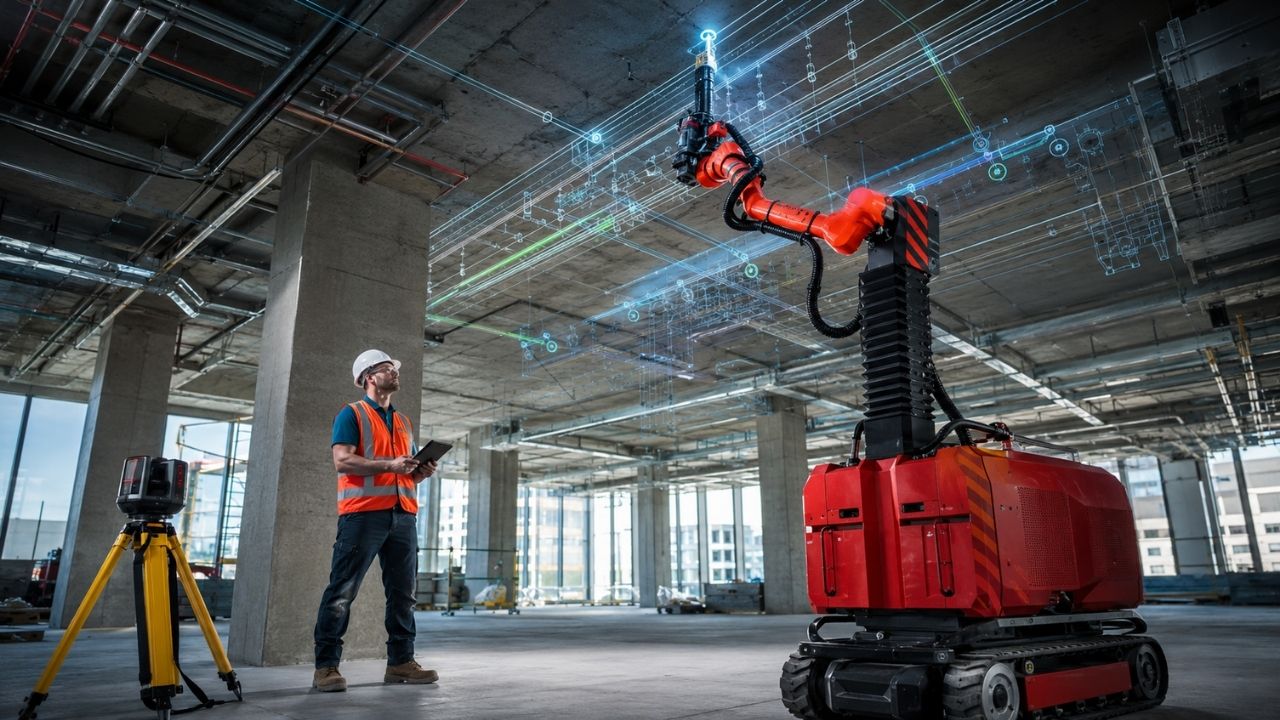

The Jaibot robot, from Hilti, uses data from AutoCAD and Revit to mark and drill holes in construction ceilings, reducing overhead manual work. The semi-automatic solution targets electrical, hydraulic, mechanical installations, and internal finishes, with gains in precision, speed, digital documentation, and safety on the construction site.
The Jaibot robot, developed by Hilti, was created to perform marking and drilling in construction using digital plans, utilizing information from software like AutoCAD and Revit. The technology operates on construction sites during stages of mechanical, electrical, hydraulic installations, and internal finishes.
According to Hilti, the proposal is to reduce one of the most repetitive and exhausting tasks in construction: drilling overhead to prepare installation points. Instead of relying solely on manual drilling, the system uses digital data to guide the equipment to the correct location, at the defined depth, and with more control over the progress of the service.
Robot takes the digital project to the ceiling of the construction

The Jaibot functions as a bridge between digital planning and physical execution on site. The project that was previously restricted to technical plans now directly guides the marking and drilling of defined points for installations. In practice, the robot transforms digital coordinates into real holes in the structure.
-
Unable to secure a mortgage as a self-employed single mother, she designed her own floating home from a 20-meter boat and now lives “off-grid” with her two children and solar panels on an English canal.

-
Man Transforms Rusty Shipping Container into Luxury Home with Insulated Walls, Large Windows, and Drywall Finish, Surprising Onlookers

-
“Super Grass” Miscanthus Grows Rapidly Without Pesticides, Replacing Heating Oil in Europe and Now Used in Carbon-Capturing Concrete and Walls in World’s First “Bale House”
-
Abandoned House Renovation Fixes Decades-Long Leak in Two Days with Red Steel Roof Installation



This type of application gains strength in projects that already use BIM and digital models to reduce conflicts between disciplines. When electrical, hydraulic, mechanical systems, and finishes need to share the same space, the precision of the hole ceases to be just an operational detail and starts to influence the deadline, rework, and quality of delivery.
How Jaibot uses AutoCAD, Revit, and total station
The process begins with sending AutoCAD or Revit data to Hilti’s cloud. Then, the work file is imported into a field tablet, used in layout applications. Next, a Hilti PLT 300 total station helps locate the equipment within the construction site and orient its position.
From there, the robot executes the drilling within its range, following the digital drilling plan. Location, diameter, and depth are not solely dependent on manual marking but on a data flow previously defined in the project. This helps reduce variations between what was planned and what appears on the construction ceiling.
Overhead drilling ceases to be a purely manual task

Overhead drilling is a tiring activity, especially in installations that require repeated drilling over large areas. Besides the physical effort, there is exposure to dust, constant need for positioning, and risk associated with working at heights or in uncomfortable postures.
With Jaibot, the worker no longer focuses on the direct execution of each hole and instead operates, positions, and monitors the equipment. The change does not eliminate human presence but alters the team’s role, shifting from manually executing the heaviest task to supervising the process.
Speed and precision depend on correct planning
Hilti presents Jaibot as a semi-automatic technology aimed at increasing productivity, precision, and safety. But the robot’s performance directly depends on the quality of the data used at the start of the process. If the digital project is poorly coordinated, the execution can also carry problems.
Therefore, the speed gain does not come solely from the machine itself. It depends on an integrated flow between engineering, planning, layout, and operation on site. The robot drills based on the plan it receives; the better resolved the project, the greater the execution efficiency tends to be.
Electrical, hydraulic, and mechanical installations are at the core of the application

The Jaibot was designed for mechanical, electrical, and plumbing installations, areas known for the large number of fixing points, supports, passages, and interferences. In larger projects, small marking errors can cause delays, improvised adjustments, and loss of productivity.
The technology can also be applied in interior finishes, when there is a need for repetitive drilling aligned with the project. The central point is to use automation in a stage that usually involves physical effort, repetition, and high precision requirements. In this context, the robot acts as an execution tool, not as an isolated solution for all construction problems.
Wireless system operates with integrated dust removal
Another aspect informed by Hilti is that the Jaibot works with a wireless system and can operate for up to 8 hours between recharges. The equipment also features integrated dust removal, an important feature in drilling activities, especially in indoor environments.
The manufacturer also states that the robot does not require specialized skills for operation. Even so, efficient use of the system requires site organization, file preparation, correct positioning of the total station, and execution monitoring. Automating drilling does not mean dispensing with method; it means shifting part of the effort to planning and control.
Less error can mean less rework


In projects with several teams working simultaneously, drilling errors can create a chain of problems. A point out of position may require correction, interfere with another system, or compromise the installation pace. When this happens on a large scale, rework ceases to be occasional and starts to affect the schedule.
By following the digital project, the Jaibot aims to reduce this type of failure. During marking and drilling, the system also synchronizes information to monitor the project’s status. This real-time documentation can help managers see the project’s progress more clearly, instead of relying solely on subsequent manual checks.
Automation arrives in a sector pressured by labor
The construction industry faces, in many markets, difficulty in finding qualified labor for certain roles. In this scenario, semi-automatic technologies are gaining ground because they promise to alleviate repetitive tasks and direct workers towards operation, inspection, and coordination activities.
This does not mean that the construction site becomes completely automated. The robot needs a team, planning, transport, positioning, supervision, and integration with the rest of the project. The difference is that part of the heavy work starts being executed by a data-driven machine, while professionals focus more on process control.
The advancement draws attention because it is not just about placing a machine on the site, but about connecting digital design, total station, construction team, and documentation in real-time. Do you think robots like Jaibot can improve safety and productivity in construction, or is this type of technology still far from the reality of most projects? Leave your opinion in the comments.