






 Portuguese
  Spanish


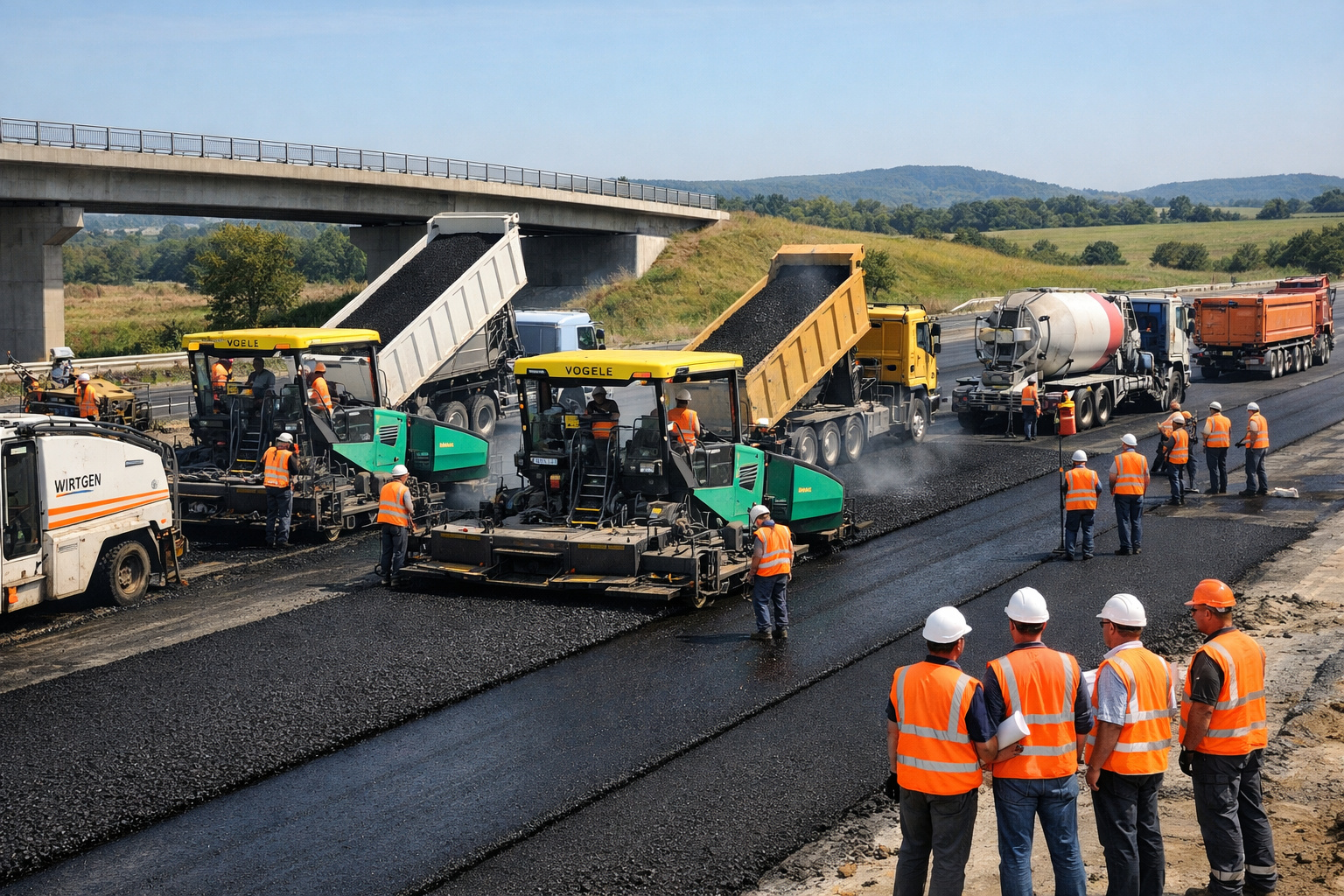


Germany’s Highway System Combines Deep Structural Engineering, Extreme Compaction, Laser Control, and Advanced Materials to Maintain Safety, Durability, and Stability Even Without Speed Limits Over Vast Stretches
No speed limits on extensive stretches. This is how the Autobahn, Germany’s highway system, sets itself apart from any other in the world. More than the fame of supercars speeding down these roads at speeds over 186 mph, what captures the attention of engineers from various countries is the structural stability of the roadway. At first glance, the absence of restrictions should compromise traffic safety. However, the numbers show exactly the opposite.
Despite the extreme speed allowed in various sections, the Autobahn statistically operates as one of the safest high-speed road systems on the planet. The explanation lies not only in the discipline of drivers but primarily in the engineering philosophy applied since the road’s foundation. Unlike conventional highways, the Autobahn is not just paved — it is built as a massive civil engineering structure.


This information was disseminated through technical content and specialized analyses in European infrastructure engineering, extensively studied by universities and research centers in transportation, detailing why the German model has become a worldwide reference.
-
Affordable Housing Project in Brazil’s Mato Grosso Aims for 700 Deliveries and $34 Million in 2026, Outpacing Major Developers in High-Demand Areas

-
Brazil’s Largest Port to Accommodate Bigger Ships by October as Ibama Approves Non-Explosive Removal of Hidden Rocks and Sediments
-
Mexico Develops 3D-Printed Concrete from Corn Waste, Cutting Emissions by 70% and Reducing Construction Waste by 90%
-
Traditional Mortar to Decline by 2026: ACIII-E Solution for Large Porcelain Tiles Offers Better Adhesion and Reduces Risk of Loose Pieces in Floors and Facades


A Highway Built as a Structure, Not Just Simple Pavement
Germany has a total area of approximately 137,847 square miles, less than half the size of Texas in the United States. Still, its road density is seven times greater than the U.S., with over 8,000 miles (about 13,000 km) of high-performance roads. This volume is only possible thanks to a radically different construction method.
It all begins with a structural base formed by four fundamental layers. The process starts with the compacted subgrade, followed by a stabilized subbase, a load-bearing base, and finally, the high-performance wearing course. Each stage is designed to distribute forces, prevent deformations, and ensure stability even under constant impact.
During compaction, vibratory rollers apply between 55 and 77 tons of force with each pass. Depending on the soil type and moisture, between 6 and 12 passes are performed until standard Proctor density is achieved, capable of supporting the extreme weight of European trucks and the stress caused by high speeds.
Additionally, the asphalt used incorporates advanced polymers, which maintain flexibility in winter and withstand temperatures up to 158 °F in summer, preventing cracks from freezing or thermal deformations. This combination allows the surface to remain stable even under intense and continuous traffic.
From Reinforced Concrete to Millimeter Laser Control

After preparing the soil and the crushed stone base, a crucial stage comes into play: the application of the concrete base, which reaches a thickness of about 16 inches. Before pouring, the soil receives a technical white protective barrier, preventing moisture loss and contamination of the fresh concrete.
Paving is performed by slipform machines, continuously fed by excavators, ensuring uninterrupted flow. High-frequency vibrators eliminate air bubbles, while rear molds define the exact geometry of the roadway. The entire process is guided by laser control systems, ensuring millimeter inclinations and smoothness.
During application, steel bars are automatically inserted into the concrete at the correct depth and spacing. These bars transfer loads between adjacent slabs, preventing cracks and ensuring that the highway functions as a continuous structure. After finishing, a curing compound — usually made of paraffin or acrylic — is sprayed to maintain moisture and prevent cracking.
Between 30 and 60 minutes later, specialized machines texture the surface with rotating brushes, creating grooves that increase tire grip at high speeds. Finally, expansion joints are cut at precise intervals to control internal stresses.
Asphalt at 320 °F, Recycling, and Durability of Up to 15 Years
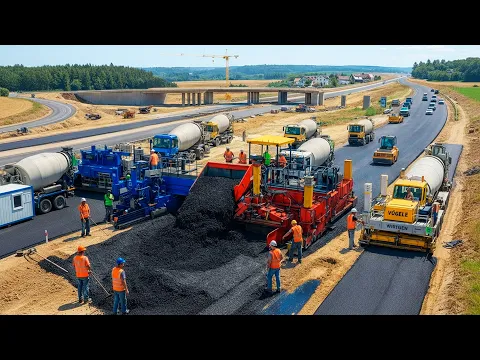
With the cured concrete base, the application of asphalt begins. The material arrives at the work sites at 320 °F, distributed by pavers that achieve between 85% and 92% compaction while still hot, in a single pass. This method is essential for thin layers of about 1 to 1.2 inches, such as stone mastic asphalt, which cools quickly.
Modern machines, like pavers from Vögele, reduce the need for external rollers by up to 70%, ensuring superior uniformity. In many cases, a single final pass with a lightweight roller is enough to complete the process.
The average durability of the Autobahn ranges between 8 and 15 years, depending on traffic volume and weather conditions. When wear becomes inevitable, recycling comes into play. Milling removes between 0.8 and 4 inches of the old asphalt, preserving the foundation. The material is reused in plants, where it can make up between 30% and 60% of new mixtures, reducing costs and CO₂ emissions.
Before reapplication, the roadway receives a layer of asphalt emulsion that functions as structural glue. The recycled asphalt is then applied and compacted immediately, ensuring full adhesion. This continuous cycle of construction, maintenance, and recycling is what allows the Autobahn to maintain new roadway performance for decades.






The writer is Brazilian and in Brazil, they have this misconception and romantic view of things that the motorways in Germany don’t have speed limits, that everyone can drive over 200 km/h (!). Out of reality. This guy, for sure, neither saw nor drove on a Autobahn in his life. This news is pure misinformation.
Excelente!!!! 🙂
This is a marvel of engineering. The world should concentrate on such inventions rather on wars.