Portuguese
  Spanish


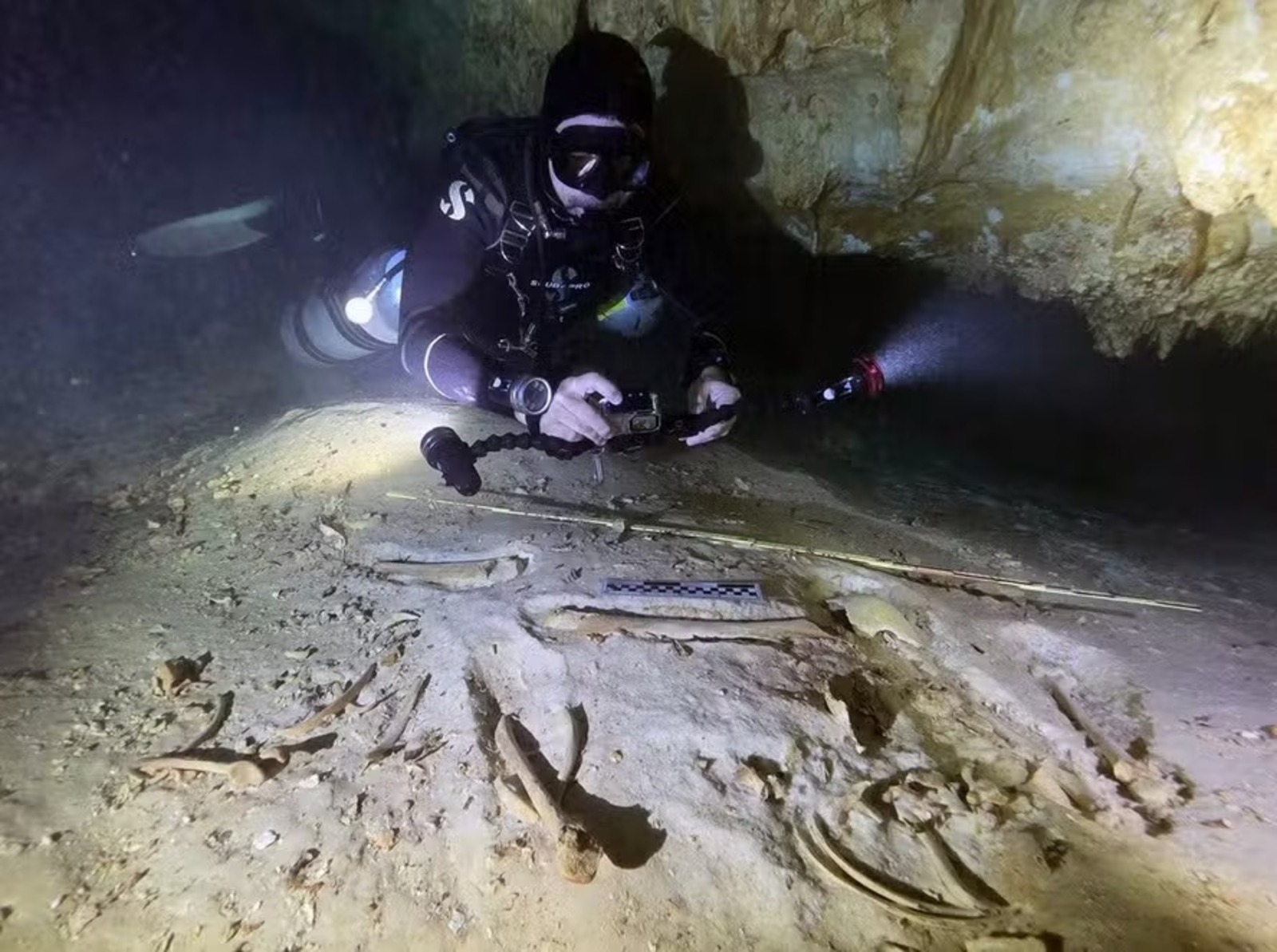


Human Skeleton Found At 8 Meters Depth In Submerged Caves Between Tulum And Playa Del Carmen, Area Affected By Maia Train Construction Of 1,554 Km
A prehistoric skeleton was found eight meters deep in submerged caves between Tulum and Playa del Carmen, in the Yucatán Peninsula, an area impacted by the construction of the 1,554 km Maia Train, reigniting debates about archaeological preservation.
The discovery occurred in a complex system of underwater caves along the Caribbean coast of Mexico, which extends for kilometers beneath the Yucatán Peninsula. The area has been submerged since the end of the last Ice Age, about 8,000 years ago.
According to the HeritageDaily website, archaeologists working in the region located the remains in caves that are part of a vast network of underground rivers and cenotes between the two tourist poles. The find was recorded at a depth of eight meters.
-
Scientists Discover 125-Million-Year-Old “Pregnant Fossil” with Preserved Embryos and Microscopic Larvae Inside Mollusk in England

-
17-Year-Old Justin Bernstein Develops Bacteria to Produce Glass on Arctic Ice to Reflect Sunlight, Wins $50,000 U.S. Scholarship

-
The 19-Meter Rocket-Helicopter: A Private Industry Prototype That Challenged Space Race Logic

-
Brazilian Students Convert Seized Illegal TV Boxes into Linux-Powered Mini Computers for Schools and Social Projects Across São Paulo




According to Octavio del Río, an underwater archaeologist from Mexico’s National Institute of Anthropology and History, the remains could only have reached the site when the cave was still dry, before being flooded.
Prehistoric Skeleton Is The 11th Found In The Region In 30 Years
The discovery represents the eleventh prehistoric skeleton identified in the area in the last three decades.
The area between Tulum and Playa del Carmen is considered strategic for research on the oldest inhabitants of North America.
Previous finds in the region have been dated to over 13,000 years. These records reinforce the archaeological relevance of the submerged cave system, identified as one of the main sites for understanding ancient human occupation on the continent.
Bones Were In Funeral Deposit With Indications Of Ritualism
When located, the skeleton was positioned on a sediment dune in a narrower section of an inner chamber. According to del Río, the bones were intentionally placed there.
The archaeologist stated that the area served as a funeral deposit where ritual practices were conducted by the earliest peoples that inhabited the region. The positioning of the remains reinforces this interpretation.
Discovery Could Expand Understanding Of Ancient Migration
Researchers believe that the new prehistoric skeleton, like the previous ones, could contribute to understanding how ancient populations migrated and adapted to the Yucatán Peninsula.
At that time, the region was composed of open plains and cliffs, differing from the current landscape of jungle and coastline. The analysis of the remains is expected to deepen studies on human adaptation in distinct environmental scenarios.
Area Affected By Maia Train Could Become Protected Heritage By 2026
In addition to human remains, the caves also contain remains of extinct animals, such as giant sloths, saber-toothed tigers, and ancestral bears.
These materials may assist in reconstructing the Ice Age ecosystems in future research.
The remains were recovered in late 2025 and are undergoing detailed studies. The discovery occurred after kilometers of rivers and underground caves beneath the Caribbean coast were impacted by the construction of the Maia Train.
Given the ecological vulnerability and archaeological significance, Mexican authorities are working to designate the underground area as a protected natural and cultural heritage by 2026, recognizing its historical and environmental importance.
With information from Revista Galileu.