






 Portuguese
  Spanish


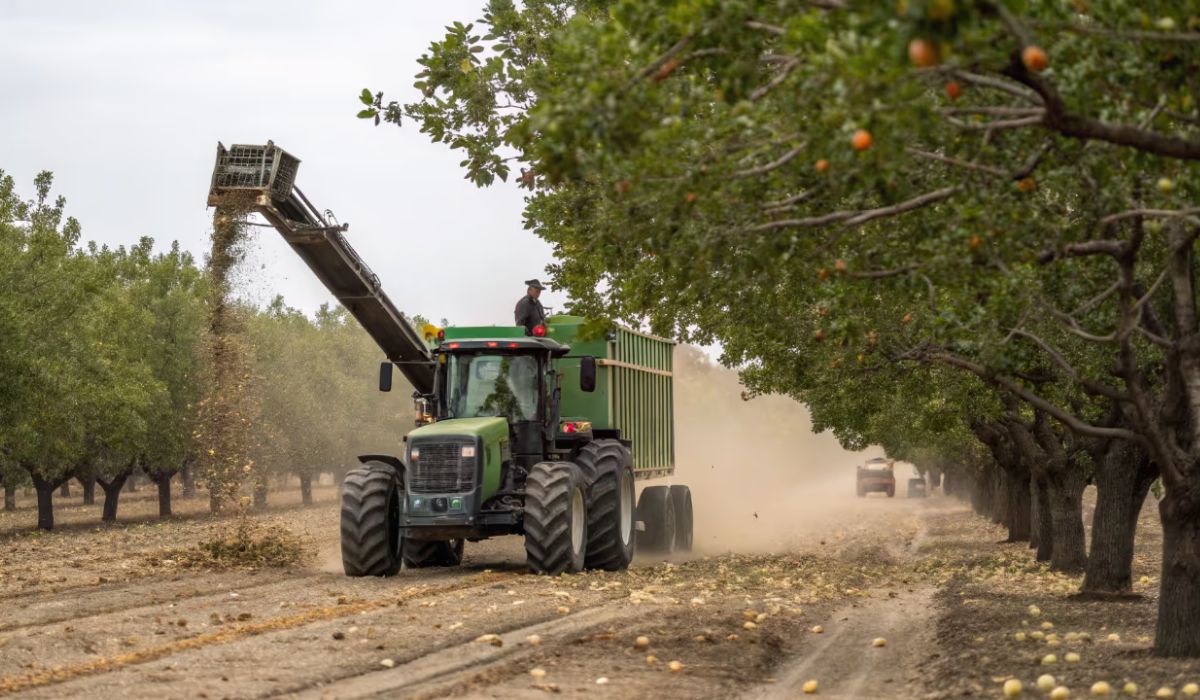


From Greenhouse to Industrial Processing, Pistachio Production Depends on Technical Decisions, Specialized Machines, and Short Windows of Time That Determine Productivity, Quality, and Logistics in One of the Most Mechanized Agricultural Chains in the World.
The pistachio harvest involves a concentrated operation over a few days, during which producers need to remove large volumes from the field and quickly send them for processing.
When the fruits reach the ideal point, the window is short.
Delays increase the risk of losses associated with humidity and heat.
-
Bruno Guimarães, 28, Misses Crucial Penalty Against Norway in World Cup After Replacing Vinicius Jr.

-
Inspired by a school lesson on Africa’s water crisis, a young boy raised money through chores to fund a well that transformed a Ugandan community.

-
Brazilian Construction Worker Moves to France, Earns Up to €2,500 Monthly with Home Renovations, Gains Social Media Attention

-
US Navy Sinks USS Oriskany with 230 kg of C-4, Creating World’s Largest Artificial Reef in 37 Minutes





In a process presented by the channel Everything For Everything, mechanized machines perform the shaking of the fruits by vibrating the trunk, allowing the collection of about 300 tons in approximately one week.
This performance, however, is the result of planning that begins years before the harvest.
The pistachio cycle includes stages of nursery, tree formation, and large-scale orchard organization, with technical decisions that directly affect productivity and quality.
Industry experts often emphasize that success depends less on an isolated phase and more on the integration of cultivation, harvesting, and logistics.
Global Pistachio Production and the Role of California
Commercial pistachio production is concentrated in regions with hot and dry climates, with long summers and low humidity during maturation.
In the United States, California plays a central role in this scenario, especially the San Joaquin Valley in the Central Valley, an area that combines favorable climatic conditions and established agricultural infrastructure.
According to data from the United States Department of Agriculture (USDA), the U.S. pistachio crop for 2024/25 is projected at about 1.1 billion pounds in shell, the equivalent of approximately 500,000 tons.
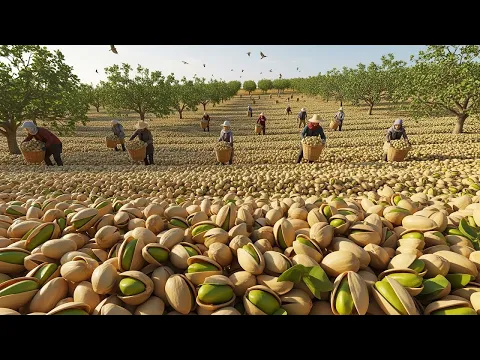

The same agency points out that the productive area in California reached about 488,000 acres in 2024, keeping the country as the main global producer in recent years.
This growth is associated with the expansion of commercial orchards and the use of mechanized systems, which allow dealing with high volumes in increasingly restricted time windows.
Still, industry technicians emphasize that a significant portion of these areas still consists of young trees, which gradually come into full production.
How Pistachio Cultivation Begins in Greenhouses
Before reaching the definitive field, the pistachio goes through a nursery phase that typically takes place in greenhouses with controlled environments.
According to the material presented by Everything For Everything, these structures maintain stable temperature and humidity to favor the initial development of seedlings and reduce early losses.
In the first months, the plants receive adjusted irrigation and nutrition, as well as protection against pests and sudden climatic variations.
This management seeks to ensure uniformity of the seedlings, a factor considered important for large-scale commercial orchards.
After about a year, the seedlings undergo pruning and selection, focusing on specimens that show greater vegetative vigor.
Producers and agricultural technicians often point out that failures in this initial stage have a long-term impact.
This is because pistachio is a perennial crop with a slow return, requiring prolonged financial planning.
Grafting and Standardization of Production
Grafting appears as a central stage in the production system presented.
The technique consists of joining a rootstock adapted to the soil and climate conditions with a selected productive variety.

In the case shown, the Kerman variety is used due to its widespread commercial adoption and characteristics suitable for the market.
This procedure, according to fruit cultivation experts, seeks to increase production predictability and standardization of the fruits, without altering the time required for the tree to reach maturity.
Even with grafting, the pistachio remains a long-cycle crop.
The information from the video indicates that trees take about six years after planting in the orchard to achieve full production.
During this period, maintenance costs remain, which explains why decisions made at the beginning of cultivation are considered strategic for the economic viability of the project.
Mechanized Harvest and Critical Time Window
When the fruits open naturally, signaling that they have reached the harvest point, a phase considered critical begins.
The operation needs to be quick to avoid problems associated with the excessive presence of pistachios in the field.
In the example shown, the goal is to collect more than 300 tons in about seven days.
To achieve this, harvesters that attach to the trunk and apply controlled vibration come into action, making the fruits fall in a few seconds.
The method reduces reliance on manual labor and allows greater standardization of work pace.
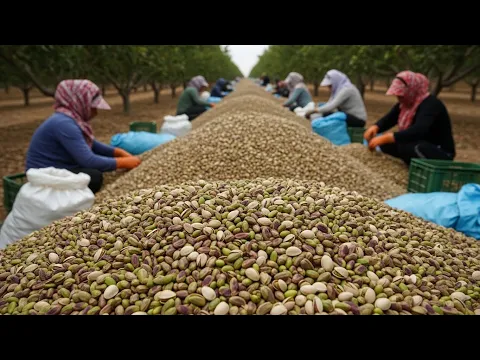
Moreover, it decreases the pistachios’ exposure time to environmental conditions.
After collection, transport to the processing plant also requires attention.
In the presented case, the distance is approximately 75 kilometers, and the operational goal is to start processing in less than 24 hours.
This timeframe is cited by technicians as relevant to reduce risks of contamination by fungi.
Industrial Processing and Quality Control
The processing involves a sequence of steps aimed at cleaning, drying, and sorting the fruits.
Initially, the pistachios undergo washing to remove impurities.
Then, they enter vertical drying systems, described as structures with about 12 meters high, designed to quickly reduce humidity.
In the next phase, sensors and sorting equipment analyze the fruits, separating those that meet commercial standards.
The presented material mentions processing capacity of several tons per hour, compatible with the concentrated volume of the harvest.
Finally, the moisture is adjusted to levels close to 5%, a value generally associated with stability and texture of the product.
From there, the pistachio proceeds to packaging and distribution.
The process concludes a cycle that combines years of cultivation with few decisive days of harvesting and processing.





se brincar a nordeste poderia ser om local de cultivo. pena que o povo ao pensa no bolsa familia