Portuguese
  Spanish


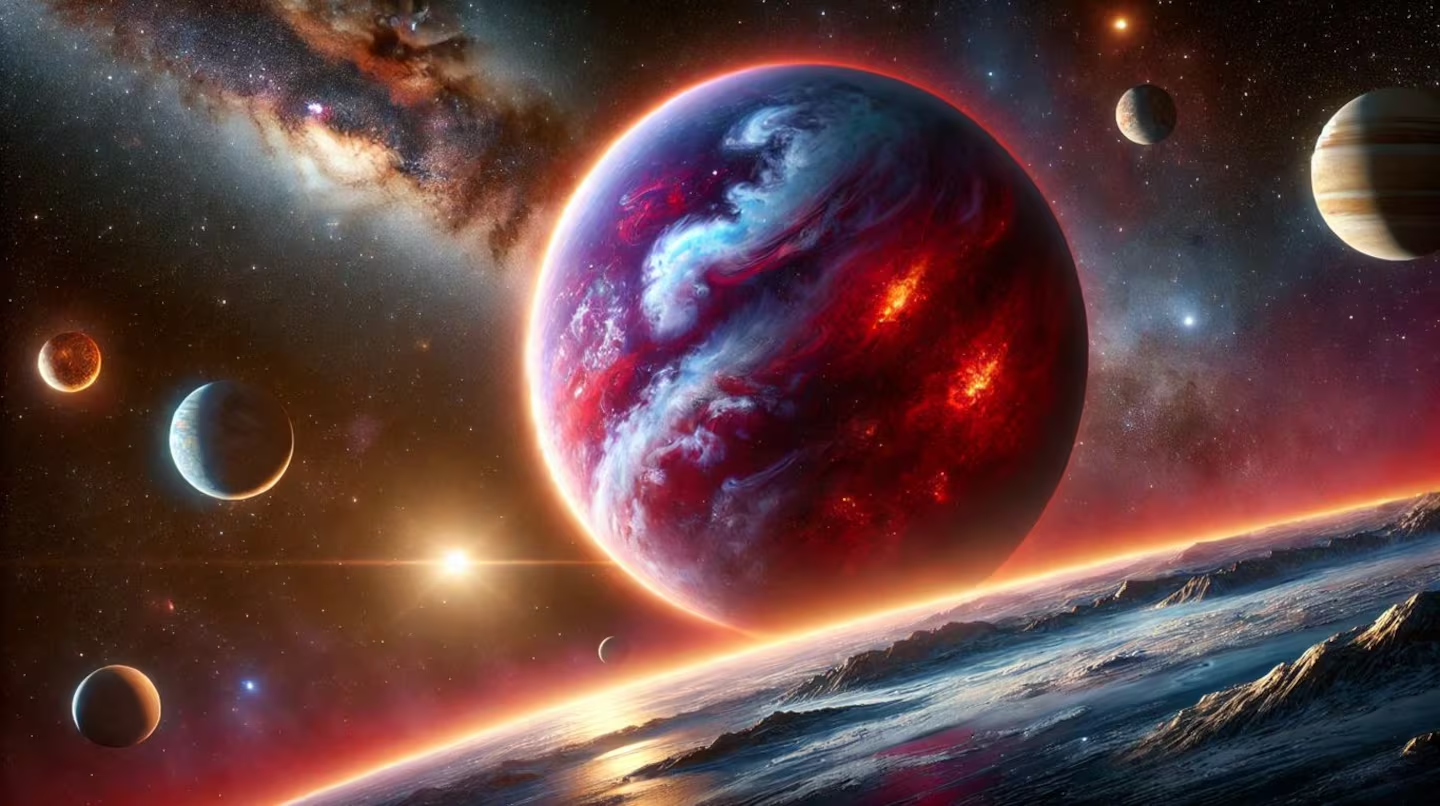

The Universe Hides Planets With Conditions So Extreme They Challenge The Imagination. Some Of Them Have Scorching Heat, Metallic Rains, And Incredibly Fast Orbits, Surprising Astronomers
The vastness of the universe harbors mysteries that go beyond human imagination. Since science began to explore deep space, thousands of exoplanets have been identified, revealing extreme and surprising conditions.
Among these worlds, some defy any known standard.
Three of them stand out: one where it rains metal, another so hot that it vaporizes common materials on Earth, and a system that moves at impressive speeds.
-
Meteor Showers and Full Moon Create Rare Celestial Display Over Brazil in Late July

-
Metal Detector Enthusiasts Uncover Largest Viking Coin Hoard in Norwegian History with 2,970 Silver Pieces Near Rena

-
5 km Lunar Pipeline Could Supply Oxygen to Astronaut Bases, Replace Transport Robots, and Become First Major Infrastructure Project Beyond Earth
-
U.S. Attempted to Tame Hurricanes with Silver Iodide and Aircraft for Nearly 20 Years



The Universe Of Exoplanets
The existence of exoplanets was first confirmed in 1992.
Since then, more than 5,800 have been cataloged, and thousands more are under analysis.
These worlds range from rocky, gaseous, icy, to incandescent. Studying them is essential to understanding planetary formation and, perhaps, finding signs of life.
Alexander Wolszczan, responsible for the initial discovery of planets outside the Solar System, believes that finding life somewhere in the universe is only a matter of time. “The chemical composition of life on Earth is similar to that found in other places in the cosmos,” he stated.
Exoplanets With Scorching Temperatures
WASP-69b: Located 164 light-years away, WASP-69b is peculiar for two reasons: its extreme temperature and its gas tail.
The proximity to its star causes its atmosphere to be stripped away, forming a trail similar to that of a comet.
Moreover, its surface reaches about 600 °C. Its orbital cycle is incredibly fast, completing a year in less than four days.
WASP-121b: At 858 light-years away, WASP-121b exhibits a rare and impressive phenomenon: metallic rain.
The temperature on the side facing its star reaches 2,500 °C, sufficient to vaporize metals.
These vapors are carried by winds of 17,000 km/h to the dark side, where they cool and fall like rain of iron and titanium.
This exoplanet is a gas giant, 1.2 times the size of Jupiter, and completes its orbit in just 1.3 Earth days.
It is an extreme example of a “hot Jupiter,” massive gas planets that orbit their stars at incredibly short distances.
The Fastest Exoplanet Ever Registered
One of the fastest systems known in the universe was recently identified. The exoplanet and its star travel together at 540 km/s, almost three times the speed of the Solar System.
For comparison, the speed is so extreme that the planet could cover the distance between Buenos Aires and Mar del Plata in less than a second.
This system was first identified in 2011 but was only recently analyzed in detail.
It is believed that the planet is a super-Neptune, orbiting a low-mass star in an orbit comparable to that of Venus or Earth.
The Youngest Exoplanet Known
Another recent finding impresses with its age. IRAS 04125+2902 b is the youngest exoplanet identified, at only 3 million years old. For comparison, most known exoplanets are about 4.5 billion years old.
The planet was discovered by Madyson Barber, a researcher at the University of Northern California. “At the moment of discovery, I didn’t realize the magnitude of what I had found,” she stated.
Its youth may provide valuable clues about planet formation, including that of Earth.
Scientists hope that the James Webb Space Telescope will be able to conduct more detailed observations of this planet, helping to better understand its mass and origin.
“If we can better determine its mass, we may be able to understand how it formed and, consequently, how our own planet came to be,” Barber concluded.
The study of exoplanets continues to reveal exotic and surprising worlds.
Each discovery broadens our understanding of the cosmos and may provide clues about the very existence of life beyond Earth.
With increasingly advanced telescopes, the exploration of the universe holds even more mysteries to be unraveled.