Portuguese
  Spanish




Revolutionary Innovation! Students Developed Pyri, A Pineapple-Shaped Wildfire Detector Made With Organic Materials
September has arrived bringing an environmental crisis that threatens Brazilian biomes. The country is facing an alarming increase in the number of wildfires, especially in the Amazon, in the Pantanal, and in the Cerrado.
The seriousness of the situation puts wildlife and flora at risk, as well as directly impacting communities living in the affected regions.
This is a global problem, recurring in various parts of the world, which has led many researchers to seek solutions to mitigate it.
-
Spain Launches World’s Largest Floating Dry Dock: 56-Meter Giant Produces Massive Concrete Structures in A Coruña Using Technology Proven in Brazil

-
AI-powered toys that talk, recognize faces, and collect data face scrutiny from Brazilian government over children’s privacy concerns

-
4,000-Year-Old Child’s Skull Unveils Ancient Burial in 7,500-Year-Old Norwegian Rock Shelter, Impressing Archaeologists

-
Norway Defeats Brazil in World Cup but Invests Billions to Preserve the Amazon, Strengthens Amazon Fund, and Joins Brazil in Leading Global Effort Against Tropical Deforestation




A promising example comes from a group of English students who created Pyri, an innovative wildfire detector that combines cutting-edge technology with principles of sustainability.

What Is Pyri?
Pyri is an early wildfire detection system designed to operate in remote areas at low cost and high efficiency. Inspired by natural processes, the device uses organic and biodegradable materials in its composition, functioning as a “sentinel” against fires in forests.
Its detection technology is activated by heat, allowing signals to be sent in real-time to alert communities and emergency teams about the threat of wildfires.
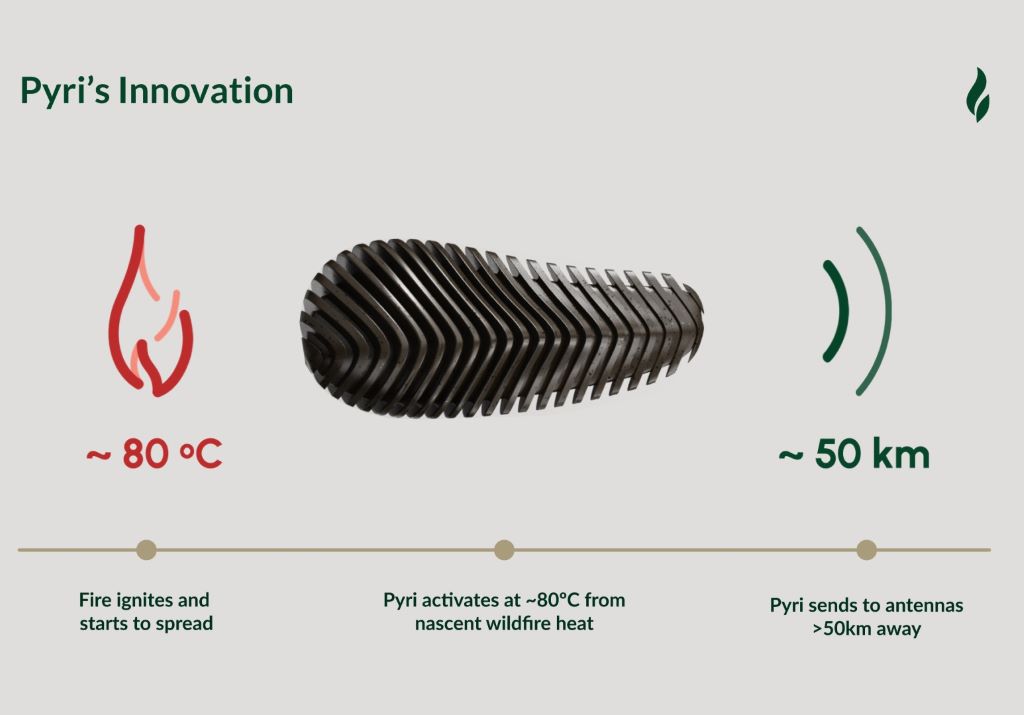
The distinguishing feature of Pyri lies in its innovative structure, which simulates a pineapple. The device has a wax shell that melts with heat, releasing a solution of saline water that activates its electronic components.
These components emit a radio frequency (RF) signal, which can be picked up by telecommunications towers or dedicated receivers. This allows the precise location of the fire to be identified, enabling swift and efficient action.
Inspiration Behind Pyri
Nature was the main source of inspiration for the development of Pyri. The serotinous pineapple, a variety that releases its seeds only when exposed to fire, served as a model for the device’s activation mechanism.
The development team aimed to create a solution that respects the environment, using organic materials and avoiding the use of toxic and polluting substances.
Climate change has been a key motivating factor for the creation of Pyri. It is estimated that by 2100, the occurrence of extreme wildfires may increase by up to 50%, especially affecting regions like the Arctic and tropical forests. These areas host communities that are often unprepared to deal with natural disasters of this magnitude.
Early detection, therefore, is vital to mitigate the damage caused by wildfires, and Pyri presents itself as an accessible and efficient solution.
How Does Pyri Work?

The operation of Pyri is simple yet extremely effective. The device is designed to be distributed in forested areas by helicopters or ground teams, using small capsules called “PyriPods.”
When a fire is detected, the heat causes the wax covering Pyri to melt, activating the internal circuit. This circuit generates enough energy to emit an RF signal, which is captured by communication towers or receiving devices.
Once the signal is sent, the fire’s location is triangulated and cross-referenced with meteorological and satellite information using artificial intelligence (AI). This way, it is possible to predict the behavior of the fire and alert emergency teams and at-risk communities. All of this happens quickly and accurately, allowing measures to be taken before the fire causes irreparable damage.
The environmental impact of Pyri has also been carefully considered. When activated and fulfilling its function, the device burns without releasing toxic substances, as it is made from biodegradable materials. This ensures that Pyri is not only efficient but also safe for the environment.
Development Process
The development of Pyri involved a rigorous process of research and experimentation. The team responsible for the project conducted interviews with more than 20 wildfires experts and members of communities affected by such disasters, in regions such as Jamaica, Turkey, and Canada.
These conversations helped shape the device’s design, ensuring that it meets the real needs of people facing wildfires in their daily lives.
Additionally, the team conducted a series of laboratory experiments to test different detection technologies, such as heat, smoke, and infrasound sensors. The result was a heat-based detection system that offers high precision and low operating costs.
With the support of Hazelab from Imperial College, the team validated the prototypes and filed a patent application for the innovative technology that enables energy generation, signaling, and radio transmission.
What Makes Pyri Different?
Although there are already other wildfire detection technologies, such as drones and Internet of Things (IoT) sensors, most of these solutions are expensive and complex, requiring constant maintenance and specialized technical knowledge.
Pyri stands out as a more accessible and sustainable alternative, using eco-friendly and low-cost materials.
Another aspect that makes Pyri unique is its scalability. The device can be used on a large scale, covering vast forest areas and providing accurate fire detection.
Its operational simplicity is also a strong point, as it does not require frequent maintenance or specialized installation.
Future Plans


The Pyri project is already in the patent application process, and the next step involves developing alpha units for reliability testing.
The team is also expanding its network of collaborators and interested parties, seeking partnerships with national parks and private landowners, who could be the first to adopt the technology in their forest areas.
Pilot tests are planned to take place in partnership with a national park or landowner, allowing the system to be tested in real conditions.
The team is confident that Pyri can become a widely used solution in wildfire prevention, helping to protect forests, communities, and entire ecosystems.
Pyri is an innovative and sustainable solution that promises to revolutionize the way we detect and combat wildfires. Inspired by nature and developed based on extensive research, the device combines technology and ecology to offer an accessible and effective alternative.
With its scalability potential and low environmental impact, Pyri has everything it takes to become an indispensable tool in preserving forests and protecting vulnerable communities around the world.