






 Portuguese
  Spanish


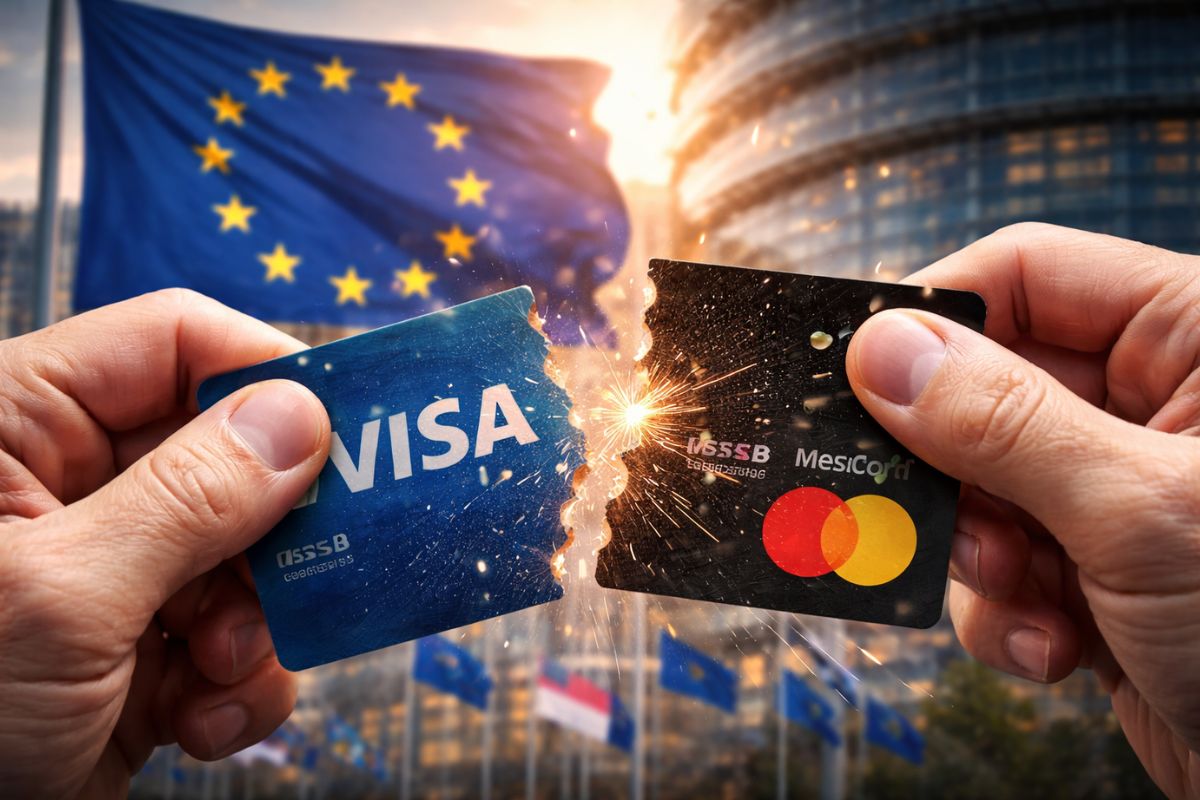


After ECB Warning, Europe Accelerates Its Own Digital Payments System to Reduce Dependence on Visa and Mastercard, Keep Data Under Local Jurisdiction, and Connect 130 Million Users in 13 Countries via Wero; The Promise is Interoperability Across Borders, with Already Strong Transfers and Retail Advancing in 2026 as Well
In 2026, Europe opened a sensitive front by discussing an operational break with American networks and reorganizing digital payments within the continent itself. The debate gained momentum when the estimated annual flow of US$ 24 trillion processed by Visa and Mastercard became the focus of public attention.
The decision stems from a point of vulnerability little perceived by consumers: card and mobile payments can shift data outside of European jurisdiction. The proposed response mixes geopolitical urgency, data protection, and an attempt to resolve a historic problem of fragmentation among countries.
What Europe Wants by Altering the Payment Infrastructure
The president of the ECB, Christine Lagarde, argued that Europe urgently needs its own digital payments system, claiming that transactions made with cards or via mobile tend to go through non-European infrastructure operated by Visa, Mastercard, and other external services.
-
IKEA’s AI Handles Nearly Half of Customer Calls, Company Reassigns 8,500 Staff as Design Consultants, Boosting Revenue by €1.3 Billion

-
Owner of Havan Visits Paraguay to Discuss Lower Taxes, Local Suppliers, and International Expansion with President

-
Brazilian Construction Retail Chain Closes After 60 Years, Begins Liquidation Sale Across Five Cities
-
Brazil Approves Landmark Bill Requiring Workplace Adaptations for Autism Inclusion





The stated goal is to regain control over the tracks through which data and money flow.
The issue is not just about efficiency. Each purchase leaves traces: who bought, what, where, when, and for how much.
By insisting on sovereignty, Europe places payments on the same strategic level of autonomy in energy and defense, as it involves data, service continuity, and the ability to respond to international shocks.
Why Visa and Mastercard Became the Pressure Point of the Debate
The scale helps explain the friction: Visa and Mastercard process together about US$ 24 trillion annually in transactions.
Within the European Union, card payments account for 56% of cashless transactions, which amplifies the systemic weight of these networks for consumers, retail, and banks.
There is also a precedent that changed the political tone. In 2022, Western sanctions cut Russia’s access to Visa and Mastercard, and the country’s internal payments suffered immediate disruptions.
The question now is direct within Europe: what would happen if a restriction scenario were to hit the continent or parts of it under external pressure?
Wero and the Attempt to Turn the Table Without Starting from Scratch
The most concrete European response mentioned at the base is the European Payments Initiative, a consortium of 16 major banks and processors, which launched the digital wallet Wero in July 2024.
The design is account-to-account, supported by instant SEPA credit transfers, allowing money to be sent with a phone number, without IBAN, without a card, and without intermediaries from American networks.
The disclosed numbers are a sign of traction: Wero has over 47 million registered users in Belgium, France, and Germany, processed over € 7.5 billion in transfers, and brings together more than 1,100 associated institutions.
In retail, payments began to operate in Germany at the end of 2025, and France and Belgium are on the expansion roadmap for 2026.
EuroPA: The Bridge to 130 Million Users and the Fragmentation Problem
The most relevant political-operational step occurred on February 2, when the EPI and the EuroPA Alliance signed a memorandum to build a pan-European interoperable payments network.
The strategy is to connect existing national solutions, rather than trying to replace everything at once, reducing friction and accelerating critical mass.
The reported reach is significant: around 130 million users in 13 countries, covering approximately 72% of the population of the EU and Norway.
The agenda is also phased: cross-border point-to-point payments are planned for this year, with payments in e-commerce and point of sale projected for 2027.
What Failed Before and Why Europe is Insisting Now
Europe has already attempted to unify payments and stumbled. The Monnet Project, launched in 2008, collapsed in 2012. The original vision of the EPI was scaled back after member exits forced a change from a comprehensive card scheme to a more restricted model.
The recurring obstacle is fragmentation, with each country advancing on its domestic solution, but lacking real functionality across borders.
The network effect complicates matters. Merchants accept Visa and Mastercard because consumers use Visa and Mastercard, and consumers use them because merchants accept them.
Breaking this cycle requires either strong regulation or sufficient critical mass, and that is exactly what Europe is trying to create with Wero connected to EuroPA, attacking the problem of cross-border payments that has always pushed users back to Visa and Mastercard.
Digital Euro: When Public Money Enters the Same Payment Dispute
In parallel, the BCE’s digital euro project is ongoing, a digital currency issued by the central bank for use throughout the eurozone.
The basis indicates that discussions have accelerated, but the European Parliament has yet to approve the necessary legislation, and the ECB estimates another two to three years for launch after approval.
The EPI is attempting to separate the components: Wero as a private initiative and digital euro as public money, designed to complement each other.
Still, the overlap is evident: both exist because Europe has come to treat payments as critical infrastructure, and not as an invisible detail of daily consumption.
The discussed break is not just about swapping one brand for another. It involves payments, data, operational continuity, and the capacity of a continent to reduce external dependence in a market where Visa and Mastercard dominate scale and habit.
The European project has traction, but it also faces high costs, entrenched consumer habits, and the challenge of moving quickly enough to make a difference.
In practice, what would you consider more decisive for Europe to change its daily payments: a regulatory requirement, retail discounts, automatic integration in banks, or a data protection argument that makes consumers abandon Visa and Mastercard and try Wero?





Problema número 1 fez o app fazendo Alarde, problema número 2 o sistema de pagamento ao meu ver não foi pensado como o Pix. Problema 3 criou a ruptura antes de saber se o app vai realmente da certo. O Pix no Brasil foi criado com uma proposta diferente, silenciosa e não houve ruptura dos cartões porém, está cada vez mais claro que vai substituir os cartões da visa e master. O Pix não criou alarde, mas hoje já processa mais transação que os cartões de crédito. E é exatamente por isso que tão **** com Pix. São pequenas diferença que a Europa fez que o Brasil não fez. Aqui fui bem no silencio e bem sorrateiramente.
Eu creio que devido a proteção de dados seja a opção dos europeus.
Algo como o Pix resolve.