Portuguese
  Spanish


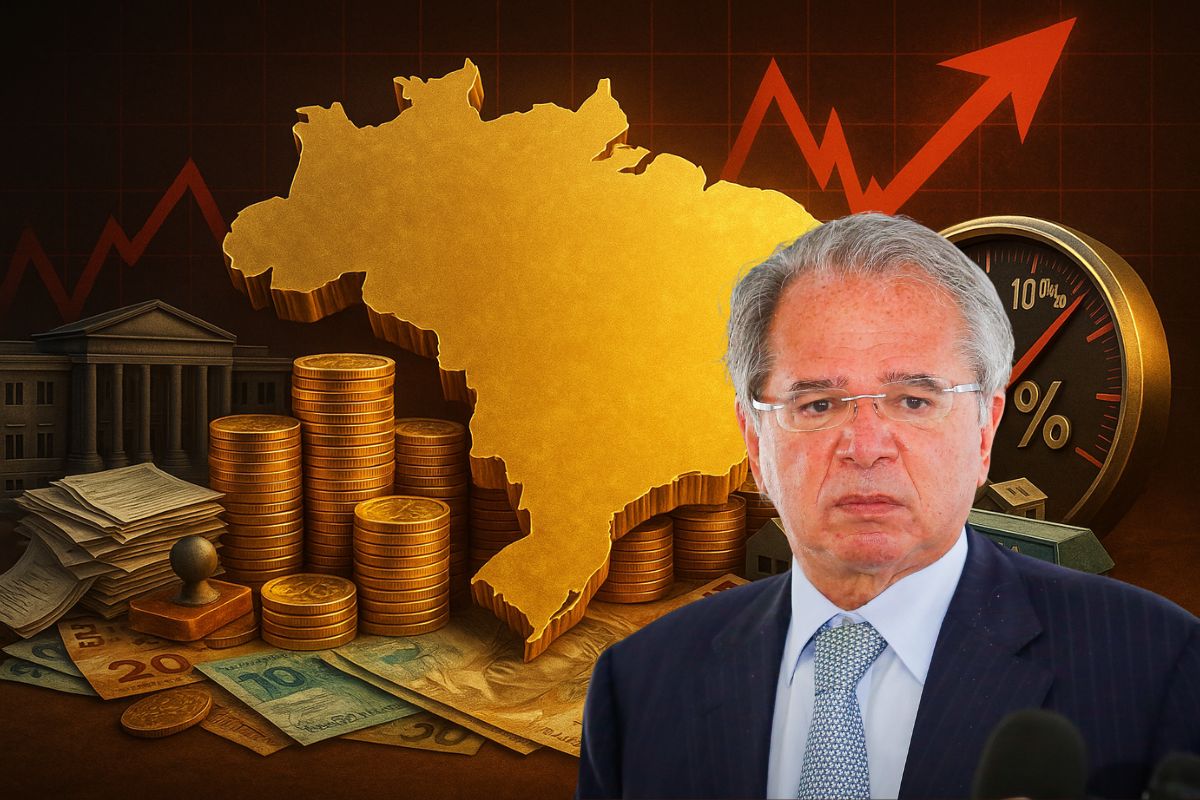


For Paulo Guedes, High Interest Rates Are Not “The Fault of the Central Bank”: They Are Directly Reflected in the Excessive Government Spending and This Harms Companies “In Full Flight”.
The economist Paulo Guedes, former Minister of Economy, has once again criticized the Brazilian fiscal model and pointed to public spending as the main reason for high interest rates in the country. In a recent interview, he explained that the Central Bank merely reacts to the imbalance in government accounts, keeping interest rates high to contain inflation. For Guedes, “high interest rates do not arise from the BC, they arise from excessive government spending”, and this model ultimately harms companies of all sizes.
He also recalled the hyperinflation that reached 5,000% in the 1980s and early 1990s, highlighting that Brazil only overcame instability with the Real Plan but remained trapped in a scenario of structurally high interest rates and weak growth.
What Paulo Guedes Points Out as the Origin of the Problem
According to Paulo Guedes, the recurrent fiscal imbalance forces the Central Bank to keep interest rates at high levels to contain pressure on prices. If the government spends too much, the BC reacts with high interest rates; if it spends less, interest rates may fall.
-
Family Quietly Transforms Old Sawmill into $700 Million Business, Opens 25 Stores in Two Years Across 22 Brazilian States

-
Couple Sold Their Home to Save Business, Now Run Platform Handling $180 Million Monthly and Managing Over 51 Million Listings
-
Brazil’s 2026 Tax Refund: Record 9.58 Million Filers in Largest Payout Ever, But a Key Detail on Priority Recipients Draws Nationwide Attention

-
Itaú Alters Hybrid Work Model, Increasing Office Days from 2028, Prompting Employees to Adjust to New Routine




In practice, this stifles economic growth. Large, medium, and small companies, which rely on credit to invest, end up being “mortally wounded” by high interest rates, which make financing more expensive and reduce the capacity for expansion.
The Reminder of Hyperinflation
During the interview, Paulo Guedes recalled the period of hyperinflation, when measures such as price freezes (Cruzado Plan) and asset blocking (Collor government) did not solve the root of the problem. According to him, the country only stabilized the currency with the Real Plan but remained trapped in the dilemma: traded inflation for indebtedness, accumulating a “snowball” of interest and low growth.
He also remembered the use of “overnight” — very short-term financial investments that families used to protect savings amid rampant price controls. This behavior marked an entire generation and shaped Brazilian financial culture.
High Taxes and Centralized State


Another central point of Paulo Guedes‘ speech was the comparison of the Brazilian tax burden with that of other emerging countries. While the international average is around 25% to 26% of GDP, in Brazil this number reaches 34% or 35%.
For Guedes, this difference shows a heavy State, concentrated in Brasília, but absent “on the ground”, that is, in essential areas like health, education, security, and sanitation. His motto, “more Brazil, less Brasília,” summarizes the defense for decentralizing resources and fiscal discipline.
What He Advocates as a Solution
In Paulo Guedes‘ view, the only way to sustainably reduce interest rates is to control public spending. Without that, Brazil will remain trapped in a vicious cycle: high spending → high interest rates → expensive credit → harmed companies → less investment and employment.
For the former minister, a consistent fiscal adjustment is the key to freeing up growth and allowing for lower interest rates in a sustainable manner. He also emphasizes that structural reforms are necessary to prioritize investments in areas that truly impact the lives of the population.
Paulo Guedes‘ remarks expose the debate over the weight of the State in the economy and how this directly affects the lives of Brazilians. For him, as long as the government spends more than it collects, interest rates will remain high and the country will continue to be limited in growth.
And you, do you agree with Paulo Guedes’ view? Do you think the problem in Brazil lies in public spending or elsewhere? Leave your opinion in the comments — we want to hear from those who experience this firsthand.