






 Portuguese
  Spanish
  4 min of reading
  0 comments


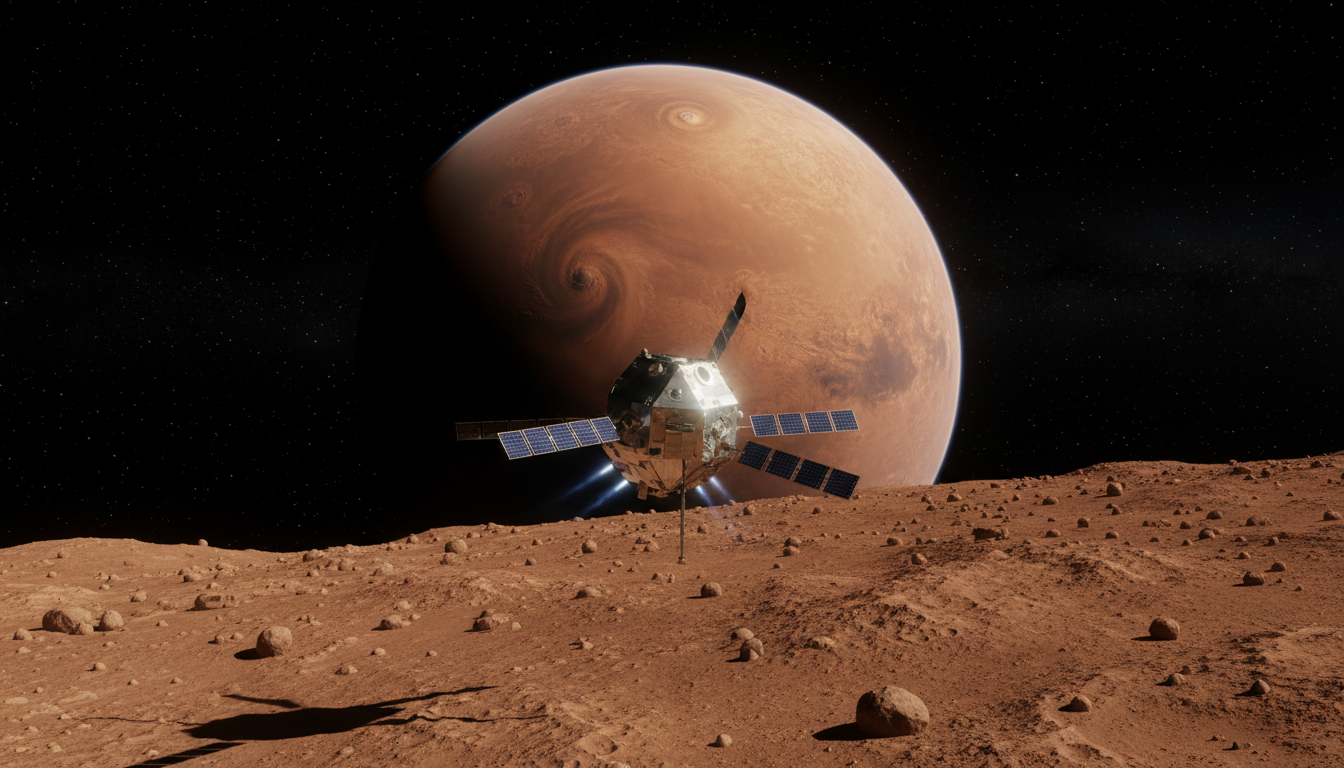
For the first time in history, a mission will land on Mars’ moon that orbits just 6,000 kilometers from the planet — and if all goes well, Japan will bring back a piece of Phobos to Earth in 2031
Humanity has already landed robots on Mars, collected samples from asteroids, and sent probes to the far reaches of the Solar System. But no one has ever touched Mars’ moons. The MMX mission — Martian Moons eXploration — from the Japanese space agency JAXA aims to change that by landing on Phobos and bringing samples back to Earth.
The launch is scheduled for late 2026. If everything goes as planned, the probe will return with material from Phobos in 2031 — five years after leaving Japan.
This will be the first time humanity collects samples from a moon of another planet. And if everything works, it could be the key to understanding how Mars — and perhaps life — formed in the Solar System.
-
A doctor from Minas Gerais warns that sleeping with the fan pointed at the body all night is not as harmless as you think; it dries out the respiratory tract, causes mucus buildup, spreads dust mites, and can even irritate the cornea of the eyes.

-
Ecuadorian volcano at 6,268 meters is more than 2,000 meters closer to space than Everest, which is 8,848 meters, because the Earth is wider at the equator.
-
Public school students in the hinterlands of Maranhão create a bioinsecticide with neem and castor to protect corn crops, transform rural waste into biogas and biofertilizer, and bring sustainable technology to producers at ExpoSertão.

-
Ötzi, the 5,300-year-old mummy found in the Alps, reveals a still active microbiome, and the Iceman’s yeast points to an energy-saving fermentation.


Phobos: the mysterious moon that orbits Mars just 6,000 kilometers away
Mars has two moons: Phobos and Deimos. Both are small, irregular, and dark — very different from our Moon.
Phobos is the larger of the two, with a diameter of about 22 kilometers. It orbits Mars so closely — just 6,000 kilometers from the surface — that it completes an orbit around the planet in less than 8 hours.
For comparison, our Moon is 384,000 kilometers from Earth. Phobos is 64 times closer to Mars than the Moon is to us.
And no one knows for sure where it came from. Phobos is so dark that it reflects less than 7% of the sunlight it receives — darker than coal. Its surface is covered in craters, and the largest of them, Stickney, is nearly half the diameter of the moon itself.
One theory suggests that Phobos is an asteroid captured by Mars’ gravity. Another suggests that it formed from debris from a giant collision with the planet.
The MMX mission aims to resolve this question by bringing samples back to Earth for laboratory analysis.

What the MMX will do — and why it is so difficult
The MMX probe is an ambitious project that involves multiple phases over five years.
After the launch in late 2026, the spacecraft will travel for approximately one year to Mars’ orbit.
Once there, it will spend months orbiting Phobos and Deimos, mapping the surface, analyzing the composition, and selecting the ideal landing site.
The landing itself is extremely challenging. Phobos has almost nonexistent gravity — about a thousand times less than Earth’s. An astronaut on Phobos would weigh less than 100 grams.
In these conditions, landing without bouncing back into space requires absolute control of speed and orientation.
The probe will collect surface samples using a robotic arm and a drilling mechanism. The material will be stored in a capsule that will be sent back to Earth.
12 scientific instruments on board
The MMX carries instruments from four space agencies: JAXA (Japan), NASA (USA), ESA (Europe), and CNES (France).
- High-resolution cameras to map Phobos and Deimos
- Spectrometers to analyze the mineral composition of the surface
- Radar to study the internal structure of the moons
- Instruments to measure dust, radiation, and gravitational field
This is the first time a mission to Mars has direct participation from four space agencies — a rare level of international cooperation in deep space exploration.
NASA contributes an instrument called MEGANE, which will measure the elemental composition of Phobos’ surface using gamma rays and neutrons.

Why bringing back a piece of Phobos could change what we know about Mars
Phobos may contain something extraordinarily valuable: material ejected from Mars.
Over billions of years, asteroid impacts on the Martian surface have launched rock fragments into space. Some of this material may have landed on Phobos.
This means that samples from Phobos could literally contain pieces of Mars — including material from times when the planet had liquid water on its surface.
Finding organic matter or minerals formed in water within this material would be powerful evidence that Mars once harbored conditions favorable to life.
And all of this would be analyzed with laboratory equipment on Earth — infinitely more precise than any instrument a probe can carry.

The way back: bringing samples from 300 million kilometers
Collecting samples is one thing. Bringing them back is a completely different matter.
The MMX will need to take off from Phobos, enter orbit around Mars, and then begin the journey back to Earth — a journey of hundreds of millions of kilometers.
The return capsule will re-enter the Earth’s atmosphere at extreme speed and will need to be recovered intact.
JAXA has experience with this type of operation. In 2020, the Hayabusa2 mission successfully brought samples from the asteroid Ryugu — proving that the Japanese agency has mastered the art of round trips in deep space. But Ryugu was “only” 300 million kilometers away. Mars can be over 400 million, depending on orbital position.
The MMX mission is not just about science. According to JAXA, it is “an extremely important step in acquiring new exploration technologies” for future deep space missions.
However, the project faces uncertainties. In 2024, JAXA postponed the launch from 2024 to 2026 due to issues with the H3 rocket. The launch window for Mars is limited — if they miss the 2026 window, they will have to wait until 2028.
If all goes well, in 2031 scientists around the world will have something humanity has never had: a real fragment of a moon of Mars.
If all goes well and samples from Phobos arrive in 2031, will we find traces that Mars once harbored life — or just more unanswered questions?




-

-

4 people reacted to this.