Portuguese
  Spanish


Water structure in São Gabriel gathers million-dollar investment, large-scale reservoir, and technical stages that still define when water will reach the agricultural areas planned in the project.
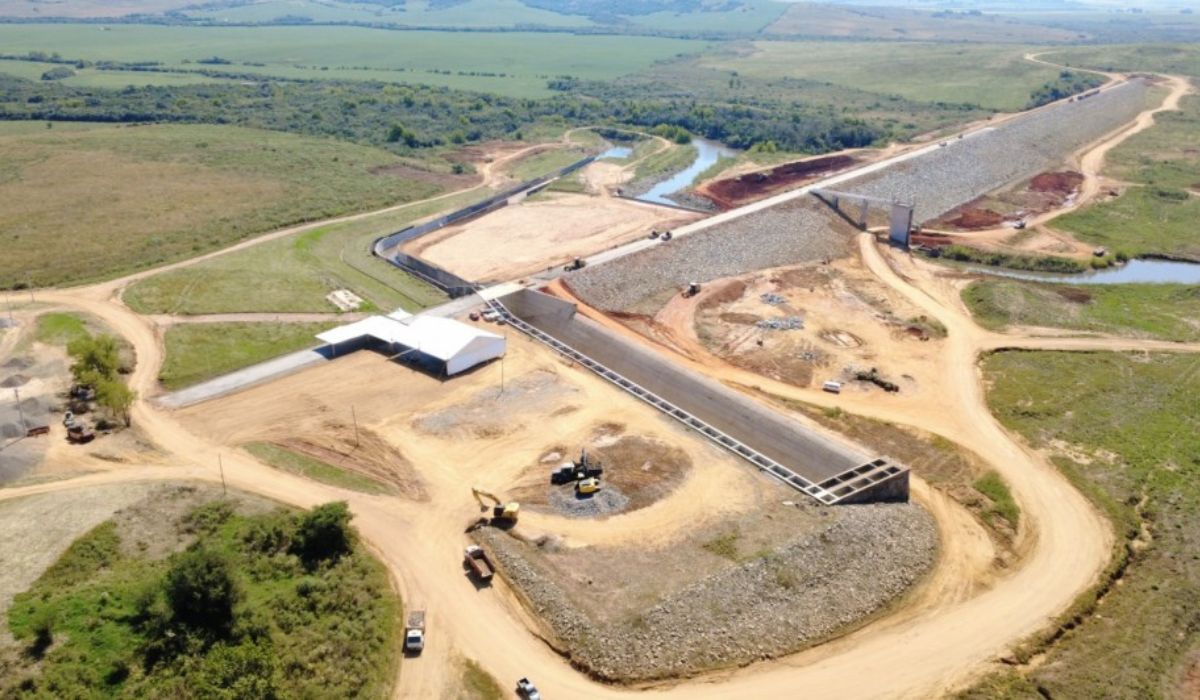
The government of Rio Grande do Sul delivered, on April 1, 2026, the main structure of the Jaguari Dam, in São Gabriel, in the Western Frontier.
The project received R$ 365.7 million in state and federal investments and was planned to increase the water supply for irrigation, reduce losses caused by droughts, and help control floods in the region.
The dam is located in the district of Suspiro, on the border with Lavras do Sul, and was built over the Jaguari stream.
-
As Brazil Expands Social Welfare, Survey Reveals 40% Blame Poverty on Laziness, While 58% Cite Lack of Opportunities

-
Giant 3,600-ton Crane Breaks Two World Records by Installing World’s Largest Single-Piece Forged and Welded Hydrogenation Reactor, Weighing 3,037 Tons, in Chinese Petrochemical Plant in Just Six Days

-
$80 Million Bridge in Brazil Cuts Travel Time from 30 Minutes to 1 Minute, but Audit Reveals Major Flaws
-
Man Builds Stone Bed with Granite Rocks and Hand-Sawn Cedar Beams, Home Extension Garners Over 437,000 Views on Bonus Bolts Channel


The completion of the main structure was announced by Governor Eduardo Leite, Vice-Governor Gabriel Souza, and the State Secretary of Public Works, Izabel Matte, according to information released by the state government.
Of the R$ 365.7 million invested in the project, R$ 249 million were provided by the government of Rio Grande do Sul.
From this amount, R$ 122 million came from the State Treasury and R$ 127 million came from the Water Resources Investment Fund.
The Union contributed another R$ 116.7 million for the construction.
Jaguari Dam is expected to serve municipalities of the Campaign and the Western Frontier
The Jaguari Dam is expected to benefit more than 100,000 inhabitants of São Gabriel, Lavras do Sul, and Rosário do Sul, according to the state government.
Integrated with the Taquarembó Dam, under construction in Dom Pedrito, the structure is also expected to form a system aimed at serving Cacequi and Sant’Ana do Livramento, where another 95,600 people live.
With 25 meters in height and more than one kilometer in length, the dam can form a reservoir with more than 138 million cubic meters of water.
The volume was compared by the State to about 55,300 Olympic swimming pools.
The planned flooded area is 1,798 hectares, equivalent to more than 2,500 football fields.
The structure was mainly built with compacted clay, a material used in dams for its low permeability.
The project also includes filters, drainage systems, stone lining on the reservoir side, and vegetation cover on the opposite face, resources aimed at protection against erosion and maintaining the stability of the dam.
In a statement released by the state government, Secretary Izabel Matte stated that the delivery represents “a great instrument of economic incentive and protection against climate crises.”
The statement was made in the context of the completion of a project that underwent stoppages, environmental adjustments, and contractual revisions since the start of construction.
Irrigation gains weight in the debate on losses in the Gaucho countryside
The delivery of the structure occurs during a period of frequent losses in Gaucho agriculture caused by climatic events.
A survey by the Federation of Agriculture of the State of Rio Grande do Sul indicates that, between 2020 and 2024, rural producers lost R$ 106.6 billion due to climate-related breakdowns.
In the same period, according to data attributed to Farsul, Rio Grande do Sul lost 40.6 million tons of grains, considering rice, corn, soybeans, and wheat.
The entity also estimated that the state economy failed to generate R$ 319.2 billion in Gross Domestic Product, equivalent to 49% of the 2023 Gaucho GDP.
In this scenario, the state government presents the Jaguari Dam as a project to increase predictability in water use.
When operational, the reservoir is expected to allow areas currently without access to irrigation to receive water in a controlled manner, especially during drought periods.
Besides its function for the countryside, the dam was also planned to act as a regulator of water volume in the region’s watercourses.
According to the state government, this control can reduce fluctuations throughout the year and contribute to water management during times of drought or intense rain.
São Gabriel has expanded its agricultural area in recent years.
According to data released by the state government, the municipality has 137,000 hectares planted with soybeans, an increase of almost 50% in ten years.
Alongside rice, the crop represents more than 90% of the harvested area in the municipality.
Irrigation is cited by the State as one of the factors for increased productivity in the field.
According to the official publication on the project, this resource can increase rice production by 3.5 times and double soybean production in the areas served, although it is currently present in only 3.5% of the Gaucho agricultural area.
Construction of the Jaguari Dam began in 2009 and was halted
The Jaguari Dam was announced in 2008, after meetings with rural producers, municipalities, basin committees, and entities linked to the agricultural sector.
The works began in 2009 but were interrupted in 2012.
The resumption occurred only in 2018, six years after the halt.
Among the obstacles pointed out by the state government were adaptations to new legislation, environmental requirements, and limitations of the original contract, which did not cover all services identified during execution.
Throughout the period, the project management went through different departments until it returned to the Department of Public Works.
In the first ten years, 44% of the work was completed, according to the state government.
From 2019 to 2022, the progress was 21 percentage points.
The final stage, corresponding to the remaining 35%, occurred between 2023 and 2026, when the main structure was completed.
The State Attorney General’s Office also participated in the process, with opinions and participation in administrative, judicial, and control stages.
In a statement released by the state government, Attorney General Eduardo Cunha da Costa said that the completion of the work resulted from a “continuous, firm, and technical” legal performance by PGE-RS over more than a decade.
According to the Attorney General, the process involved contractual obstacles, halts, supervening environmental requirements, and administrative restructurings.
He also stated that it was up to PGE-RS to ensure the legality of the acts and the defense of the public interest during the resumption and completion of the project.
Operation of the dam still depends on tests, licenses, and channels
The delivery made in April 2026 corresponds to the main structure of the dam.
Full operation still depends on tests, implementation of complementary systems, licensing, and construction of irrigation channels, which will be responsible for carrying water from the reservoir to the agricultural areas.
The first stage after completion includes initial filling tests.
According to the state government, this procedure will be done slowly, gradually, and controlled, up to a depth of five meters, with a planned duration of up to 18 months.
The goal is to assess risks and identify any anomalies in the structure.
Another phase involves the implementation of the controlled water outlet hydraulic system.
This set of equipment will be responsible for allowing the complete filling of the reservoir safely and for connecting the dam to future distribution structures.
With the approval of the tests and the completion of the necessary improvements, the next step will be obtaining the Operating License and other legal authorizations.
Only after these steps will Jaguari be formally able to supply water for irrigation.
The expectation informed by the state government is that activities will begin in 2027 and that the first impacts will be noticed in the 2028 harvest.
This forecast depends on the progress of the technical and legal stages still pending.
Irrigation channels will be necessary to bring water to the crops
The implementation of irrigation channels will be one of the essential phases for the dam to fulfill its agricultural purpose.
The state government reported that the selection of the company responsible for the preliminary design of the channels and the surveys for the preparation of the Environmental Impact Study and the Environmental Impact Report are already underway.
These studies aim to assess environmental risks and indicate prevention or mitigation measures.
Without the channels, the dam will be able to store water but will not be able to distribute the volume widely to the agricultural areas planned in the project.
The reservoir will have regulated release through water intake, valves, and gates operated from the control house.
The water can follow a diversion channel, used for safe filling or emptying of the lake, or be directed to the irrigation system when this structure is completed.
If the reservoir reaches maximum capacity, the excess should flow through the spillway, equipment used to control the flow rate.
Then, the water will pass through a discharge channel and an energy dissipation basin before returning to the natural bed, a procedure intended to reduce the force of the flow.
The full operation of the Jaguari Dam will, therefore, depend on the completion of stages that go beyond the structure already delivered.