Portuguese
  Spanish


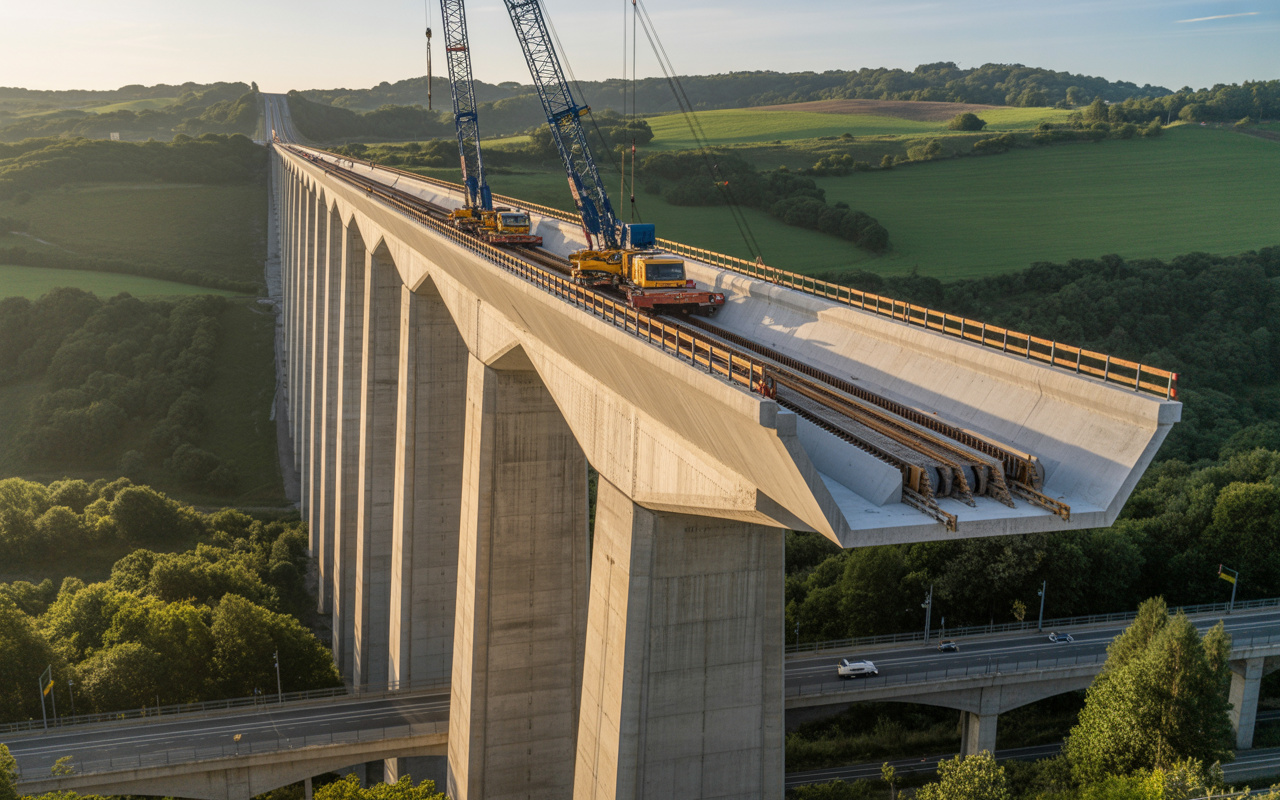


France Builds TGV Viaducts Using Incremental Launching: Segments of Up to 25 Meters and Hundreds of Tons Are Pushed with Hydraulic Jacks Without Interrupting Highways and Valleys Below.
The construction of railway viaducts for high-speed trains in France faces a classic heavy engineering dilemma: long, extremely rigid and precise structures need to cross highways, rivers, deep valleys, and environmentally sensitive areas without halting the country for the work to take place. To solve this problem, French engineers have repeatedly adopted the incremental launching method for the deck, a technique that turns the construction of the viaduct into a continuous and highly controlled process.
Instead of assembling the viaduct span by span on temporary supports, the deck is manufactured in successive segments in a fixed area, typically behind one of the bridge’s abutments. Each pre-tensioned concrete segment, up to 25 meters in length and weighing in the hundreds of tons, is integrated into the existing structure. Then, the entire deck that has been built is pushed forward, as a single block, using large-capacity hydraulic jacks.
Giant Segments Molded Outside the Critical Area
The central principle of the method is simple but powerful: take as much work as possible off the obstacle. The segments are always molded at the same point, under controlled conditions, with geometrical precision and adequate curing of the concrete. This reduces errors, accelerates the pace, and eliminates the need for large construction sites spread along the route.
-
Why can the crane operator only obey the correct signalman on the construction site: among dozens of workers, a hand raised by the wrong person can confuse the maneuver and turn a load of tons into an immediate risk.

-
What changes with the new public transportation rules that can reduce pressure on fares and pave the way for zero fare in Brazil?
-
Argentina confirms Belgian giant to lead strategic Paraná River waterway and promises to reduce logistical costs on one of South America’s most important routes
-
MBRF surprises the logistics sector by demonstrating how Artificial Intelligence can directly influence deliveries throughout Brazil by reorganizing distribution routes in seconds, optimizing fleet usage, reducing logistics costs, and speeding up product arrivals even in the face of unforeseen road incidents.

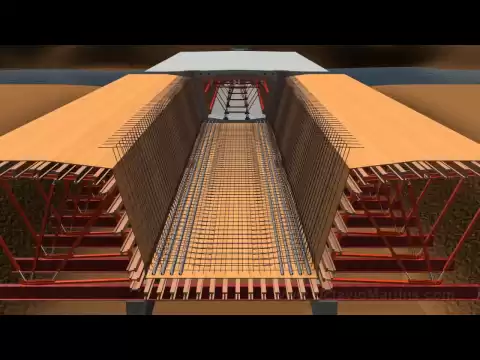

As new segments are added, the deck grows in length and weight. Still, the process remains the same: manufacture, pre-tension, integrate, and push.
Pushing the Entire Deck with Hydraulic Jacks
The most impressive moment occurs in each advance cycle. Sets of synchronized hydraulic jacks come into operation and move the entire deck a few meters forward. The movement is slow and continuous, monitored in real time to control stresses, alignment, and deformations.
To reduce bending moments during the advance, especially when the deck has not yet reached the next support, it is common to use a temporary metal nose attached to the front end. This element, lighter than concrete, helps “pull” the deck over the piers without overloading the structure.
Each cycle represents tens of meters of viaduct positioned, repeated until the deck reaches its final length.
Real Projects in France That Used This Method
This method is not theoretical or sporadic. It has been applied in real viaducts of the TGV system, already in operation. One of the most emblematic cases is the Ventabren Viaduct on the TGV Méditerranée line. With about 1.7 kilometers in length, the viaduct crosses the A8 highway and sensitive areas where traditional props would be unfeasible. A significant part of the deck was constructed using incremental launching, allowing the highway to remain operational throughout the work.
Another example is found in several viaducts of the LGV Est Européenne and the LGV Bretagne–Pays de la Loire, where the method was chosen to cross wide valleys and agricultural land without interrupting activities below. In these projects, incremental launching allowed for reduced environmental impact, limited temporary access, and concentrated the work in a few fixed points.
Construction Without Touching the Ground Below
The greatest differentiator of the method is precisely what does not happen: there are no props in the valley, no prolonged highway closures, and no need for large temporary foundations. The deck literally “slides” over the supports, advancing over the void.
This explains why the method is so valued in high-speed railway works, where any prolonged interference can create significant logistical and economic impacts.
Predictable and Repetitive Rhythm
From an engineering perspective, incremental launching creates a rhythm that is almost industrial. Each cycle repeats the same steps: segment manufacturing, pre-tensioning, integration into the deck, hydraulic advancement, and stabilization. This repetition reduces risks, improves productivity, and makes the schedule more predictable.

Although each advance represents only a few meters, the cumulative effect is powerful. In a few weeks or months, viaducts hundreds or thousands of meters long are positioned without the end user perceiving the complexity involved.
Heavy Engineering Done Invisibly
The French experience shows that heavy engineering does not have to mean visible chaos. By pushing giant pre-tensioned concrete decks with millimeter precision, France is able to build monumental railway viaducts while keeping highways, valleys, and cities operating normally below.
The result is an infrastructure that seems simple when completed, but hides one of the most impressive construction processes of modern engineering: raising structures weighing hundreds of tons moving through the air, cycle after cycle, without stopping the surrounding country.