Portuguese
  Spanish


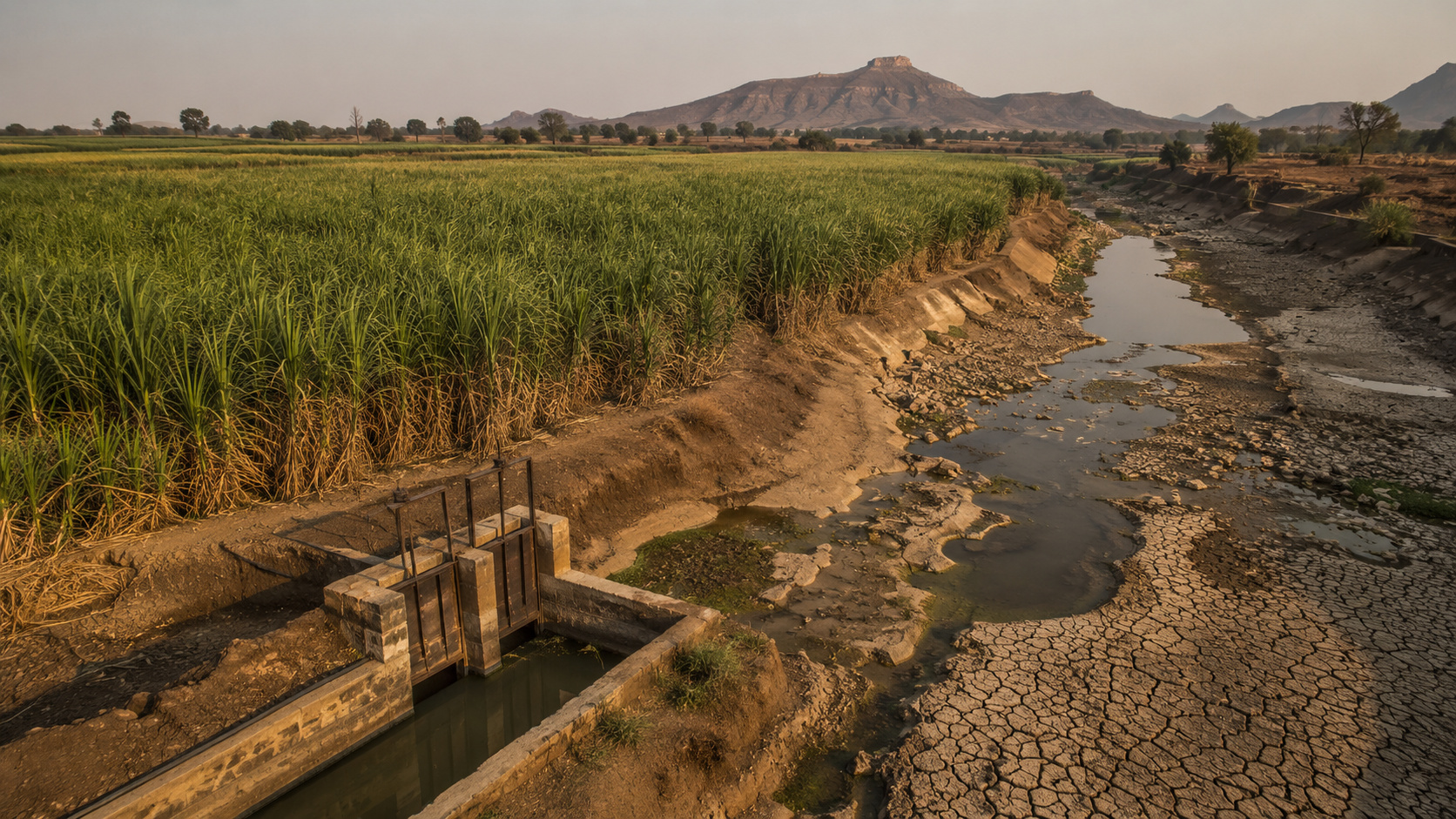

Maharashtra expanded sugarcane and ethanol in India, but the country’s thirstiest crop pressures rivers, wells, and water reserves in dry areas.
The state of Maharashtra has become one of the pillars of India’s sugar-energy economy. On the official website of the state’s Sugar Commissionerate, the government reports that in the 2023-24 harvest, 208 mills operated in Maharashtra and that the sugarcane area exceeded 14.87 lakh hectares, playing a significant role in Indian sugar production and the advancement of associated activities such as distilleries and ethanol.
The problem is that this economic strength relies on a highly water-intensive crop. In the official roadmap of NITI Aayog for ethanol blending in India, the agency states that the production of 1 kg of sugar requires, on average, 1,600 to 2,000 liters of water, and that 1 liter of ethanol derived from sugar may require about 2,860 liters of water, in a country where sugarcane and rice already account for a huge share of irrigation water.
Sugarcane in Maharashtra grows under water scarcity
The central paradox of this story lies in the geography. The study Water-food-energy challenges in India, published in Environmental Research Letters, shows that 82% of the sugarcane cultivated area in Maharashtra is in regions with less than 1,000 mm of rain per year, a level that the study itself points out as the minimum annual recommendation for the crop.
-
Innovative Farm in Northeastern Brazil Combats Drought with Advanced Techniques, Aiming for 10,000 Liters of Milk Daily Production

-
Australian Desert Farm Uses Solar Power and Seawater to Produce 15,000 Tons of Tomatoes Annually, Resembling a Sci-Fi Agricultural Innovation

-
Brazilian Child Becomes National Role Model by Turning Financial Education Lesson into Thriving Poultry Business with 25 Hens and 150 Eggs Weekly
-
California’s Almond Industry Consumes Over 4 Trillion Liters of Water Annually Amid Drought, Relies on Trucked-In Bees for Pollination



The same research highlights that the Western Ghats mountain range creates a great inequality in rainfall distribution within the state. In practice, this helps explain why a thirsty crop continues to advance precisely in areas where the natural water supply is already more limited.
This scenario does not persist by chance. The study links the persistence of the model to policies supporting the sector, with incentives that sustain sugarcane production even in low-precipitation zones and increase pressure on water, energy, and food security simultaneously.
Water for sugar and ethanol has become the center of the environmental conflict
The water weight of sugarcane appears not only in the field but also in the fuel. NITI Aayog reports that, on average, 1 ton of sugarcane can produce about 100 kg of sugar and 70 liters of ethanol, which helps explain why the biofuel expansion policy also broadens the discussion on water use.
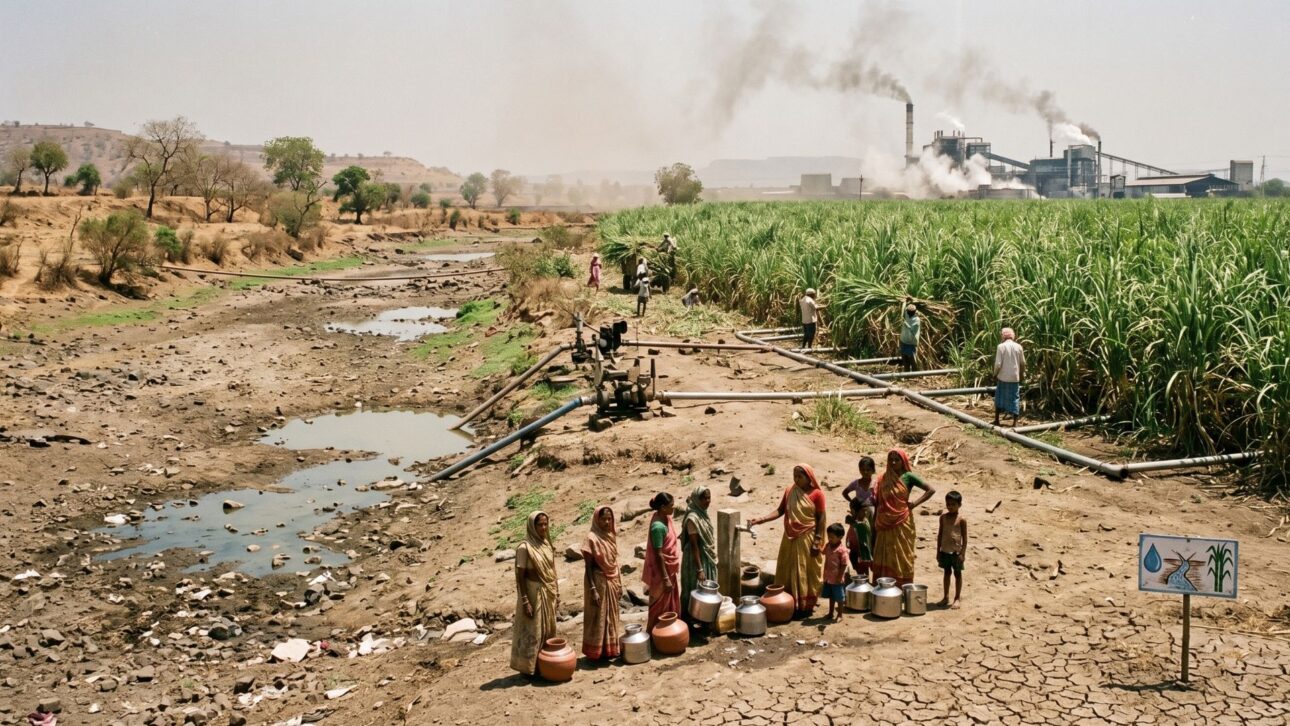
In the same document, the agency acknowledges that sugarcane is a water-intensive crop and recommends shifting part of the planted area to less thirsty crops. This observation is important because the promise of a cleaner fuel does not eliminate the invisible cost paid by rivers, reservoirs, wells, and aquifers.
In other words, the environmental cost of ethanol does not end at the exhaust pipe. When the raw material comes from a crop that requires such high volumes of water, the energy gain starts to compete with a structural problem of water security.
Upper Bhima Basin reveals how sugarcane expansion can reduce downstream water
The study on Maharashtra provides particularly important data about the Upper Bhima Basin. According to the authors, water use for sugarcane irrigation increased substantially between 2000-01 and 2010-11, while the average outflow of the basin decreased over comparable periods between 1996 and 2012.

The more water is retained upstream to sustain an irrigation-intensive crop, the less likely it is to be available for downstream sections, where other producers, cities, and ecosystems depend on the same water system.
This type of pressure does not only appear on maps but in agricultural routines. In drier regions, the continuity of sugarcane tends to push production towards greater dependence on irrigation and pumping, exacerbating water vulnerability in poor rainfall years.
Sugarcane sustains income, mills, and jobs, but makes the transition more difficult
The difficulty in changing this model lies in the economic weight of the chain. The Sugar Commissionerate itself states that about 4 million farmers grow sugarcane in Maharashtra, that the sector moves something close to one trillion rupees per year, and that the industry maintains a wide rural presence, with mills, distilleries, cogeneration, and other businesses linked to the sugar-energy complex.
Therefore, the solution is not to treat sugarcane as a simple villain. The real challenge is to reduce dependence on a system that generates income and employment in the present but also increases the depletion of an increasingly strategic and finite resource.

This is where the discussion about sustainability becomes more serious. The issue is not just how much sugar or ethanol Maharashtra can produce, but how much water the state needs to sacrifice to sustain this expansion in a landscape marked by uneven rainfall, intensive irrigation, and recurring risk of scarcity.
Solution involves agricultural diversification and more efficient water use
The documents consulted converge in one direction: maintaining the expansion of sugarcane without changing water management tends to deepen the problem.
The NITI Aayog advocates for the migration of part of the area to less water-intensive crops, while the academic study points out that current incentives help perpetuate an environmentally fragile arrangement.
In practice, this pushes the debate towards measures such as agricultural diversification, revision of incentives, greater irrigation efficiency, and containment of dependence on a single crop in low-rainfall areas. It’s not about eliminating sugarcane, but preventing today’s growth from depleting tomorrow’s water base.
The story of Maharashtra summarizes a dilemma that appears in various parts of the world. A commodity can generate wealth, exports, and fuel, but remain unsustainable when it silently consumes the scarcest asset of all: water.