Portuguese
  Spanish


Cleanup At Lake Lure, After Hurricane Helene, Reveals Submerged Relics From Almost A Century Ago, Such As A Model T Truck And A 1920s Boat
The passage of Hurricane Helene through the southeastern United States in September of the previous year caused widespread destruction. With over 200 deaths and billions in damages, the impacts were compared to those of Hurricane Katrina in 2005. Now, nearly a year later, the reconstruction efforts reveal not only damage but also traces of a hidden past.
Cleanup Reveals Unexpected Discoveries
In western North Carolina, a recovery project at Lake Lure is removing tons of sediment accumulated during the hurricane.
The effort is the result of a partnership between the town of Lake Lure, the U.S. Army Corps of Engineers, and private companies. The work has already removed about 376,000 tons of sludge and 35,700 cubic meters of debris.
-
Brazilian Airport to Receive $2.8 Million Investment, Completion Expected Within a Year

-
UN Warns of AI’s Environmental Impact and Calls for Greater Corporate Transparency

-
Former Atacadão Employee Turns Online Cake-Baking Lessons into a Confectionery Brand with Factory, Store, Delivery, and Nearly $400,000 in Revenue
-
Brazilian Startup Sells Nearly 9 Million Surprise Bags of Near-Expiry Food, Prevents Thousands of Tons of Waste, Aiming for $42 Million Revenue by 2026




During the partial draining of the reservoir, structures and objects that had been submerged for almost a century began to surface.
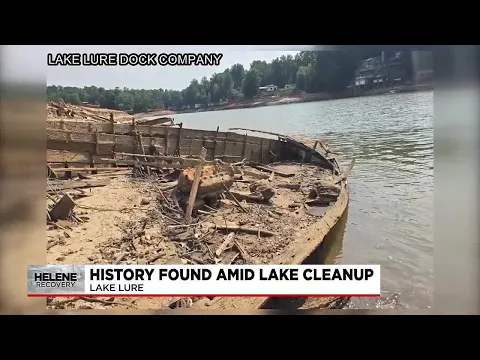
Among the most curious finds is the carcass of a 1920s Ford Model T truck. A 32-foot (approx. 10 m) wooden boat, used as a water taxi during the region’s development, was also discovered.
Submerged History Resurfaces
The cleanup project brought to the surface parts of local history that had been forgotten. The old truck, according to the city, was swallowed by the waters of a nearby reservoir, built a year before the formation of the artificial lake.
The boat belonged to a transportation service that ceased operations during the Great Depression. After the company closed, the vessel was purchased by the Tanner family, one of the oldest in the area.
The boat, nicknamed “Pooh Bear,” still bears the name painted on its side. According to local reports, it was used as regular transportation in the area until it was abandoned. Now, exposed once more, it has become a symbol of the recovered local memory.

Shared Images And Reinforced Security
Jake Mohl, owner of Lake Lure Dock Company, told Fox Weather that he has been working on the lake for decades and has never seen anything like it.
His company is responsible for repairing docks and boathouses. He has been sharing the discoveries on social media, where the images have sparked curiosity and nostalgia.
Despite the public interest, access to Lake Lure remains restricted. This measure is taken for safety, as work is still ongoing.
No exact date has been announced for the completion of operations, but authorities estimate that they will continue until mid-2026.
Recovering The Lake And Preserving Its History
The main objective of the project, according to a statement from the town of Lake Lure, is to restore the natural beauty of the area. In addition, the action aims to ensure navigation safety and public access in the future.
The discovery of historical items was an unexpected consequence, but it has brought to light a forgotten part of the past.
Amid the damages caused by Hurricane Helene, the low waters of Lake Lure revealed something more than destruction.
They also brought a reconnection with the history of the region itself, once hidden beneath decades of sediment.
With information from Galileu Magazine.