Portuguese
  Spanish


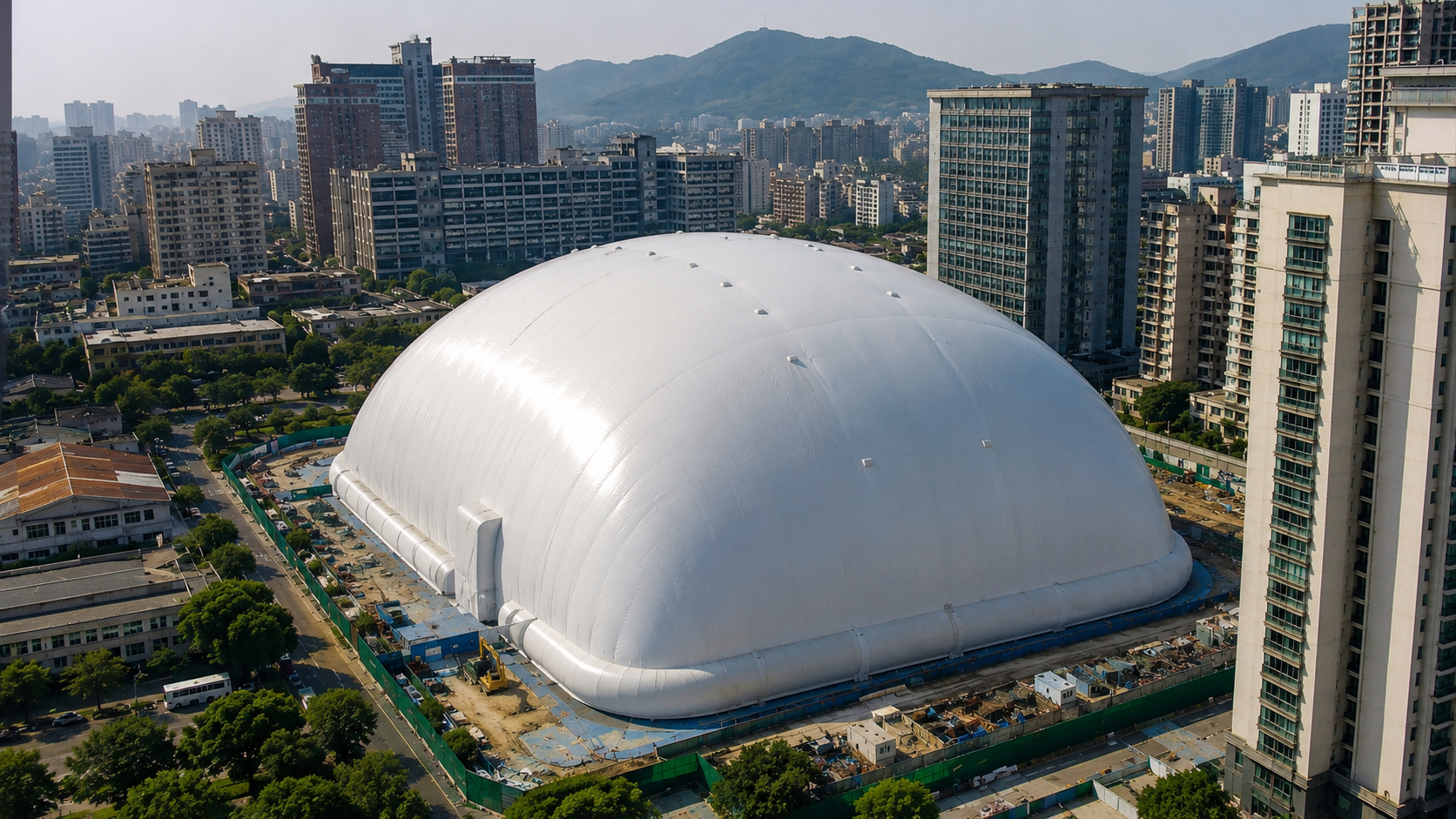

Giant inflatable domes installed in cities like Guangzhou, Shenzhen, and Jinan have begun transforming construction sites into enclosed areas to reduce dust, limit noise, control temperature, and lessen the impacts caused by civil construction in urban regions surrounded by residents, schools, residential buildings, local commerce, and bustling historical areas
Construction companies in China have started using giant inflatable domes over construction sites in cities like Guangzhou, Shenzhen, and Jinan.
With this, the technology aims to reduce dust, dirt, and noise in busy urban areas. Thus, the structures create a barrier between the construction and the surroundings.
According to information released by the Shenzhen government and the state agency Xinhua, in 2026, a dome of nearly 9,000 square meters was installed in Guangzhou. The structure blocks up to 99% of dust and keeps noise below 60 decibels.
-
Detroit Microhouse Village Offers Former Homeless Residents Ownership After 7 Years: First 3 Tenants Receive Deeds

-
Brazilian Factory in Ivoti Produces 500 Modular Steel and Fiberglass Concrete Homes Following 2024 Floods, Securing $13 Million Contract
-
Brazilian Startup Develops Recycled Plastic Bricks, Cutting Construction Costs by 40% and Speeding Up Building by 90%

-
Tarcísio Opens New São Paulo Metro Line After 18-Year Wait, Offering Free Rides at 6 Stations and Aiming to Cut Commute to 23 Minutes for 633,000 Daily Passengers



How the giant bubbles work on construction sites
For this, the domes remain inflated by continuous ventilation systems. Therefore, they do not require internal pillars.
Thus, trucks, heavy machinery, and teams can operate normally within the covered area.
The structures are made with polyester membranes coated with PVDF, a lightweight and resistant material used in technical coverings.
At the same time, the domes help control the temperature and internal air circulation.

Technology can be reused in other sites
Still, the highlight is the mobility of the structure. After use, the domes can be deflated, folded, and transported to other projects.
In this way, the technology attempts to reduce visual impact, limit urban noise, and contain particles released into the air.
According to Chinese authorities, the domes help in complying with stricter environmental standards.
Consequently, the solution also seeks to reduce complaints from residents about dirt and noise caused by the construction works.

Use cases in Guangzhou, Shenzhen, and Jinan
In Guangzhou, a dome of nearly 9,000 square meters was installed over a renovation area.
In this case, data released by the Shenzhen government indicates a blockage of up to 99% of dust.
Meanwhile, in Shenzhen, another dome reached about 40 meters in height and exceeded 12,000 square meters.
In addition to the covering systems, the structure received smart technologies for spraying, cooling, and environmental monitoring.
Meanwhile, in Jinan, one of the largest inflatable structures of this type reached approximately 50 meters in height and 20,000 square meters.
The installation took place near schools, residential buildings, and a historic church, precisely to reduce impacts on residents and local businesses.
Therefore, the giant bubbles on construction sites emerge as a Chinese attempt to make urban construction sites less aggressive to the surroundings. After all, can a construction surrounded by dust and noise still function without disrupting the neighborhood’s routine?