Portuguese
  Spanish


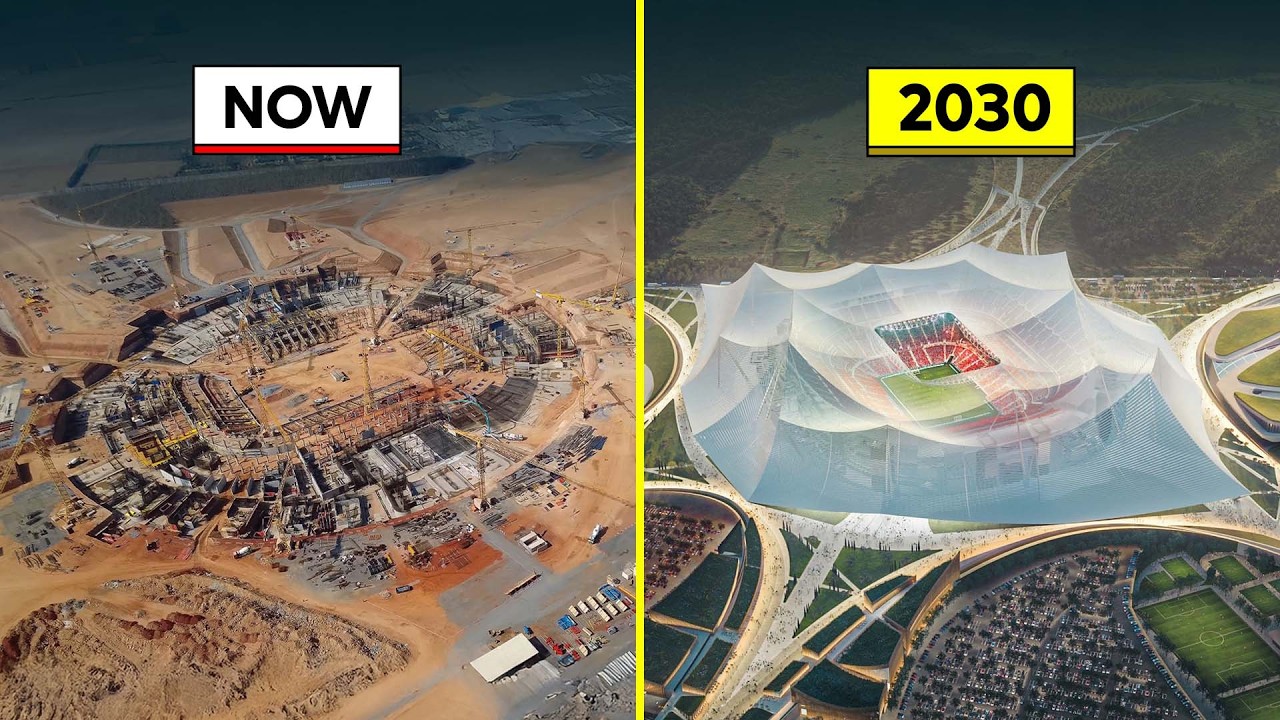


Morocco advances in the construction of the Grand Stade Hassan II, a 115,000-seat stadium that could become the largest in the world.
In 2025, Morocco accelerated one of the most ambitious sports projects on the planet by advancing the construction of the Grand Stade Hassan II, an arena planned to accommodate up to 115,000 spectators near Casablanca, which could become the largest football stadium in the world by capacity. The project is part of the country’s preparation for the 2030 World Cup, which will be held jointly with Spain and Portugal. According to the international office Populous and CNN, responsible for the concept alongside the Moroccan studio Oualalou + Choi, the arena was designed to redefine the scale of modern stadiums and transform the Benslimane region into a new sports and urban hub.
The stadium is being built in El Mansouria, in the province of Benslimane, about 40 km from Casablanca, on an area of approximately 100 hectares, equivalent to about 1 million square meters. The official project released by the regional agency Casa Invest reports a budget of about 5 billion Moroccan dirhams, equivalent to approximately R$ 2.7 billion to R$ 3 billion, depending on the exchange rate.
Grand Stade Hassan II was designed to accommodate 115,000 people and surpass historic arenas in North Korea and India
The number that made the project a global highlight is the planned capacity of 115,000 spectators. According to the Populous office, the stadium was designed to become the largest football stadium in the world in terms of sports-dedicated capacity.
-
Bristol Builds 11 Steel Stilt Houses Over Parking Lot, Providing Zero-Carbon Homes for Youth at Risk of Homelessness

-
New York Converts Massive Landfill with 150 Million Tons of Waste into a Giant Park, Concealing Decades of Consumption Beneath Green Hills
-
Experts Share 5 Practical Ways to Detect Hidden Wiring in Walls Before Drilling, Using Simple Techniques and Affordable Devices to Prevent Electrical Damage and Unexpected Costs

-
Brazilian Architect Wins International Award for Empowering Ugandan Women to Build Their Own Homes



If completed according to the current project, it will surpass gigantic arenas like the Rungrado 1st of May Stadium in North Korea and enter the symbolic competition with the Narendra Modi Stadium in India, primarily used for cricket.
Visual impact of the 115,000-seat stadium leaves fans eager
The visual impact of the stadium is also part of the strategy. Instead of relying solely on exposed concrete and steel, the architects created a structure inspired by traditional Moroccan tents used in large cultural gatherings.
The concept called “Moussem” attempts to combine sports monumentality with local cultural identity. According to the architects of Oualalou + Choi, the main cover was conceived as a massive architectural intervention over the forest landscape of Benslimane.


The released conceptual images show a kind of translucent metallic membrane covering a large part of the complex.
The goal is to allow partial entry of natural light, create internal shading, and reduce the sensation of excessive structural mass. The design completely deviates from the “closed box” standard adopted in many modern stadiums in Europe and the Middle East.
Moroccan project bets on gardens, open areas, and landscape integration to create a giant “sports district”
Another central point of the project is the stadium’s surroundings. Unlike isolated arenas surrounded only by parking lots, the Grand Stade Hassan II was conceived as part of a large sports and leisure district. Reports related to the project mention extensive green areas, gardens integrated into the structure, and complementary sports spaces spread throughout the complex.

According to information released by media specialized in sports architecture, the stadium is expected to include auxiliary fields, social spaces, premium hospitality areas, and an urban infrastructure far superior to the current standard of the region. The complex occupies an area equivalent to hundreds of football fields combined, reinforcing the character of a national megaproject.
The choice of Benslimane was also not random. The region is strategically positioned between Casablanca and Rabat, two of Morocco’s main cities, and has enough space for large urban and logistical expansions. This allowed planners to envision a monumental stadium without the severe limitations of densely occupied urban areas.
Monumental stadium structure will require large-scale engineering to support a roof inspired by giant tents
Although the complete structural details have not yet been officially released, sports architecture specialists point out that the roof will be one of the biggest engineering challenges of the project.
The stadium was designed to support a gigantic partially translucent metallic structure over an arena for 115 thousand people, something that requires extremely complex calculations of load distribution, wind resistance, and dynamic stability.
The official images indicate that the roof will have large open spans, reducing the number of internal pillars and increasing the visibility of the field. In projects of this scale, this usually requires intensive use of structural cables, compression rings, and high-strength metal components, similar to those used in Olympic arenas and international airports.

Another relevant factor is the region’s climate. The stadium will need to handle high temperatures at certain times of the year while maintaining thermal comfort for tens of thousands of people. The use of translucent surfaces and open areas can help with natural ventilation and reduce extreme heat accumulation inside the arena.
2030 World Cup accelerated global race for gigantic stadiums and increasingly futuristic projects
The Grand Stade Hassan II is part of a silent competition among countries that use major sporting events to demonstrate economic, technological, and architectural capabilities. Since the Qatar World Cup in 2022, several governments have started investing in increasingly monumental arenas to try to transform stadiums into national symbols.
In Morocco’s case, the project gained even more weight because the country will be the first in North Africa to host matches of a FIFA Men’s World Cup. Additionally, the Moroccan national team gained enormous international projection after reaching the semifinals of the 2022 World Cup in Qatar, something unprecedented for an African team.
The stadium can also function as a political and economic instrument. Mega sports projects are often used to accelerate investments in infrastructure, tourism, hospitality, urban mobility, and regional redevelopment. The construction of the Grand Stade Hassan II fits exactly into this pattern.
Moroccan arena enters symbolic race for the world’s largest stadiums and challenges traditional European models
The size of the project draws attention because most modern European stadiums follow the opposite trend: smaller, more compact, and highly profitable arenas. Morocco decided to bet on maximum scale, creating an arena far above the current international average.
For comparison, the new Camp Nou in Barcelona is expected to reach about 105,000 seats after renovation, while Wembley has about 90,000 seats. The Santiago Bernabéu, often cited as a candidate for the 2030 World Cup final, operates around 85,000 spectators. The Grand Stade Hassan II surpasses all these numbers.
The gigantism of the project generated debates about operational viability after the World Cup. Maintaining an arena with 115,000 seats active requires an enormous flow of events, heavy maintenance, and constant revenue. Even so, the Moroccan government seems willing to use the stadium as a long-term centerpiece for international events, national team games, and continental competitions.
Stadium construction began with earthworks in 2024 and forecast points to delivery before the 2030 World Cup
According to information published by sports infrastructure monitoring platforms, the initial earthworks began in 2024 after the hiring of the company responsible for the preliminary works.
The current expectation is that the arena will be ready by 2028, creating an operational margin before the 2030 World Cup.
The scale of the work will require massive soil movement, implementation of infrastructure networks, road systems, drainage, energy, telecommunications, and auxiliary structures. In projects of this magnitude, land preparation typically already represents an engineering operation comparable to the construction of small urban neighborhoods.
International companies linked to the sports engineering sector are also participating in the development of the stadium. RLB Europe confirmed participation in cost management and economic engineering of the project, reinforcing the international nature of the work.