





 Portuguese
  English
  Spanish
  5 min of reading
  0 comments


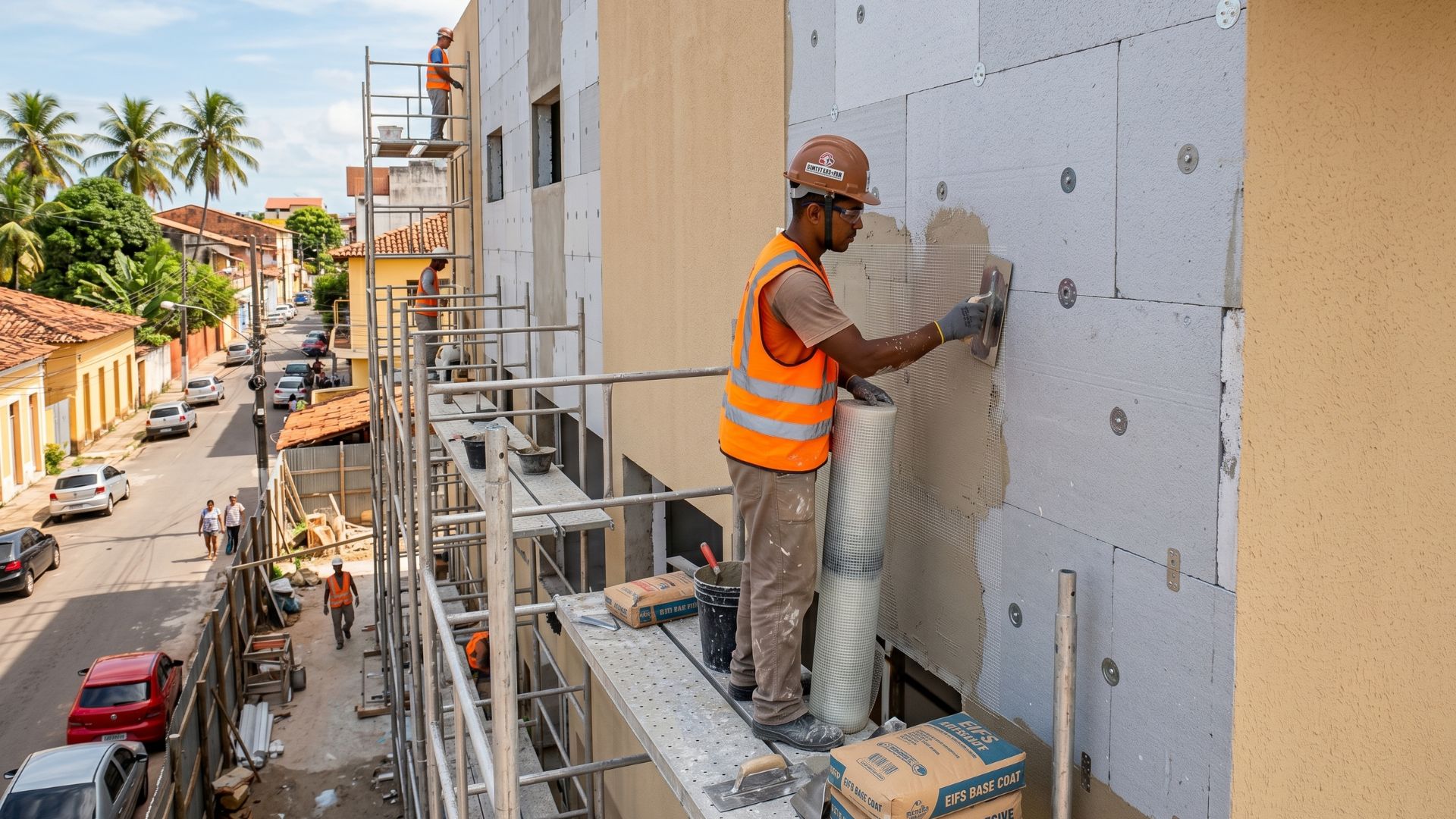
EIFS System uses insulating panels on the facade to reduce heat transfer and is gaining ground in residential and commercial construction.
The increase in temperatures in urban areas and the search for more efficient buildings have increased interest in systems capable of reducing heat inside buildings without relying solely on air conditioning. In this scenario, EIFS has started to gain ground in civil construction as a facade solution aimed at thermal insulation and external finishing at the same time. The data comes from the portal archdaily.
The acronym EIFS stands for Exterior Insulation and Finish System, a term used to define a multi-layered system applied to the exterior of walls. The method uses insulating panels, usually made of EPS, fixed onto the facade and protected by layers of mortar, structural mesh, and final coating.
The concept attracted attention because it transforms the facade into a kind of continuous thermal barrier, reducing part of the heat transfer between the external environment and the interior of the building.
-
A R$ 370 million tender for the construction of 4 prisons in SC is released from blockage after correction of flaws, unlocking works in Chapecó, Lages, and Xanxerê, and reigniting the debate on the urgency of the Santa Catarina penitentiary system.

-
Mother and daughter build a 70 m² house with more than 8,000 discarded glass bottles and impress with their creativity; known as the Casa de Sal, the property is located on Itamaracá Island, in Pernambuco.
-
Construction material store starts selling modular units that resemble small houses, assembled in a few days in the backyard, as the housing crisis pushes families towards unconventional solutions in Australia.
-
India approved the country’s first submerged road-rail tunnel, 15.8 kilometers dug under the bed of the Brahmaputra River.




The EIFS system functions as an insulating layer installed on the outside of the wall
Unlike conventional plaster, EIFS does not act only as a surface finish. The system is designed to add thermal insulation directly to the facade of the property.
In practice, EPS panels or other insulating materials are externally fixed onto the masonry or structure of the building. On these panels, layers of polymeric mortar and reinforcement mesh are applied, creating a protected surface ready for decorative finishing.


According to technical materials from IPT and manufacturers in the sector, the system helps reduce thermal bridges and decrease heat transfer through external walls.
This means that part of the thermal radiation from the external environment is blocked even before it directly reaches the main structure of the building.
EPS has become the main material used in the insulating core of the system
A large part of EIFS systems uses EPS panels, popularly known as expanded polystyrene, as the core of thermal insulation.
The EPS has low thermal conductivity because its structure contains millions of small cells filled with air. This makes it difficult for heat to pass through the material.

According to manufacturers and technical studies in civil construction, thermal performance depends on the thickness of the panels, EPS density, and the complete system configuration.
In very hot regions, external insulation can help reduce excessive wall heating during the day. In cold regions, the system can also contribute to retaining internal heat.
The result is a facade that functions not only as a visual finish but as a thermal performance component of the building.
The system began to grow in cold countries before advancing in hot regions
EIFS initially gained strength in Europe and North America, especially in countries seeking to improve the energy efficiency of buildings during winter.
Over time, however, the system also began to be used in hot regions due to its ability to reduce heat entry into buildings.
According to industry manufacturers, insulated facades can reduce the need for artificial climate control under certain conditions, reducing air conditioning use throughout the day.
The advancement of the topic also follows international regulations related to energy efficiency, thermal comfort, and sustainability in civil construction.
In Brazil, the growth of EIFS still occurs more concentrated in modern projects, contemporary facades, and constructions focused on thermal performance.
The external finish can imitate different textures and architectural styles
Besides thermal insulation, EIFS also gained space because it allows for different types of visual finishes. The final coating can receive acrylic textures, cementitious effects, elastomeric paint, and various decorative finishes.
This makes it possible to adapt the system to residential, commercial, and corporate projects with different architectural styles.
Another commercially explored advantage is the visual uniformity of the facade. Since the system creates a continuous layer over the structure, it can help reduce small surface irregularities of the original wall.
Architects have started using EIFS mainly in minimalist facades, contemporary lines, and projects that prioritize a clean appearance and continuous surfaces.
The system also tries to reduce cracks associated with thermal variations
According to manufacturers and technical materials in the sector, external insulation helps reduce some of the sudden temperature variations experienced by the main structure of the building.
When walls constantly heat and cool, expansion and contraction movements occur that can contribute to the appearance of surface cracks over time.

By positioning the insulating layer on the outside, the EIFS tries to reduce these thermal oscillations directly on the structural wall.
This does not automatically eliminate the risk of construction pathologies, but it can help the facade’s performance depending on the quality of the installation and the executive project.
The system’s behavior varies according to local climate, sunlight exposure, materials used, and maintenance over the years.
Installation requires specialized labor and careful execution
Despite the thermal advantages, experts point out that EIFS heavily depends on correct execution. Improper fixing of the boards, waterproofing failures, or incorrect application of reinforcement layers can compromise thermal performance, watertightness, and system durability.
Therefore, manufacturers usually require trained labor and certified compatible components for proper installation.
The system also needs special attention to joints, corners, areas near frames, and points prone to infiltration.
In facades highly exposed to rain and intense sunlight, poorly executed construction details can cause problems over time.
EIFS shows how the facade has ceased to be just a finish and has become an intelligent thermal barrier
For decades, facades were mainly seen as aesthetic elements and protective against rain. The advancement of EIFS shows an important change in this logic.
Today, external walls have started to incorporate functions related to thermal insulation, energy efficiency, and environmental comfort.
The system transforms the facade into a technical layer capable of directly influencing the internal temperature of the building.
Although traditional plastering remains extremely prevalent in Brazilian civil construction, multi-layer solutions like EIFS show how external coatings are becoming increasingly technological.
And as urban heat, energy consumption, and thermal comfort gain importance in cities, insulating facade systems tend to occupy a growing space in modern residential and commercial projects.




Be the first to react!