






 Portuguese
  Spanish


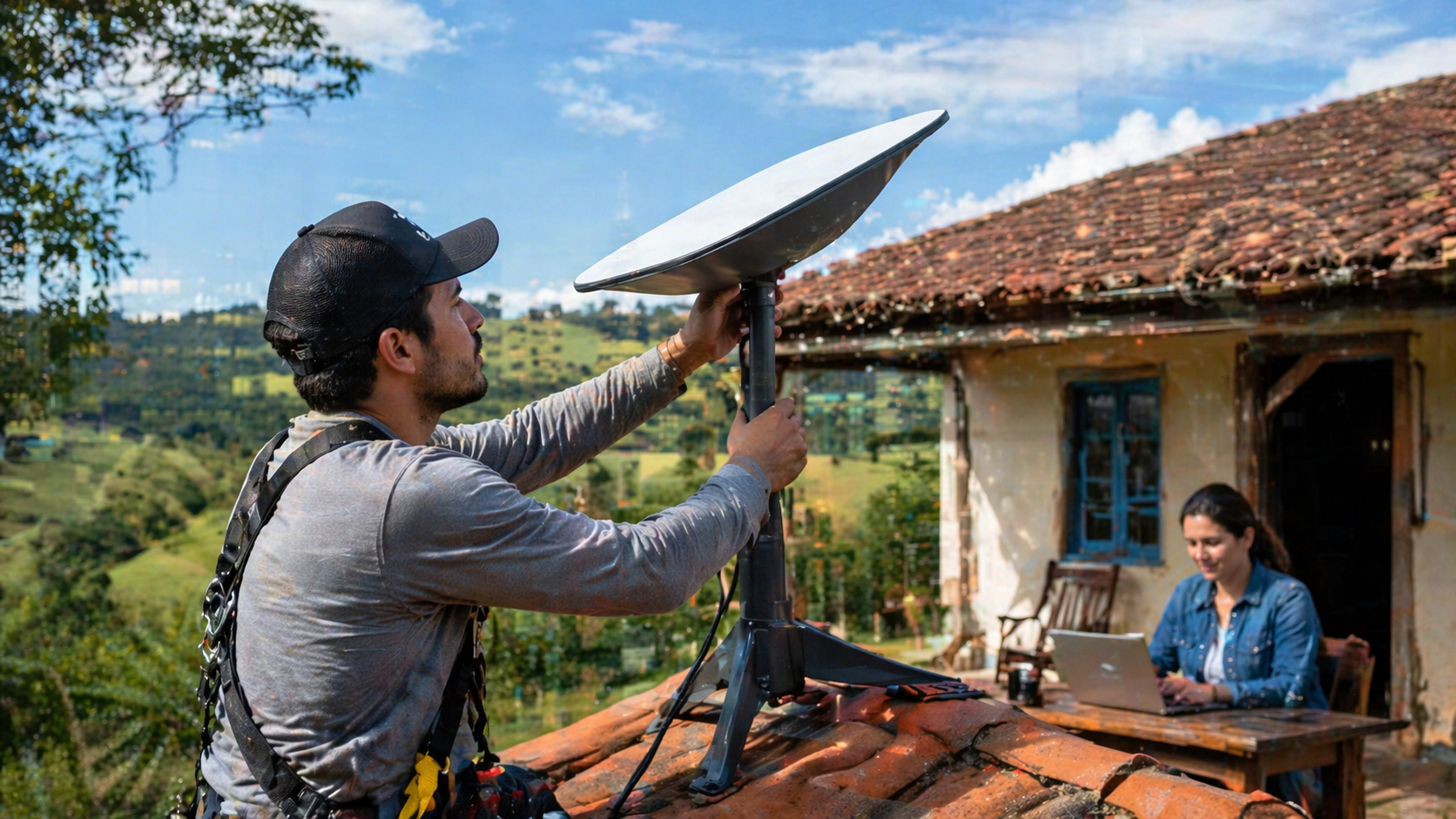

Starlink closes partnership with Alares to expand satellite internet in Brazil and advance in areas without fiber optic.
On April 19, 2026, the company Starlink, controlled by SpaceX, confirmed a strategic agreement with the Brazilian operator Alares to expand the offering of satellite internet in the country. The information was first reported by the newspaper O Estado de S. Paulo and echoed by outlets such as Revista Oeste, with an official launch expected in May 2026. The central objective of the partnership is clear: to expand high-speed connectivity in regions where terrestrial infrastructure has not yet reached, especially rural areas, small towns, and locations far from major urban centers.
This move marks an important change in the Brazilian telecommunications market, combining a global network of satellites with the commercial reach of a national operator.
How the partnership between Starlink and Alares works and why it changes the connectivity game
The structure of the agreement follows a model already used in other countries: Alares will act as a commercial partner of Starlink, offering its services directly to Brazilian consumers.
-
NOAA Scientists Discover Mysterious, Perfectly Aligned Holes on the Mid-Atlantic Ridge Seafloor, Origin Still Unknown

-
California Startup Develops Giant “Space Sling” to Launch Vehicles at Mach 6, Reducing Fuel Use and Enabling Thousands of Satellite Deployments

-
ChatGPT Alerts FBI to Prevent Planned Murder of 8-Year-Old in Brazil’s Espírito Santo
-
Scientists Discover 125-Million-Year-Old “Pregnant Fossil” with Preserved Embryos and Microscopic Larvae Inside Mollusk in England





This means that:
- The technology remains with Starlink, based on low-orbit satellites
- The distribution, customer service, and marketing will be the responsibility of Alares
According to disclosed information, the offered plans are expected to maintain the same prices practiced by Starlink, including options with speeds between 100 Mbps and 400 Mbps, depending on the region and the contracted package
This model reduces one of the main barriers of satellite internet: commercial access and local support, which will now be provided by a Brazilian operator with a physical presence.
Who is Alares and why it became a key piece in Starlink’s strategy in Brazil
Alares is an operator that emerged from the consolidation of regional providers and today serves around 800,000 customers in more than 200 cities across seven Brazilian states
The company mainly operates with:
- Fiber optic internet
- Subscription TV
- Landline telephone
- Digital solutions
With a significant presence in regions outside major centers, Alares positions itself as a bridge between Starlink’s global technology and the real Brazilian market, especially where large operators have less presence.
In addition, the company has more than 120 physical stores and local service structure, which facilitates the adoption of technology by users who previously faced technical or logistical barriers.
Why Starlink invests in Brazil and in areas without fiber optic
Brazil is one of the most strategic markets for Starlink, mainly due to the inequality in internet infrastructure.


Even with advancements in fiber optic, there are still millions of Brazilians in areas where:
- There is no fixed broadband coverage
- The mobile signal is unstable or non-existent
- The connection relies on precarious solutions
It is precisely in this “connectivity gap” that Starlink positions itself as a solution, using low-orbit satellites to provide high-speed internet with low latency.
Data from the National Telecommunications Agency (Anatel) indicates that Starlink already has around 660 thousand customers in Brazil, a number that tends to grow with the new partnership.
Satellite internet gains strength and pressures traditional operators in the country
The expansion of Starlink in Brazil, now with the support of Alares, intensifies the competition in the telecommunications sector.
Unlike traditional infrastructure, which depends on:
- Fiber optic cables
- Transmission towers
- Heavy investments in terrestrial networks
Starlink operates with a constellation of thousands of satellites, allowing for virtually global coverage.
This drastically reduces the time and cost to bring internet to remote areas, creating a scenario where traditional operators begin to face direct competition in areas they previously dominated.
This movement has already been observed globally and is expected to intensify in Brazil, especially in agribusiness, mining, and urban interiorization regions.
Speed, latency, and new possibilities for the field and isolated regions
The proposal of Starlink is not just to provide internet, but to offer a connection with quality sufficient for demanding activities.
With speeds between 100 Mbps and 400 Mbps, the technology allows:
- Video conferences
- Distance learning
- Telemedicine
- Rural monitoring
- Real-time business operations
This completely transforms the dynamics of regions that were previously disconnected, opening up space for digitization, productivity, and access to services.
In agribusiness, for example, connectivity can directly impact farm management, use of sensors, climate monitoring, and integration with markets.
What changes in practice for the Brazilian consumer with this partnership
The entry of Alares as a partner of Starlink tends to facilitate access to the service in several aspects:
- Greater commercial reach
- Local support
- Integration with other telecom services
- Simplification in contracting
Moreover, the presence of a national operator can increase consumer confidence, especially in regions where the technology is still little known.
Another relevant point is the possibility of faster expansion, as Alares already has infrastructure installed in several cities.
Starlink’s expansion indicates a structural change in internet access in Brazil
The partnership between Starlink and Alares is not an isolated movement, but part of a larger trend: the transformation of global connectivity.
With the advancement of low-orbit satellites, the internet ceases to depend exclusively on terrestrial physical infrastructure, creating a new paradigm for digital access.
This has direct implications for:
- Digital inclusion
- Regional development
- Economic competitiveness
- Education and health
The technology does not completely replace fiber optics, but acts as a strategic complement, especially in areas where the traditional network is not viable.


