Portuguese
  Spanish


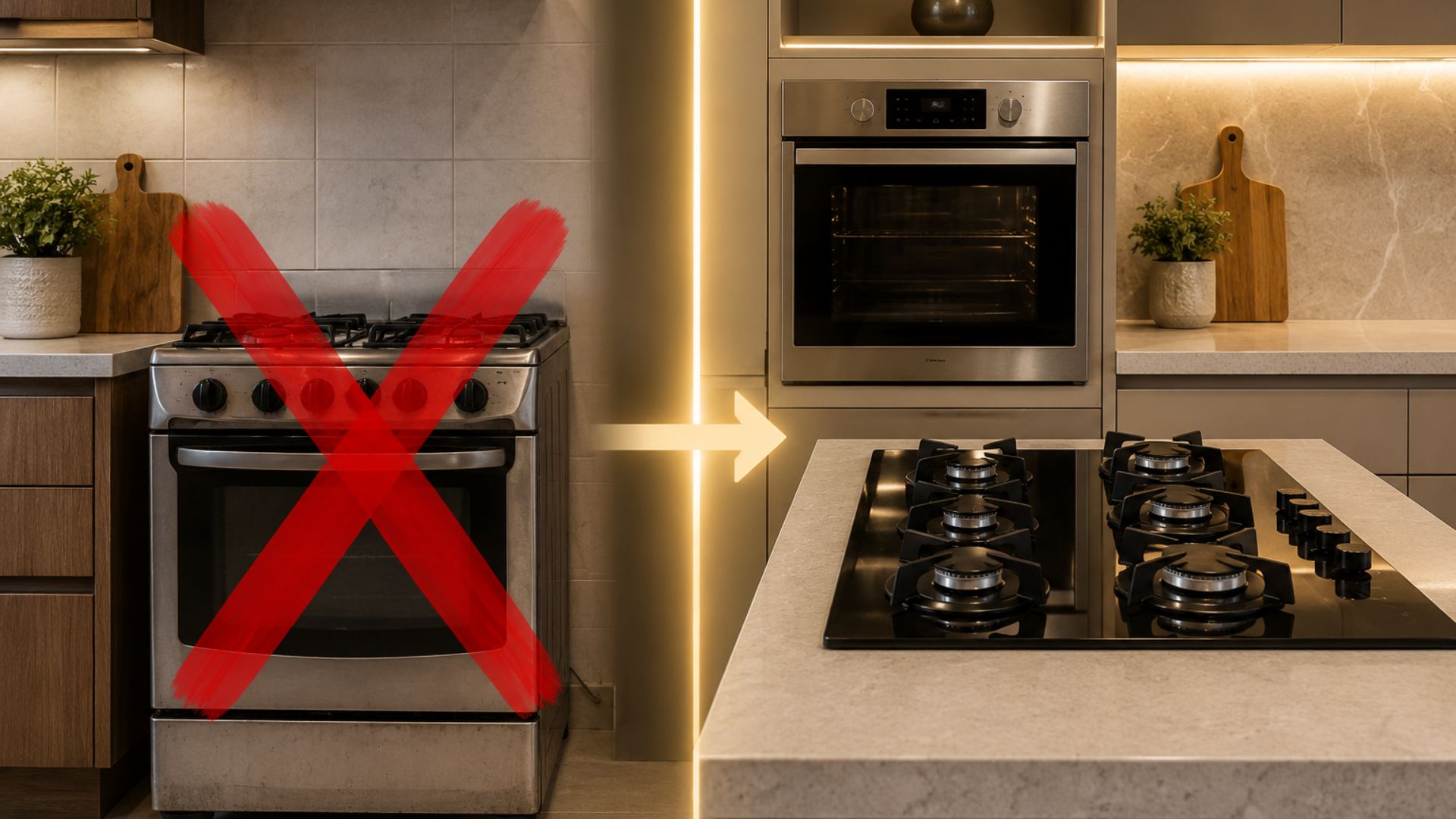


Changes in kitchen design transform the role of the traditional stove and drive the search for cooktops and built-in ovens, a combination that expands circulation, improves space utilization, and reinforces visual integration in planned projects increasingly connected to the home’s style.
The freestanding range is no longer the sole reference in custom kitchens and now competes for space with the combination of cooktop and built-in oven, a solution that separates cooking and baking functions to improve layout, expand circulation, and better integrate countertops, islands, and cabinetry.
The trend appears in the 2025 U.S. Houzz Kitchen Trends Study, a survey of 1,620 U.S. homeowners who had renovated, were renovating, or planned to renovate their kitchen.
Custom Kitchens Drive New Choices
The change does not mean the end of the freestanding range, but it shows that it no longer solely occupies the center of renovation decisions.
-
Man Disguises as His Own Mother to Collect €3,000 Monthly Pension, but Makeup and Beard Stubble Raise Suspicions at Registry Office

-
Brazilian Airport to Receive $2.8 Million Investment, Completion Expected Within a Year

-
UN Warns of AI’s Environmental Impact and Calls for Greater Corporate Transparency

-
Former Atacadão Employee Turns Online Cake-Baking Lessons into a Confectionery Brand with Factory, Store, Delivery, and Nearly $400,000 in Revenue




According to Houzz, 53% of respondents changed their kitchen layout, a choice that places the room’s distribution among the most important aspects of the analyzed projects.
When the floor plan is redesigned, the logic of concentrating burners and oven in a single block loses strength.
Continuous countertops, prep islands, and custom cabinets favor separate appliances, installed according to the actual use of the space.
In this context, the cooktop can be placed on a linear countertop or an island, while the built-in oven usually occupies a tower or niche at a more comfortable height.
This division allows for better organization of preparation stages, without requiring all functions to be at the same point.
Cooktop and Built-in Oven Gain Space in Renovations
Among the major appliances purchased in renovations, 39% of homeowners chose cooktops and 31% opted for wall ovens, a category equivalent to built-in ovens.
The integrated stove, referred to as a range in the survey, still appears in 64% of choices, indicating coexistence between models, not total replacement.
The difference lies in flexibility.
The freestanding range requires a specific position, with width and height determined by the appliance.
The cooktop and built-in oven duo, however, allows equipment to be distributed according to circulation, kitchen size, and cabinet design.
In compact kitchens, this separation can free up storage areas or expand countertop space.
In larger environments, it helps create distinct zones for preparation, cooking, finishing, and cleaning, with less dependence on a single workstation.
Larger Spaces Favor Integrated Kitchens
The reorganization also accompanies the expansion of kitchens.
The study indicates that 35% of respondents increased the room’s area and, among them, 29% incorporated part of the dining room.
After the renovation, 53% of kitchens became 200 square feet or larger.
With greater integration between the kitchen, dining room, and living areas, appliances are no longer chosen solely for their function.
Appearance, proportion, and alignment with cabinetry become more important, especially in open-concept designs.
The cooktop contributes to this look by being flush with the countertop.
The built-in oven, in turn, can be integrated into cabinets and installed at a height that reduces the need to bend down to monitor or remove hot dishes.
Modern Look Weighs in Appliance Choice
Houzz identified that 64% of respondents prioritized quality when purchasing major appliances, while 50% cited appearance and aesthetic perception.
Cost appeared at 29%, followed by size, special features, and energy efficiency.
This data helps explain why the kitchen is no longer treated solely as an operational area.
In many projects, it also functions as a living space, which requires efficient appliances that are visually compatible with the rest of the house.
The same survey registered a strong presence of other appliances in planning.
Microwaves were purchased by 70% of respondents, range hoods by 61%, and dishwashers by 71%, indicating that a renovated kitchen is often conceived as an articulated set of equipment.
New configuration changes the routine within the kitchen
In practice, separating the cooktop and oven changes how the space is used.
The cooking area can be placed near the sink, the countertop, or the island, while the oven takes up a more ergonomic and less isolated spot.
This configuration also facilitates visual organization.
Instead of a single visible block, the design can align the cooktop, range hood, oven/microwave stack, microwave, and cabinets in a cleaner composition, especially when there are continuous countertops.
Replacement usually gains momentum when the renovation seeks to correct functional problems and update the kitchen’s style.
In the survey, 41% of homeowners stated they wanted to leave an old look behind, while 35% cited deterioration or malfunction of the previous kitchen.
The freestanding range continues to be a functional solution in many homes, especially when there are budget, space, or infrastructure limitations.
Nevertheless, recent renovations show that built-in cooktops and ovens have come to play a larger role in custom kitchens, where layout, circulation, and aesthetics are defined together.