Portuguese
  Spanish


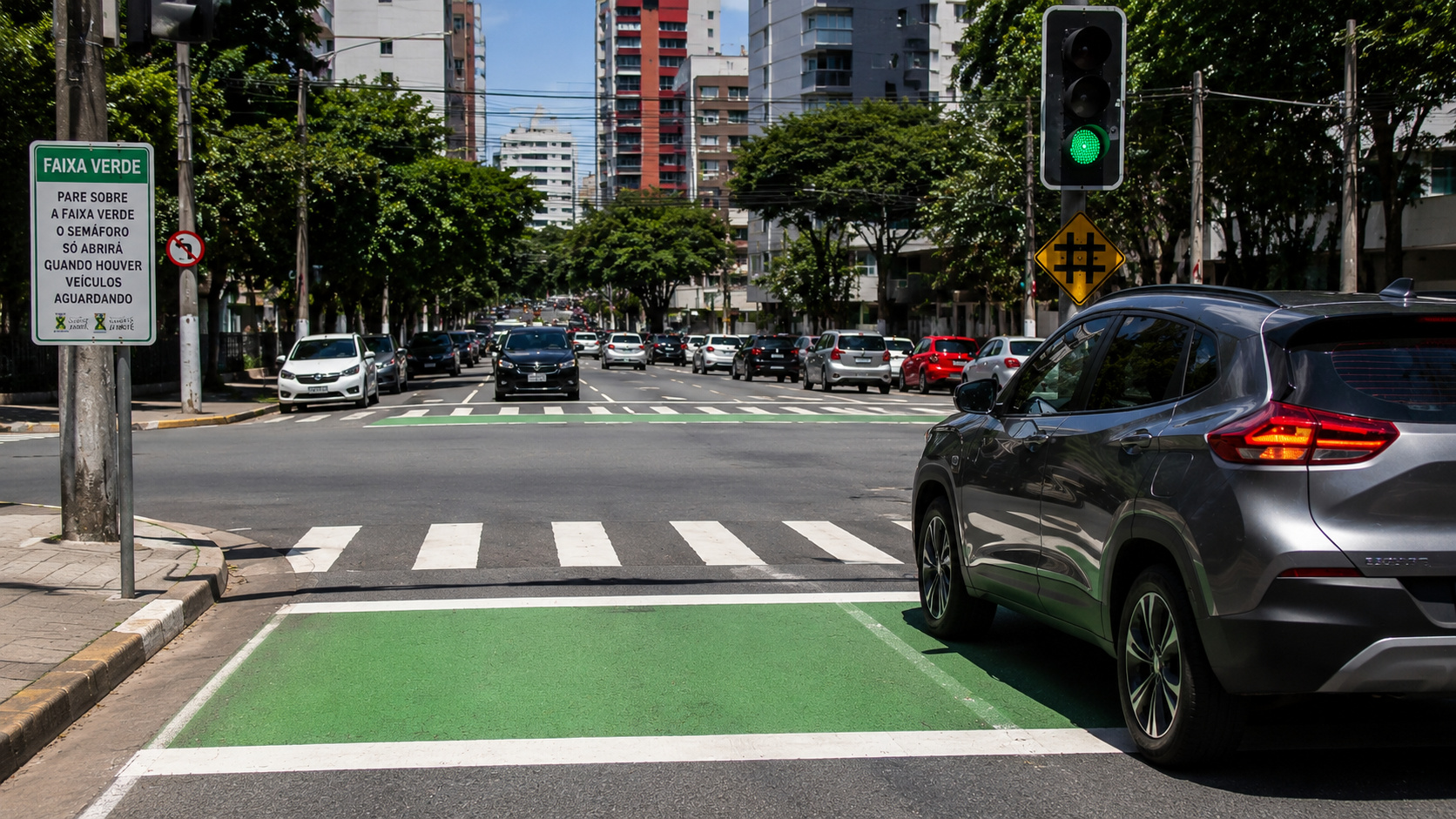

System implemented in Santo André uses pavement marking, magnetic sensors, and intelligent activation to clear intersections only when vehicles are waiting on secondary roads.
A new traffic control technology has started to gain ground in Brazilian cities and promises to change the routine of drivers at busy intersections.
The City Hall of Santo André implemented the so-called green lane traffic light in April 2026, with the aim of reducing queues and improving traffic flow on avenues.
The proposal is simple: the light only activates when there are vehicles stopped on the secondary road.
-
Cape Verde’s World Cup Surprise: Betting on Electric Cars, a 5 MW Solar Plant, and an Ambitious Plan to Transform Energy for 600,000 Residents

-
Man Finds 1,469 Ancient Roman Silver Coins While Metal Detecting in Romania
-
Young Brazilian Siblings Go Viral for Catching Giant Fish, Launch Sport Fishing Project
-
72-Year-Old Retired Professor from Rural Brazil Recites 247 Digits of Pi in One Minute, Setting National Memory Record


As a result, the main road maintains continuous flow and avoids unnecessary interruptions.
Technology identifies vehicles and clears the signal at the right time
The system uses a green stripe painted on the asphalt, positioned before the intersection.
When the driver stops over this marking, sensors installed under the pavement automatically detect the vehicle.
These sensors, called inductive loops, identify the presence of metallic mass, such as cars and motorcycles.
Then, they send the information to the traffic light controller, which adjusts the signal opening according to real demand.
Thus, when there are no vehicles on the green lane, the main road remains clear.
On the other hand, when cars are waiting on the secondary road, the transversal traffic light clears the passage at the appropriate time.
System avoids unnecessary traffic light opening
In practice, the green lane traffic light prevents the signal from opening when no vehicle is waiting at the intersection.
This operation reduces unnecessary interruptions on busier avenues.
For this reason, the system also respects a minimum time for the main road before allowing passage from the secondary road.
If vehicles remain positioned on the lane, the equipment can reopen the signal to meet the new demand.
As a result, the operation gains dynamism and better follows the real traffic flow.
According to the Santo André City Hall, informative signs should guide drivers on the correct use of the technology.
Santo André received its first green lanes in April
The city received its first installations in April 2026, at five intersections.
The implementation included Avenida Príncipe de Gales, at the access to Fundação Santo André, and Rua Nova Zelândia with Avenida Presidente Costa e Silva.
The project also included Rua Maringá with Rua das Hortências and Avenida Prestes Maia, at the exit of the GCM headquarters.
In the same phase, the City Hall installed the technology on Avenida Presidente Costa e Silva, at the return near White Martins.
These points help improve traffic organization at intersections with significant vehicle circulation.
Green lane already appears in other Brazilian cities
Although Santo André began implementation in April, other Brazilian municipalities also use the technology.
The system already appears in cities such as Londrina, Poços de Caldas, Aparecida de Goiânia, Rio de Janeiro, Campinas, São José dos Pinhais, and Porto Velho.
This expansion shows how traffic sensors are gaining ground in different Brazilian regions.
At the same time, the green lane reinforces the search for smarter solutions to reduce urban congestion.
The future of smart intersections
The advancement of the green lane traffic light indicates an important change in the organization of urban intersections.
Instead of operating only by fixed cycles, the system responds to the actual presence of vehicles on the secondary road.
Thus, main avenues maintain continuous flow for longer, while transversal streets receive an opening when necessary.
This combination of sensors, pavement signaling, and traffic light control can make traffic more efficient.
Now, the question is whether Brazilian cities will expand this technology to more intersections and noticeably reduce the time lost by drivers.
Do you think the green lane traffic light can really improve traffic in big cities, or is there still a lack of infrastructure for this technology to work on a large scale?