Portuguese
  Spanish


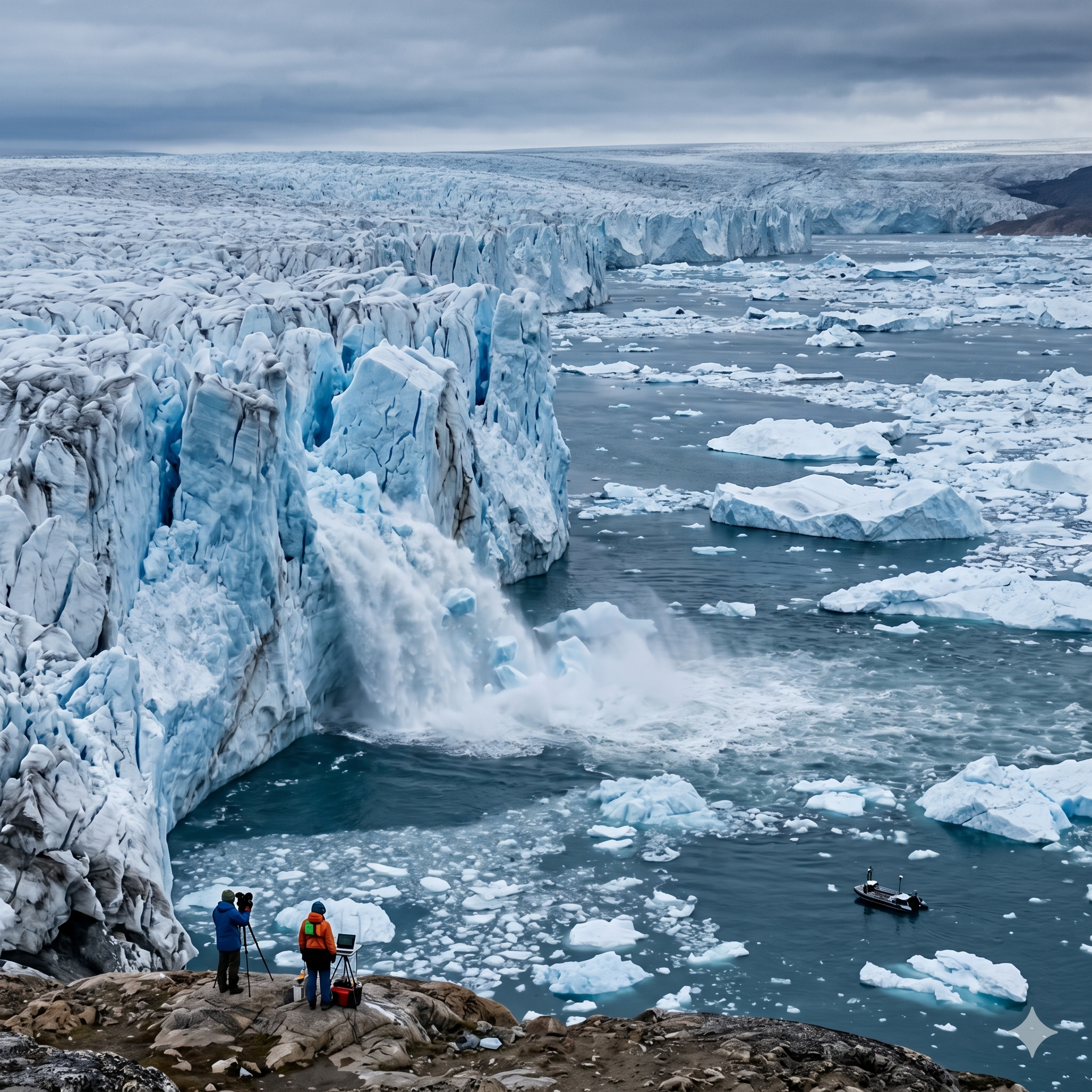

Greenland loses 30 million tons of ice per hour and study points to irreversible tipping point that could raise sea levels even without new emissions.
According to Instituto Humanitas Unisinos, Greenland, with 2.2 million square kilometers and about 80% of its territory covered by ice, is losing glacial mass at a rate five times faster than twenty years ago. The current volume of loss reaches approximately 30 million tons per hour, a number difficult to visualize, but which can be compared to the complete emptying of the Cantareira Dam every 24 minutes.
This pace places the island, located between the Atlantic and the Arctic, at the center of global climate discussions, not only due to the volume of ice lost, but also due to the continuous acceleration of this process.
Greenland ice sheet contains enough volume to raise sea level by up to 7 meters
Greenland is home to approximately 1.7 million square kilometers of ice sheet, making it one of the largest frozen masses on the planet alongside Antarctica.
-
EcoFlow’s Portable Fridge Offers 43 Hours Off-Grid, Reaches -25°C, App-Controlled, Solar-Powered for Camping and RV Adventures

-
Vietnamese Inventor Overcomes Debt and Develops Agricultural Robot Sold in 15 Countries
-
3,000 Sheep Maintain 900 MW Solar Farm Transforming Texas Fields into Energy for Data Centers

-
Distant Galaxy Shaped Like a Giant Jellyfish Sheds Gas, Forming New Stars as It Moves Through Hot Cosmic Gas


Should complete melting occur, the potential for sea level rise reaches about 7 meters. This scenario, however, would unfold over thousands of years on a geological scale.
What concerns scientists is not just the total volume, but the speed at which the system is changing and the mechanisms that begin to operate independently of additional warming.
Data shows consistent acceleration in ice loss since the early 2000s
Between 2003 and 2016, Greenland lost an average of 255 gigatons of ice per year. In 2012, the loss reached 610 gigatons, and in 2019, about 560 gigatons.
Projections for the end of the century indicate that annual loss could range between 964 and 1,735 gigatons under high-emission scenarios.

Despite uncertainties in absolute values, the acceleration trend is considered unequivocal by the scientific community.
2025 study identifies climate tipping point that makes Greenland’s melting irreversible
In January 2025, researchers from the Bjerknes Centre for Climate Research published a study in the journal The Cryosphere that identified a critical threshold for Greenland’s glacial system.
The loss of approximately 230 gigatons in a single year represents the point from which melting enters a self-sustaining cycle.
From this stage, the system begins to evolve independently, maintaining ice loss even in the absence of additional temperature increase.
Elevation-melt feedback accelerates ice loss with local temperature increase
The mechanism identified by scientists is known as elevation-melt feedback. As the ice sheet shrinks, its surface becomes lower, exposing itself to higher temperatures. This temperature increase accelerates melting, which in turn further reduces the surface altitude.
A reduction of about 100 meters in ice thickness can generate a local increase of up to 1°C, creating a continuous cycle of acceleration.
Another critical factor is the so-called albedo feedback. Ice-covered surfaces reflect between 80% and 90% of solar radiation. Exposed surfaces, such as water or rock, absorb most of this energy.
As ice disappears, dark areas begin to absorb more heat, intensifying melting and expanding the feedback loop.
Dark Zone with algae accelerates ice melt by up to five times in some regions
In Greenland, a region known as the “Dark Zone” further amplifies this effect.
It is a strip up to 400 kilometers wide where microorganisms with dark pigmentation proliferate on wet ice during the summer.

These organisms reduce the surface albedo and can increase the melting rate by up to five times compared to clean ice areas.
Part of the melting is already committed and will continue even with zero emissions
Research led by the Potsdam Institute indicates that a portion of Greenland’s melting is already committed due to heat accumulation in the climate system.
Even in a hypothetical scenario of immediate global zero emissions, sea levels would continue to rise for decades or centuries.
Estimates indicate a minimum additional rise of about 18 centimeters solely due to the thermal inertia already accumulated.
New studies show that ice losses were underestimated by up to 20% in recent decades
A study published in the journal Nature in 2024, based on over 236,000 satellite observations, revealed that previous estimates underestimated ice loss by about 20%.
The main reason was the methodological limitation of models that did not adequately consider melting at the edges of glaciers. These regions, where ice meets the ocean, are precisely the most vulnerable to warming.

In addition to sea level rise, the melting of Greenland directly influences global ocean circulation.
The influx of freshwater into the North Atlantic interferes with the Atlantic Meridional Overturning Circulation, responsible for transporting heat to Western Europe.
The slowdown of this system can cause complex climatic effects, including regional cooling in parts of Europe.
Now we want to know: is Greenland’s tipping point closer than imagined?
The latest data indicate that Greenland’s climate system may be approaching a critical limit.
In your view, has science already correctly assessed this risk, or are we still underestimating the speed of these changes?