






 Portuguese
  Spanish
  5 min of reading
  0 comments


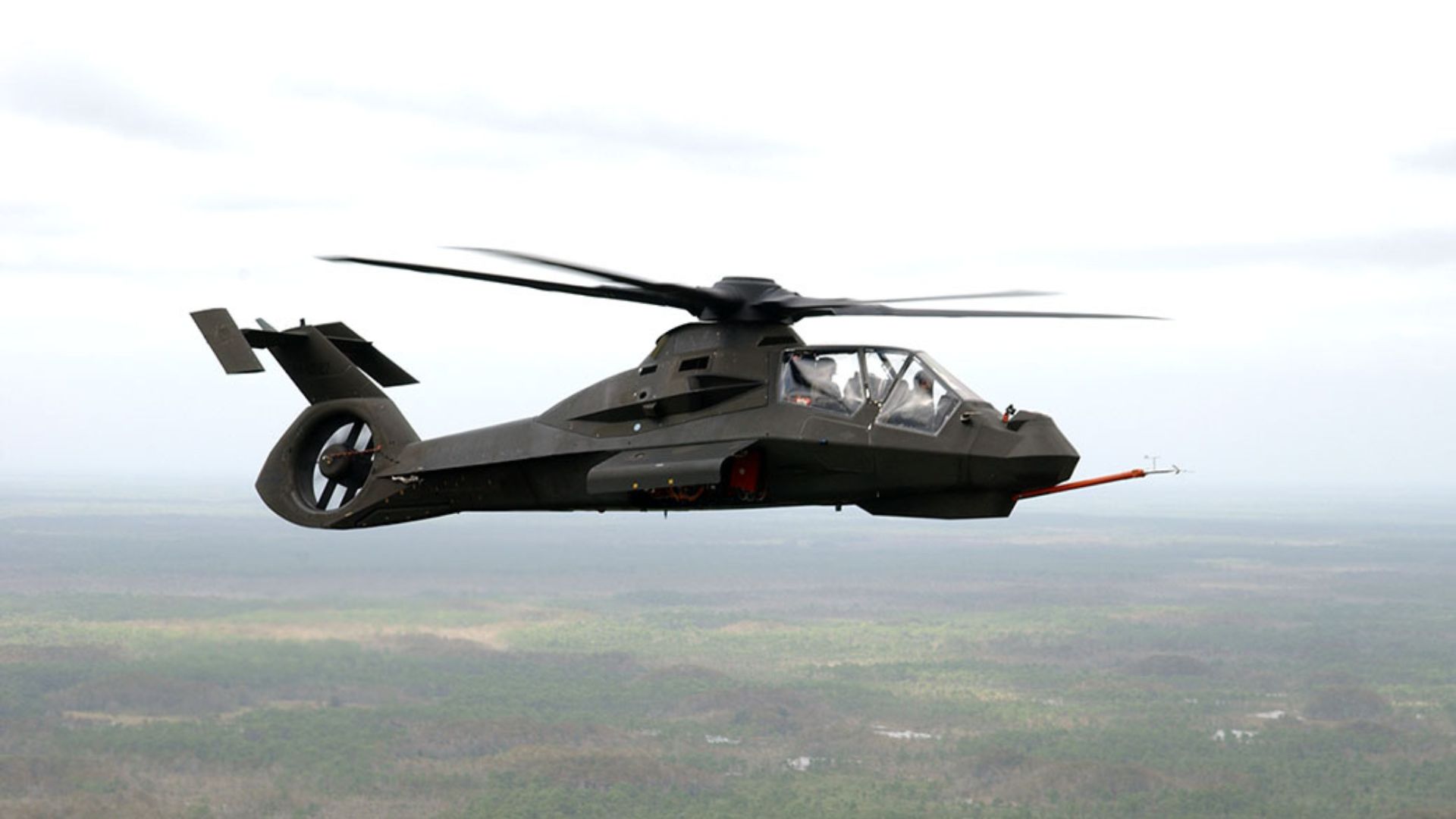
Advanced military project combined stealth, noise reduction, and integrated sensors to operate in highly protected areas without immediate detection, influencing modern technologies even after a billion-dollar cancellation before large-scale production.
Developed by Boeing and Sikorsky for the United States Army, the RAH-66 Comanche was one of the most ambitious stealth helicopter projects ever publicly presented, although it never advanced to series production.
Designed for armed reconnaissance missions, the model combined a low radar signature, refined acoustic control, infrared reduction, and internal armaments, forming a package designed to operate discreetly in heavily monitored areas.
Its first flight took place in January 1996, as part of a program aimed at partially replacing light reconnaissance and attack helicopters, expanding data collection and surveillance capabilities in high-risk environments.
-
He started with a jigsaw, his father’s screwdriver, and many drawings made during classes; years later, the young man who built a roller coaster in his own backyard went viral on the internet, was hired by Cacau Park, and now coordinates Brazilian and foreign professionals in the installation of an attraction weighing 737 tons, 55 meters high, one kilometer long, featuring moments of zero gravity and a speed of 120 km/h, in a journey that turned curiosity, calculations, and persistence into a professional career.

-
Between Egypt and Sudan, Bir Tawil is no man’s land that neither country wants on paper, but in practice has gold mining, nomadic tribes, and even fake “kings.”

-
Swimming champion Shavarsh Karapetyan dove about 40 times into a frozen lake in Armenia to rescue a sunken bus, saved 20 lives, and lost his career because of it.
-
Júlia Pimentel, an 11-year-old from Minas Gerais, independently invented a new formula to calculate the square root using simple addition and multiplication, and her method was published in one of the most important mathematical scientific journals in Brazil.


Throughout its development, the central proposal was to allow crews to identify targets, transmit information in near real-time, and operate in hostile territory with less exposure to air defense systems.
Stealth technology in the Comanche prioritized low detection

Unlike conventional helicopters, the Comanche was designed to simultaneously reduce multiple forms of detection, including radar reflection, heat emission, blade noise, and even its own visual silhouette from different observation angles.
To achieve this goal, the project incorporated an angled fuselage, composite materials, retractable landing gear, and specific coatings to reduce signatures, creating a structure less perceptible to electronic sensors and modern radars.
Additionally, the armaments were kept in internal compartments, a strategy that avoided exposed external surfaces and significantly reduced the aircraft’s reflective area when operating in its standard stealth configuration.
Even so, in specific situations, it was possible to use external payloads, although this adaptation compromised part of the stealth efficiency originally planned in the helicopter’s design.
Data released from files linked to Sikorsky indicated that the Comanche’s radar signature could be up to 100 times smaller compared to traditional models, in addition to relevant improvements in thermal and acoustic reduction.
Fantail rotor reduced noise and increased discretion
Among the project’s most innovative elements was the shrouded tail rotor, known as a fantail, integrated into the rear structure as a way to reduce the noise generated during low-altitude flight.
With this configuration, the aim was to reduce the characteristic sound of the exposed rotor and increase the capacity for a quiet approach, especially in close reconnaissance or infiltration missions in sensitive areas.

Complementing this solution, the five-bladed main rotor used composite materials and an aerodynamic design aimed at reducing vibration and noise, contributing to a less perceptible sound signature compared to conventional helicopters.
Still, despite the advancements, the model was not completely silent, but rather designed to reduce the distance at which it could be detected by auditory means or acoustic sensors.
In the thermal field, the Comanche included features to decrease the heat emitted by the engines, although there is no public data to prove a near-zero infrared signature, as is sometimes suggested.
Operation against Bin Laden revealed real-world use of stealth
The topic gained global attention in May 2011, when United States special forces carried out the operation that resulted in the death of Osama bin Laden in Abbottabad, Pakistan, using helicopters with officially undisclosed modifications.
During the mission, one of the helicopters crashed inside the compound, and images of the destroyed tail indicated the use of a highly modified version of the Black Hawk, with features associated with reduced radar, noise, and thermal signatures.
Although the exact model was not confirmed by authorities, experts pointed out that the visible alterations suggested the practical application of concepts similar to those studied in programs like the Comanche.
Despite this, there is no public confirmation that these aircraft crossed defense systems without any detection, only the record that there was no known interception before reaching the target.
Cancellation of the Comanche program and its military impact
Despite significant technical advances, the program was terminated in February 2004, when the United States Army decided to redirect investments to other strategic priorities, including modernizing existing fleets and expanding the use of drones.


By the time of its cancellation, the project had consumed about $7 billion, resulting in the construction of only two flying prototypes, which highlighted the financial and operational challenges involved in the proposal.
This decision reflected changes in the global military landscape, as well as the assessment that emerging technologies could fulfill some of the planned functions at a lower cost and with greater operational flexibility.
Even without entering combat, the Comanche left a relevant technical legacy, influencing the development of sensor systems, digital integration, and low-detectability concepts applied in subsequent programs.
Stealth redefines strategy in modern air operations
In the current context, the logic behind the project remains valid, as in modern military operations, detecting first can be as decisive as having greater firepower, especially in highly monitored environments.
Aircraft with lower visibility to sensors enhance the ability to approach, collect data, and withdraw safely, reducing the probability of an immediate response from defensive systems.
In the case of helicopters, however, the challenge is more complex than with stealth airplanes, due to the combination of rotors, vibration, heat, and low-altitude operation, factors that increase the chances of detection.
For this reason, projects like the Comanche depend on the integration of multiple technologies, not a single solution capable of making an aircraft completely invisible in all scenarios.
Although it was not used in the operation against Bin Laden, the RAH-66 Comanche remains the main historical reference in the attempt to create an operational stealth helicopter, bringing together advances that continue to influence contemporary military strategies.


Be the first to react!