Portuguese
  Spanish


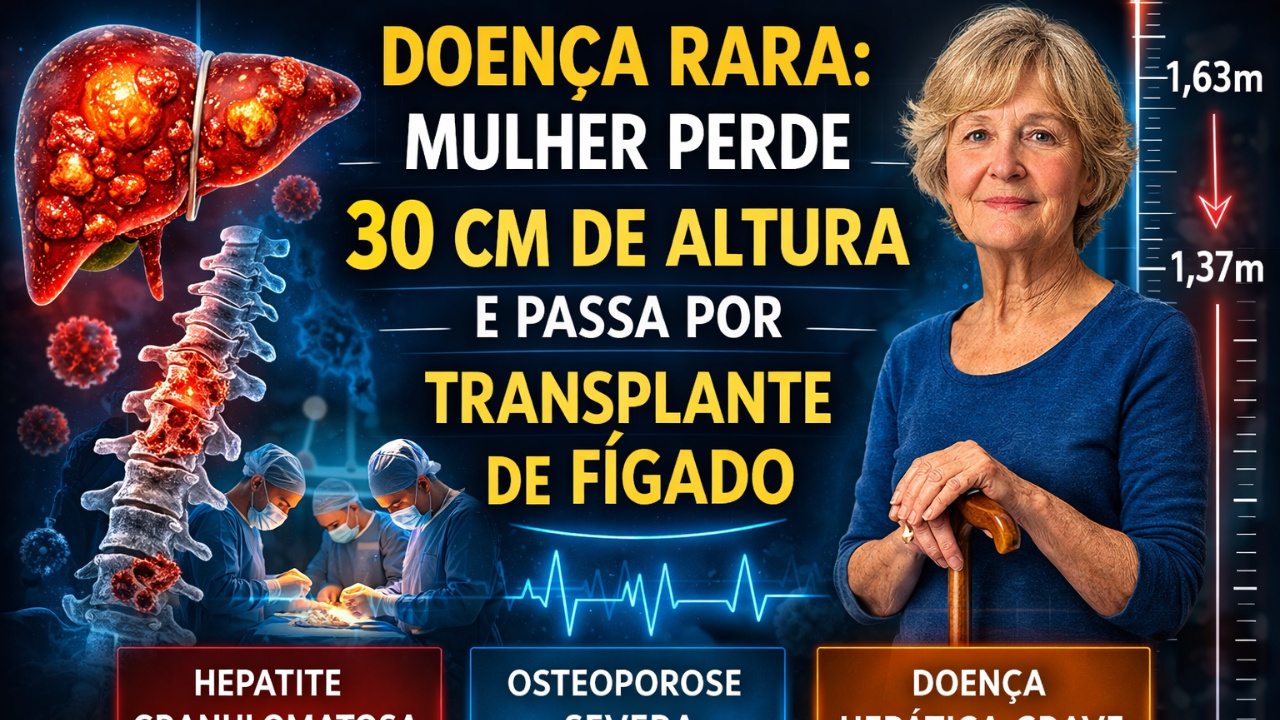


Rare Liver Disease Caused Severe Osteoporosis and Reduced Patient Height by 30 Cm Before Liver Transplant in the UK.
A rare disease in the liver caused a 63-year-old woman to lose almost 30 centimeters in height, face severe symptoms, and undergo a liver transplant in the UK.
The case involved Caroline King, a resident of Wiltshire, who started showing signs in 2018, received a diagnosis of granulomatous hepatitis in 2019, and decided to make her story public to raise awareness about rare liver disease and encourage others to “never give up.”
The condition progressed silently, starting with eye irritation and advancing to compromise her mobility and bone structure.
-
Coastal City in Rio de Janeiro Faces Slow Destruction as Sea Claims 500 Homes and Businesses

-
48-Year-Old Woman Wins Million-Dollar Prize, Gifts Neighbor First International Trip as Thanks for Years of Support

-
Women Once Mocked for Collecting Trash Form Group to Turn Organic Waste into Compost, Generate Daily Income, and Improve Market Cleanliness in One of the World’s Lowest GDP per Capita Countries
-
Archaeologists Uncover 40,000 Roman Bronze and Copper Coins from the 3rd Century in Fire-Destroyed French Neighborhood


“Looking back, I still can’t believe what happened and that I’m still here,” Caroline said.
Rare Disease Started with Simple Symptom in the Eyes
The first sign of the rare disease appeared unexpectedly.
In 2018, while watching television at home, Caroline noticed that her vision was irritated and out of focus.
“I thought: this is very, very strange,” she reported.
Initially, an ophthalmologist identified inflammation in part of the eye, but there were still no clear indications that it was something more serious.
However, months later, the symptoms intensified.
In addition to the visual change, her skin and eyes began to show a yellowish tint — a classic sign of liver problems.
Granulomatous Hepatitis: Rare Liver Disease and Difficult Diagnosis
In 2019, after more thorough examinations and a liver biopsy, the diagnosis came: granulomatous hepatitis, an extremely uncommon type of liver disease.
According to doctors involved in the case, it is such a rare condition that there may only be “one case every ten years.”
Granulomatous hepatitis causes specific inflammation in the liver, called granulomas, which can compromise the organ’s function.
Like many rare diseases, diagnosis is not immediate.
The lack of knowledge on the subject and the similarity to other conditions delay identification, which can worsen the situation.
Liver Disease Progressed and Required Liver Transplant
With the progression of the liver disease, Caroline’s health deteriorated rapidly.
She began to suffer from extreme fatigue, episodes of mental confusion, and significant loss of energy.
Before the liver transplant, she even required a wheelchair due to physical weakness.
The damage to the organ was severe, and the only viable alternative became liver replacement.
After six months of waiting, Caroline finally underwent the liver transplant, a procedure that saved her life.
The surgery marked a significant turning point in her recovery.
Severe Osteoporosis Caused Loss of 30 Centimeters in Height
In addition to the damage caused directly by the liver disease, the medication used in treatment brought additional consequences.
During the waiting period for the liver transplant, Caroline developed severe osteoporosis in her spine.
Severe osteoporosis is a condition that weakens bones, making them more fragile and susceptible to fractures.
In her case, the problem led to compressed vertebrae, reducing her height from approximately 1.63 meters to 1.37 meters.
Years later, with medical follow-up and stabilization of her condition, her height reached 1.52 meters.
Still, the physical loss was one of the most visible impacts of the rare disease.
Rare Disease and the Global Impact on the Population
Caroline King is just one among about 300 million people worldwide living with some type of rare disease.
According to the World Health Organization (WHO), a disease is considered rare when it affects up to 65 people per 100,000 inhabitants.
In general, these conditions are chronic, progressive, and debilitating.
Furthermore, they often receive less investment from the pharmaceutical industry due to the small number of patients.
In Brazil, the Ministry of Health estimates that there are between 6,000 and 8,000 different types of rare diseases.
Thus, approximately 13 million Brazilians live with some of these conditions.
Raising Awareness About Liver Disease Can Save Lives
The British Liver Trust warns that thousands of people in the UK live with rare liver disease.
Many of them face long periods before receiving a correct diagnosis.
Pamela Healy, executive director of the institution, states that although these diseases “may be less common,” they can have a “transformational” impact.
According to her, “often, the lack of awareness leads to late diagnoses and unequal access to specialized care.”
She adds: “We need greater understanding, earlier diagnosis, and continued investment in research to ensure that no one living with a rare liver disease is left behind.”
“Never Give Up”: The Message from Those Who Survived Rare Disease
Six years after the liver transplant, Caroline keeps her liver function under control and has managed to regain some mobility.
Her eyes have also stabilized, showing that the treatment has yielded positive results.
Today, while sharing her journey, she reinforces a simple yet powerful message: “never give up.”
Her story reveals not only the risks of a rare disease like granulomatous hepatitis but also the importance of early diagnosis, access to liver transplant, and attention to the first signs of liver disease.
More than a medical report, it is a testimony of resilience in the face of a condition that could have been fatal.
See more at: The Rare Disease That Made Woman Lose 30 Cm in Height After Uncommon Diagnosis – BBC News Brazil