






 Portuguese
  Spanish


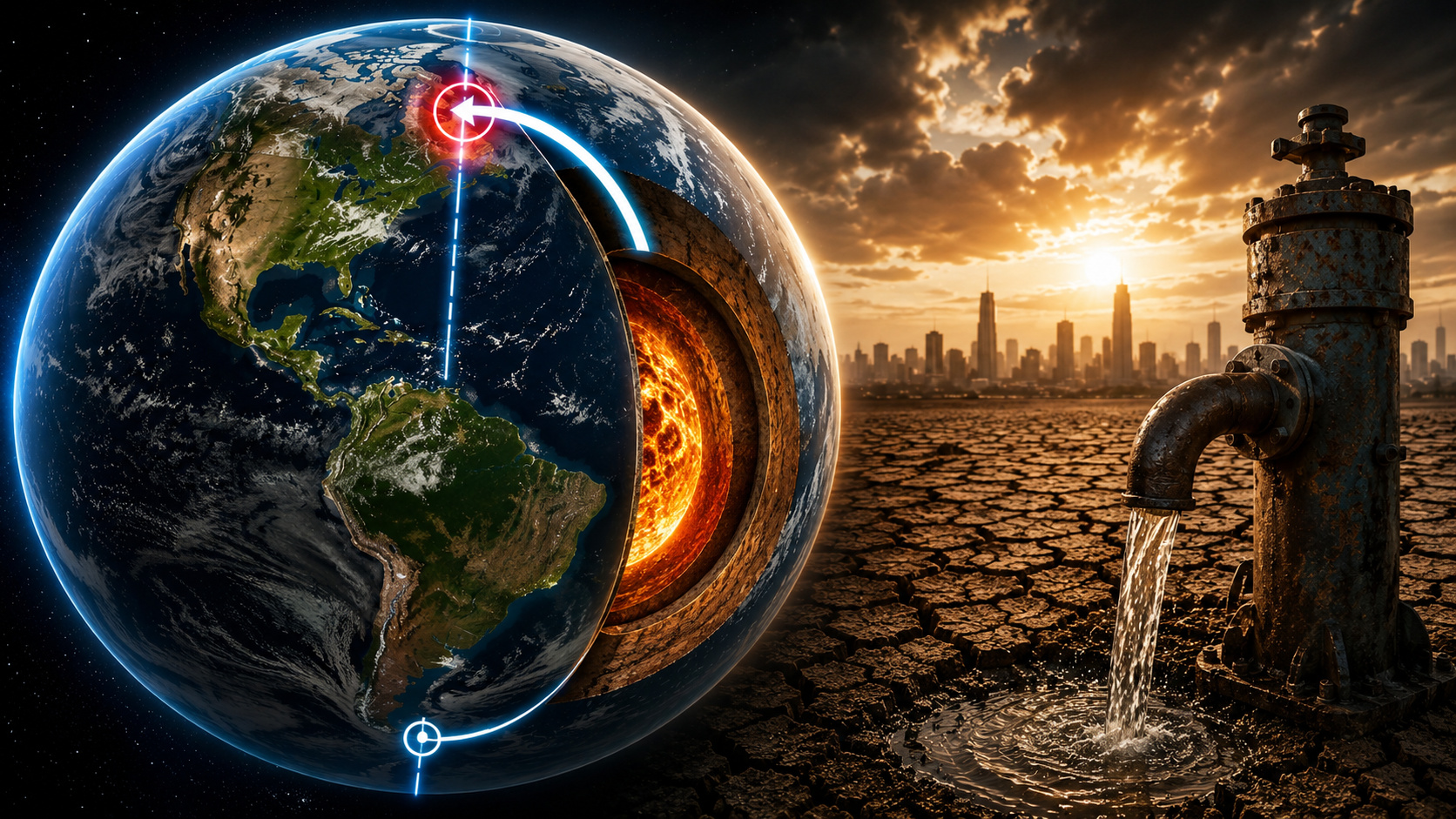


Study reveals that massive groundwater withdrawal altered Earth’s mass distribution and contributed to shifting the planet’s axis.
On June 15, 2023, a study published in the scientific journal Geophysical Research Letters, by the American Geophysical Union, presented a conclusion that caught the attention of the global scientific community: human groundwater withdrawal between 1993 and 2010 was intense enough to redistribute mass on the planet and shift the Earth’s rotational pole by almost 80 centimeters to the east. Led by Ki-Weon Seo of Seoul National University, the work estimated that aquifer pumping contributed to a drift of approximately 4.36 centimeters per year in polar motion, demonstrating that the exploitation of underground water is no longer just a water issue and has also begun to appear in the planet’s physical calculations.
The strongest data point is the volume: researchers worked with the estimate of 2,150 gigatons of groundwater withdrawn from the subsurface during the period, a quantity associated with a rise of more than 6 millimeters in global sea level. When pumped from continental aquifers and, in part, redistributed to the oceans, this mass of water slightly altered Earth’s balance, like a displaced weight on a rotating body. The study does not indicate a risk of changes in the seasons, but it shows that a daily human activity—irrigation, supply, and water extraction—is already measurable even in the planet’s movement.
Study links groundwater extraction to Earth’s pole displacement
The research analyzed the relationship between water mass redistribution and polar motion. Earth’s axis of rotation is not completely fixed. Small changes in the planet’s mass distribution can slightly alter the position of the geographic poles over time.
-
China Develops Custom 140-Ton Electric Mining Truck with 770 kWh Swappable Battery, Deploys 290 Units in Xinjiang’s Largest Zinc Mine

-
Meta to Launch Arena, a New Prediction App Targeting 3.56 Billion Users, Competing with Polymarket and Kalshi

-
Scientist Challenges Famous Human Evolution Theory, Argues Homo Sapiens Evolved Gradually Over Thousands of Years
-
15-Year-Old American Builds Ocean Generator with PVC Pipe and 3D-Printed Propeller for $12, Wins National Prize, Presents at White House, and Makes Forbes 30 Under 30 List




This phenomenon had previously been observed in relation to glacier melt and oceanic redistribution.
The new study showed that groundwater pumping also exerts a measurable influence on this process. According to the authors, intense groundwater withdrawal ended up displacing the Earth’s poles by about 4.36 centimeters per year between 1993 and 2010.
Approximately 2,150 gigatons of water were removed from the subsurface
Researchers estimated that approximately 2,150 gigatons of groundwater were pumped during this 17-year period. Much of this volume was used for agricultural irrigation, urban supply, and industrial activities.


When this water is withdrawn from the subsurface, it eventually evaporates, is consumed, or reaches the oceans via rivers and atmospheric systems.
This alters the global distribution of the planet’s water mass, slightly changing Earth’s physical balance.
Groundwater functions as distributed mass within continents
Underground aquifers store enormous volumes of water beneath continents and sedimentary basins. When this water remains trapped in the subsurface, it is part of the natural distribution of terrestrial mass.
When withdrawn and transferred to oceans and the atmosphere, a physical redistribution occurs on a planetary scale.
Although the individual effect of each well is insignificant, the total volume pumped by humanity over decades has become large enough to produce measurable consequences. The study shows that human water exploitation has begun to operate on a global geophysical scale.
Polar movement does not mean the planet is “tipping over”
Researchers emphasize that the detected displacement does not represent a risk of catastrophic planetary inversion or abrupt changes in Earth’s rotation.

The phenomenon involves small changes in the position of the axis relative to the surface. These movements are part of Earth’s natural dynamics but can be influenced by mass redistributions.
Similar changes also occur due to giant earthquakes, ice melt, and ocean circulation. The study’s unique contribution is showing that human activities related to groundwater now also participate in this process.
Pumping contributed to global sea level rise
In addition to polar displacement, researchers calculated that extracted groundwater raised the global sea level by approximately 6 millimeters between 1993 and 2010.
Although the number seems small, it represents a relevant contribution within the context of global ocean rise.
Much of the discussion about sea level rise usually focuses on glacier melt and thermal expansion of the oceans.
The study shows that pumped groundwater also participates in this process. This means that depleted aquifers end up directly influencing the global ocean.
Irrigated agriculture appears among the main drivers of the problem
Most of the groundwater extracted on the planet is used for agriculture. Intensive agricultural regions rely heavily on aquifers for irrigation, especially in arid areas or those subject to prolonged droughts.

Countries with highly irrigated agriculture pump enormous underground volumes daily. Over time, some aquifers suffer severe drawdown and permanent loss of storage capacity.
The study reinforces that the global water crisis involves not only water scarcity but also the physical redistribution of planetary mass.
Scientists were able to measure the effect using advanced geophysical models
To perform the analysis, researchers combined hydrological data, geophysical models, and observations of Earth’s polar motion.
They compared simulations of Earth without groundwater pumping with scenarios that included water redistribution caused by human activity.
The results showed that the models could only correctly reproduce the observed displacement when groundwater withdrawal was incorporated.
This strengthened the evidence that human pumping played a real and measurable role in polar motion.
Mass redistribution influences the planet’s physical balance
Earth functions as a rotational system sensitive to the distribution of mass on its surface and interior. Significant changes in ice, oceans, or continental water can slightly alter the rotational dynamics.
Similar phenomena have already been observed after gigantic earthquakes, such as the 2011 one in Japan. In the case of groundwater, the difference is that the process occurs slowly, accumulating effects over decades. The research shows how seemingly local human actions can produce physical consequences on a planetary scale.
Beyond the geophysical implications, the study reinforces growing concern about aquifer depletion. Various regions of the planet already face land subsidence, permanent reduction of reserves, and underground salinization due to excessive pumping.
In some locations, the natural recharge of aquifers occurs much more slowly than human withdrawal. This means that some of the groundwater currently exploited could take centuries to be naturally replenished.
Study expands debate on human impact on the Earth system
In recent decades, scientists have begun discussing the concept of the Anthropocene, a period in which human activities started to alter planetary processes on a large scale.
The new study adds another element to this debate: the human capacity to influence even the mass distribution responsible for Earth’s rotational dynamics.
Although the effect is small in absolute terms, it symbolizes the scale of human intervention on the modern planet. Pumping water from underground is no longer just a local supply issue and has become part of global physical transformations.
Given studies like this, do you believe humanity has already crossed invisible limits of intervention in the Earth system, or will technological advancements still be able to reduce these impacts without compromising supply and agriculture?







