Portuguese
  Spanish




South Korean Naval Innovation Integrates Artificial Intelligence and Autonomous Systems
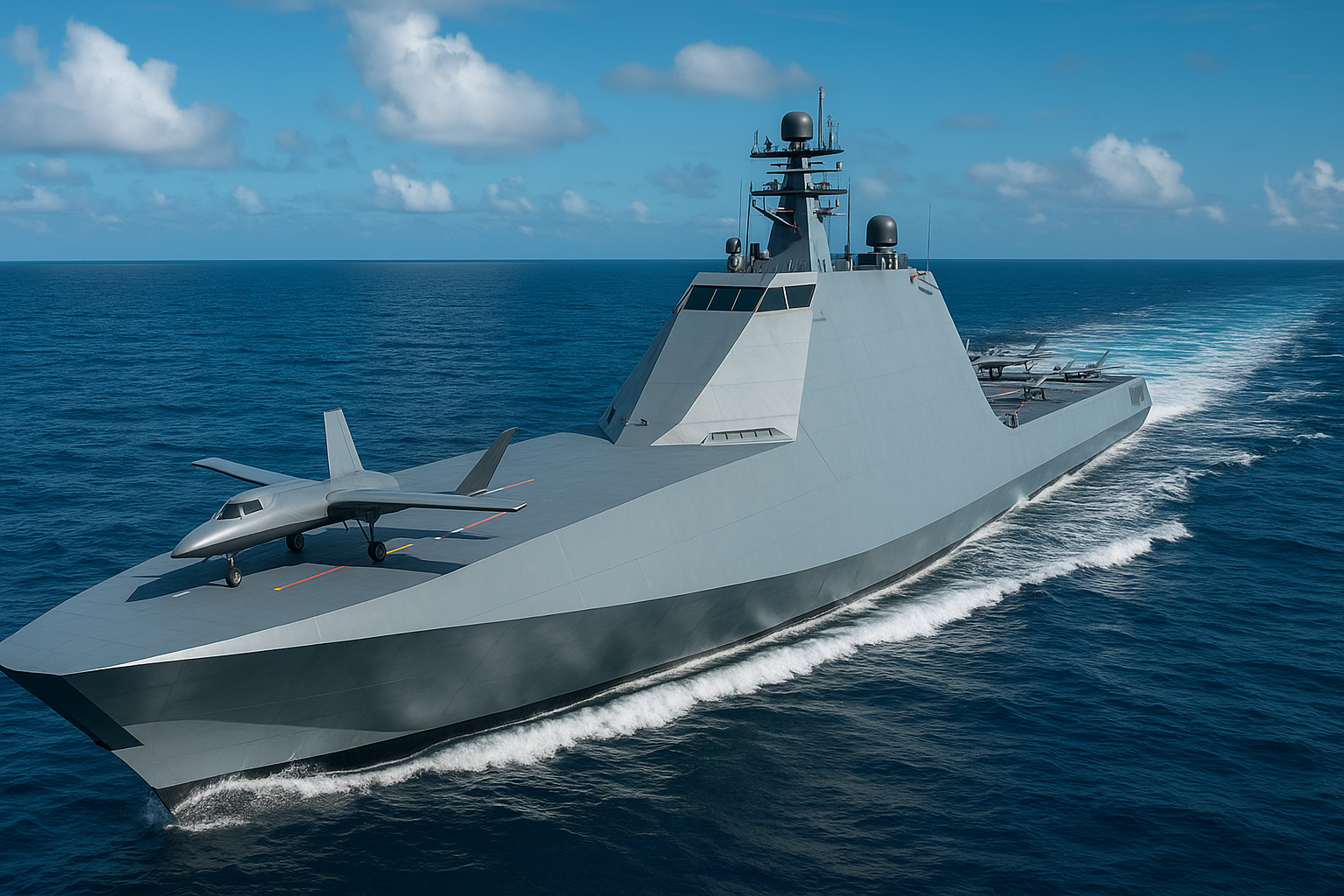
During MADEX 2025, held from May 28 to 31 at the BEXCO convention center in Busan, South Korea, HD Hyundai Heavy Industries (HD HHI) introduced the HCX-23 Plus, a next-generation drone carrier. Designed to operate as a command platform for unmanned surface vehicles (USVs) and other autonomous vessels, the HCX-23 Plus integrates artificial intelligence for combined naval operations between manned and unmanned systems.
HCX-23 Plus: Innovative Design for Autonomous Operations
The HCX-23 Plus stands out for its innovative architecture, eliminating the traditional superstructure and adopting a flat deck that extends the full length of the hull. This configuration allows for two distinct operational zones: an open area at the stern for launching and recovering fixed-wing UAVs, and a recessed section at the bow, potentially dedicated to VTOL drone operations. The vessel incorporates faceted surfaces to reduce radar cross-section and uses low-observability coatings above the waterline.
Strategic Partnerships and International Expansion
During the event, HD HHI signed memoranda of understanding with defense companies Leonardo and Thales to develop export ships. Additionally, it established agreements with Korea Aerospace Industries, LIG Nex1, and POSCO to create a multifunctional drone mothership.
The agreements also aim to develop new materials for next-generation ship hulls, reinforcing technological innovation. Highlighting international collaboration, HD HHI partnered with the Portuguese Navy to develop an advanced small submarine. Thus, the company expands its presence in the competitive global naval defense market, strengthening its leadership in the strategic sector.
-
Nuclear Submarine USS Alexandria Retired After 35 Years, Having Completed Over 1 Million Miles in Missions

-
MODEC Introduces New Hull Design for FPSO Gato do Mato to Produce Up to 120,000 Barrels of Oil Per Day in Brazil’s Pre-Salt Region
-
This Massive 12-Meter, 21-Ton Underwater Drone Can Operate Autonomously for Up to Five Days

-
Global Shipping Faces Shortage of Certified Maritime Officers, Salaries in the U.S. Can Exceed $100,000 Annually


MADEX 2025: Showcase of the Maritime Defense Industry
The MADEX 2025 featured more than 150 participating companies, representing 12 countries and naval delegations from over 30 nations. The event served as a platform to showcase the technological capabilities of HD Hyundai Heavy Industries to a specialized audience. In doing so, the company reinforced its position as a leader in integrated naval systems and technological innovation in the maritime defense sector.
Future of Naval Warfare: Integration of Autonomous Systems
With the HCX-23 Plus, therefore, HD Hyundai reaffirms its vision for the future and values the integration of autonomous and intelligent technologies. Furthermore, the vessel was designed for multiple roles, such as surveillance, electronic warfare, air denial, and immediate tactical response. For this reason, its architecture incorporates logistics and planning systems that, in fact, operate with direct support from artificial intelligence. Thus, the vessel ensures real-time adaptation to combat, even though it may eventually require low supervision from human operators. Therefore, the model symbolizes a strategic advancement in naval automation and also in the military use of artificial intelligence.