






 Portuguese
  Spanish


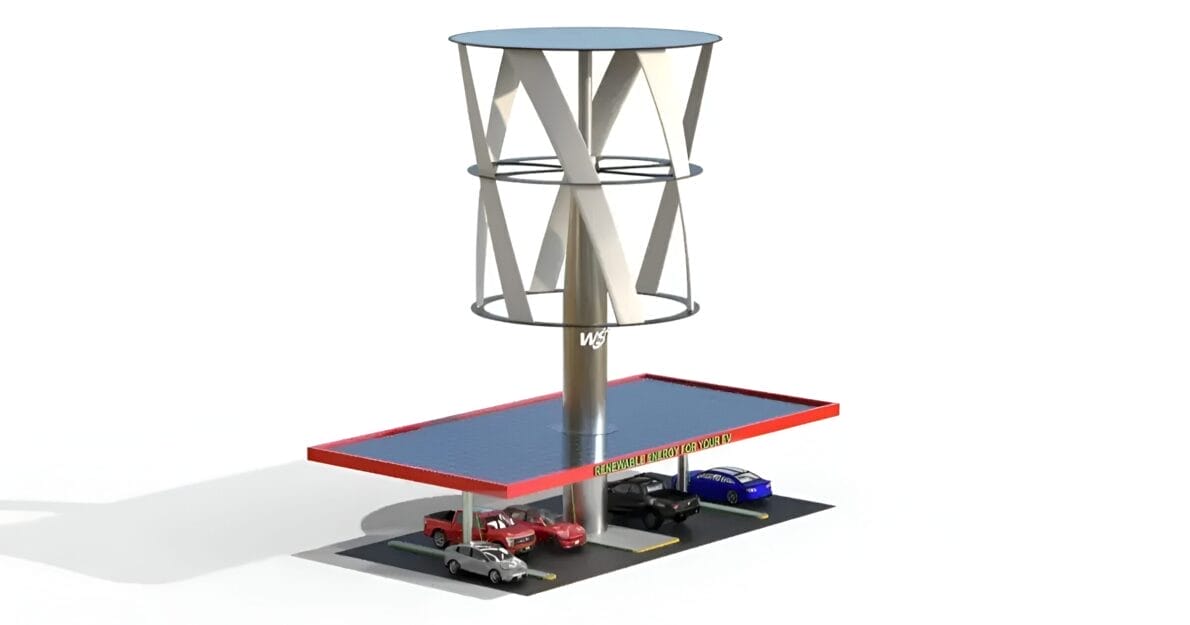
Company Develops Hybrid Tower Combining Wind and Solar Energy Capable of Generating 235,000 kWh Per Year and Charging Six Electric Cars at the Same Time.
At a time when reducing carbon emissions is becoming increasingly critical, the transition to clean energy sources is essential. The combination of wind and solar energy emerges as an effective solution to reduce dependence on fossil fuels and boost the use of electric vehicles. An innovative proposal, called Wind and Solar Energy Tower, is gaining prominence as an accessible and efficient alternative, capable of generating up to 234,154 kWh per year in a single installation. This technological convergence promises to transform the way we produce and consume energy, significantly contributing to a more sustainable future.
Wind and Solar Energy Tower Generates 38% Increase in Production
Recently presented at the Detroit Auto Show, the WST technology is hailed as the only hybrid system in the world that combines solar and wind energy. This efficiency allows the energy produced by the WST to be more accessible than traditional sources, eliminating the need for fossil fuels.
Resulting from the work of Jim Bardia over several years, the wind and solar energy tower was designed with a focus on reducing friction, resistance, redundancy, and ease of assembly and maintenance, following a similar approach to that used in race cars.
-
Brazilian scientists are simultaneously advancing two research projects on clean hydrogen and driving solutions that could transform the energy matrix, enhance industrial competitiveness, and accelerate large-scale emission reduction targets.

-
Advancement in renewable energy: A R$ 150 million project launched by Petrobras and Finep aims to create state-of-the-art electrolyzers for green hydrogen, strengthening national research and preparing Brazil to compete in a billion-dollar energy market.
-
Solar energy can increase property value by up to 10% and become a selling point.
-
Illiterate or semi-literate grandmothers were trained to repair solar systems, open rural workshops, and light up homes that still depended on kerosene.



Notably, the levitating hub with floating bearings is a crucial component that optimizes the efficiency of the vertical-axis wind turbine (VAWT) while reducing friction. Furthermore, the new wind and solar energy tower features a self-cleaning solar panel at the top of the tower, preventing performance degradation due to dirt, resulting in a 38% increase in energy production.
The tower is modular and flexible, allowing customization according to various operational needs, with key components stored in plug-and-play replaceable modules for easy maintenance.
Advantages and Disadvantages of the Wind and Solar Energy Tower
This innovative tower has the capacity to charge up to six electric cars simultaneously and can also return excess energy to the grid or store it in a 1008 kW battery.
In light of the growing demand for clean and sustainable energy, the wind and solar energy tower positions itself as an essential alternative for providing energy in a cleaner and more efficient manner.
The wind and solar energy tower uses a hybrid system, which offers several advantages. When considering the implementation of a hybrid generation system, some obvious advantages can be pointed out, such as energy storage, availability, independence, among others. However, hybrid energy generation can prove to be somewhat complex, which may also increase the final cost of the project.
Airturb Also Develops Hybrid Energy Generator
The company Airturb from the Netherlands has also developed a wind and solar energy generator that promises to be a cost-effective and efficient solution for both residential use and applications lacking grid access.
The hybrid wind and solar energy generator has the capacity to generate up to 500W of energy. The equipment consists of a vertical-axis wind turbine with a modified Savonius helical design and four 30W monocrystalline solar panels.
This wind and solar energy tower can be used in both residential applications and in situations without access to the electrical grid, with a load of 131 kg/m2. As for the solar panel, it consists of a galvanized steel and rubber structure, measuring 1.14 x 1.14 meters and 20 mm thick, weighing about 35 kg. This base can accommodate up to four solar panels with a power of 30W each, being the Eco Line ES30M36 modules from Enjoy Solar.




Be the first to react!