Portuguese
  Spanish


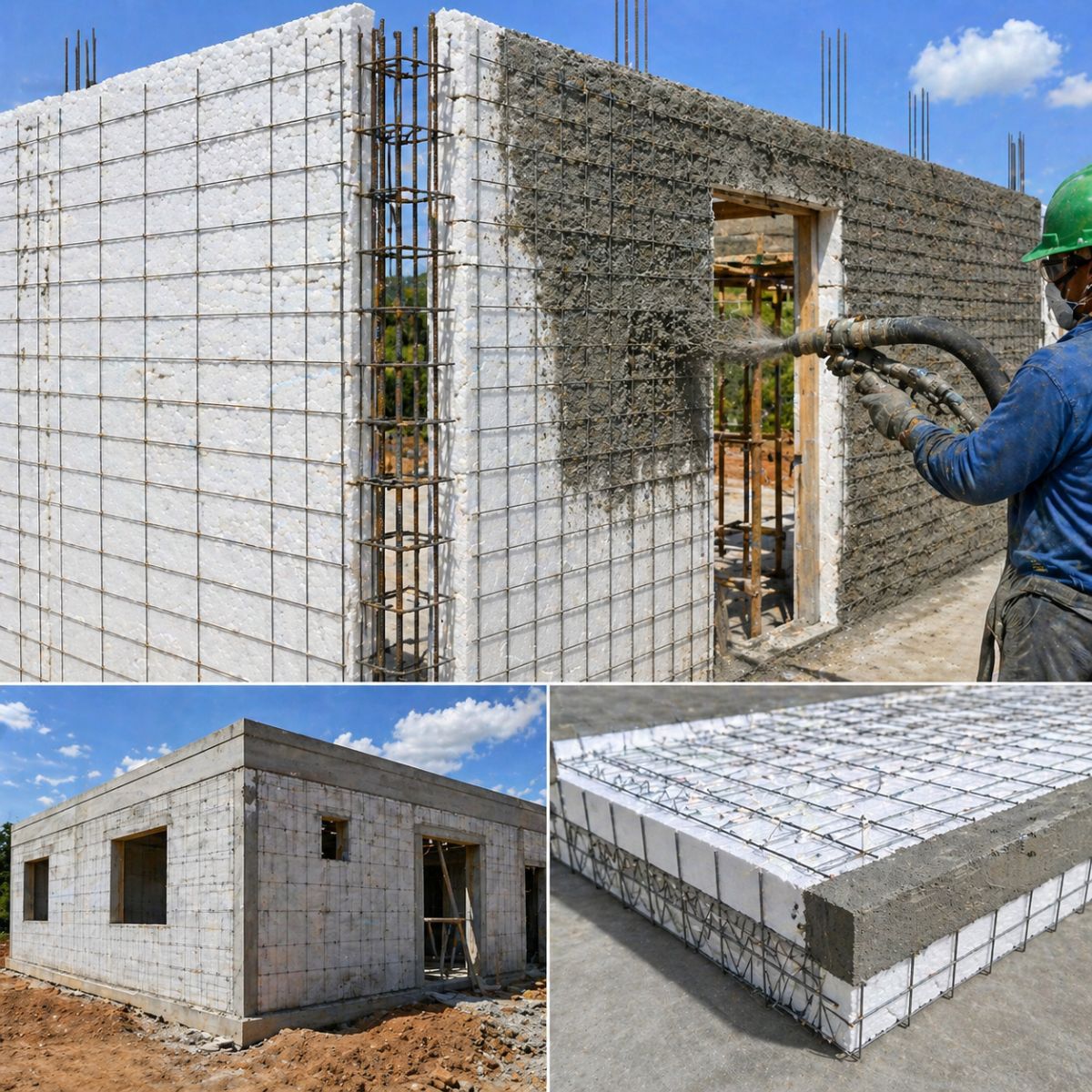


Structural EPS is a construction system that uses expanded polystyrene panels coated with metallic meshes and shotcrete to form resistant walls that are lighter and up to 30% cheaper than conventional masonry. The material already has Inmetro certification, is starting to gain traction in construction projects in Brazil, and promises to change the way houses and buildings are constructed in the country.
From a distance, one might confuse it with Styrofoam, but EPS structural is a construction system that combines expanded polystyrene panels with metallic meshes and shotcrete to create walls with proven mechanical resistance. The material already has Inmetro certification and is gaining traction in construction projects in Brazil as an alternative to traditional brick and block masonry. Savings can reach up to 30% of the total construction cost, and the lightness of the panels reduces the load on the foundation, execution time, and the need for heavy labor.
The system is neither experimental nor improvised. The EPS panels function as an insulating and structural core, and the metallic meshes welded on both sides receive layers of machine-applied shotcrete, forming a monolithic panel that supports loads and complies with Brazilian technical standards. The result is a wall that feels light to the touch but resists stresses comparable to conventional masonry, with the added advantage of offering superior thermal and acoustic insulation compared to common brick.
How structural EPS works and why it resists like concrete
According to information released by the portal oantagonista, the construction process begins with pre-fabricated expanded polystyrene panels that arrive at the construction site already cut to the dimensions of the project’s walls. Galvanized steel meshes are welded to both faces of the panel, forming an armature that will be filled with shotcrete applied by pneumatic equipment. The concrete penetrates the mesh and adheres to the EPS, creating a sandwich structure where the polystyrene core provides insulation and lightness while the external layers of concrete ensure mechanical resistance.
-
Workers excavate one of the world’s longest railway tunnels beneath the Alps between France and Italy, stretching nearly 60 km, 600 meters deep, with an investment of 11 billion euros.

-
Japanese Company Constructs 100m² 3D-Printed House Using Earth Instead of Concrete, Generating Its Own Energy and Reducing Costs and Emissions

-
In Southern Brazil, a couple builds a Russian-style stove with 430 bricks that heats their 90 m² home all night using just 15 kg of wood.
-
U.S. Farmer Tackles $4 Million Water Issue by Installing Hundreds of Miles of Drainage Pipes to Protect Farm Profits



The logic is similar to that of a drywall panel, but with structural capacity. While drywall serves only as sealing and partitioning, structural EPS supports roof, slab, and even upper floor loads, depending on the project’s dimensioning. Inmetro certified the system after tests that proved its resistance to compression, bending, and impact, attesting that the material meets the requirements for use in residential and commercial buildings in Brazil.
Why EPS costs up to 30% less than traditional masonry
The savings of up to 30% compared to conventional masonry come from multiple factors that accumulate throughout the construction project. EPS panels are significantly lighter than bricks and blocks, which reduces transportation costs, simplifies the foundation, and decreases the need for heavy equipment on the construction site. A structural EPS wall weighs a fraction of an equivalent masonry wall, which means smaller and cheaper foundations.
Execution time also factors into the cost. Assembling EPS panels and applying shotcrete is faster than laying brick by brick with mortar, which reduces construction days and, consequently, labor costs. Material waste reduction is another factor: while masonry generates significant debris from broken blocks and leftover mortar, the EPS system uses custom-cut panels that minimize losses. For those building on a tight budget, the cost difference can make projects viable that would be unfeasible with traditional methods.
The thermal and acoustic insulation that brick does not offer
An advantage that differentiates structural EPS from masonry goes beyond cost and resistance. Expanded polystyrene is one of the best thermal insulators available in civil construction, and its presence in the wall’s core creates a barrier that significantly reduces heat exchange between the interior and exterior of the building. In hot regions, this means cooler environments without air conditioning. In cold regions, less heat escapes through the walls.
Acoustic insulation is also superior. The combination of EPS, metallic meshes, and concrete creates a structure with variable density that absorbs sound waves better than a homogeneous brick wall. For those living in urban areas with traffic noise or neighborhood sounds, the difference is noticeable. Traditional masonry can be complemented with additional insulation, but this increases the cost of the project and adds steps that the EPS system already solves from the factory.
What Inmetro certification guarantees about the material
Inmetro certification is what separates structural EPS from improvised solutions that use styrofoam without technical criteria. The seal certifies that the system has undergone standardized tests for mechanical resistance, fire behavior, durability, and thermal performance, following Brazilian standards that regulate construction materials. Without this certification, construction companies and engineers would have difficulty approving projects with bank financing or municipal licensing.
Inmetro‘s endorsement also facilitates market acceptance. Financial institutions such as Caixa Econômica Federal require that materials used in financed projects have recognized certification, and structural EPS already meets this requirement. For the end consumer, the certification acts as a guarantee that their home’s wall is not made of common styrofoam, but of a constructive system that has been tested, approved, and can be safely used in Brazil.
Can structural EPS replace masonry in any type of construction?


The system has proven application in single-story houses and townhouses, and is being tested in larger buildings with promising results. For residential constructions up to two stories, structural EPS already replaces conventional masonry with advantages in cost, timeline, and thermal performance. In larger constructions, the dimensioning of the metallic meshes and the thickness of the concrete needs to be adjusted by a structural engineer to ensure structural safety.
The current limitation lies more in culture than in technique. Brazilian builders, masons, and consumers are accustomed to brick and block, and the transition to a system that looks like styrofoam requires a change in mindset that only occurs when results in cost and quality speak louder than habit. As more projects are completed with EPS and residents prove its resistance and comfort, the trend is for the material to gain increasing market share in Brazil‘s civil construction market.
Would you live in a house with structural EPS walls or do you prefer the safety of good old brick? Tell us in the comments if you’ve seen this material in any construction project and what you think about building with something that looks like styrofoam but resists like concrete.